


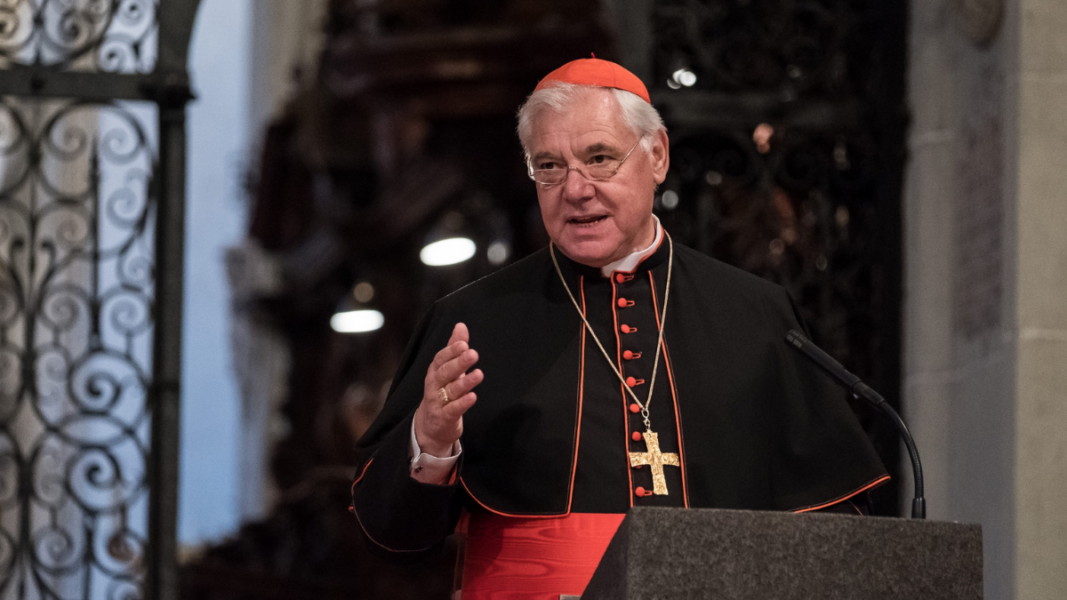
Cardinal Gerhard Ludwig Müller, emeritus prefect of the Congregation for the Doctrine of the Faith, has warned about the risks of a distorted understanding of the papacy and has criticized the so-called ultramontanism, a current that exaggerates the role and authority of the Pope. He did so in an interview granted to The Catholic Herald, in which he reflects on the current state of the Church and the way Catholics relate to authority.
Criticism of the cult of personality
During the interview, the German cardinal described the veneration of Pope Francis’s private opinions and politics as a “heresy,” emphasizing that denouncing them is part of his duty as a cardinal. Müller stated that speaking of a supposed “Church of Francis” constitutes a grave theological error, since only the Church of Christ exists.
“There is no ‘Church of Benedict,’ nor a ‘Church of Francis,’” he affirmed, recalling that the doctrine is one and belongs to the Church, although it may be expressed by the Pope in his magisterium.
The Pope, servant and not absolute monarch
Müller insisted that the Pope is not a sovereign without limits, but a bishop among other bishops, with a specific mission as successor of St. Peter and visible principle of unity. In this context, he recalled the traditional title servus servorum Dei, used by St. Gregory the Great, to emphasize that the Pope is above all the first servant of the Church.
“The Pope is not a Führer,” he noted, rejecting any personalistic or authoritarian conception of the Petrine ministry. In his view, neither the universal Church, nor the dioceses, nor the parishes should be structured around a centralized figure, since pastors are called to guide, but not to replace the action of grace.
The historical origin of ultramontanism
The cardinal explained that ultramontanism arose in the 19th century as a reaction to hostile contexts toward the Church, such as the Kulturkampf in Germany or the policies of separation between Church and State in France. In those scenarios, Catholics developed an exaggerated defense of the Pope against anti-Christian ideologies.
However, Müller warned that this historical reaction cannot justify a sacralization of every word or gesture of the pontiff. As he explained, considering the Pope’s personal opinions as dogma constitutes a deformation of the Catholic faith.
Benedict XVI and the centrality of truth
In contrast, Müller pointed out that the emeritus Pope Benedict XVI was less the object of popular admiration due to his more intellectual profile and his insistence on the truth and the transcendence of the Church. Nevertheless, he encouraged the faithful to read and listen to his teachings to better understand the appropriate limits of the papacy.
In his opinion, the tendency to treat the Pope as a celebrity reflects a disordered hierarchy of priorities, in which the figure of the pontiff eclipses the center of the Christian faith.
A call to refocus the faith on Christ
Finally, the cardinal lamented that in public acts and liturgical celebrations many faithful focus on photographing the Pope instead of living the spiritual meaning of those moments. For Müller, this behavior reveals a loss of the supernatural sense of the faith.
“If millions of pilgrims do not come into contact with Jesus Christ and the conversion of their lives, those numbers mean nothing,” he concluded, emphasizing that the mission of the Church is not to promote a cult of personality, but to lead the faithful to Christ.