


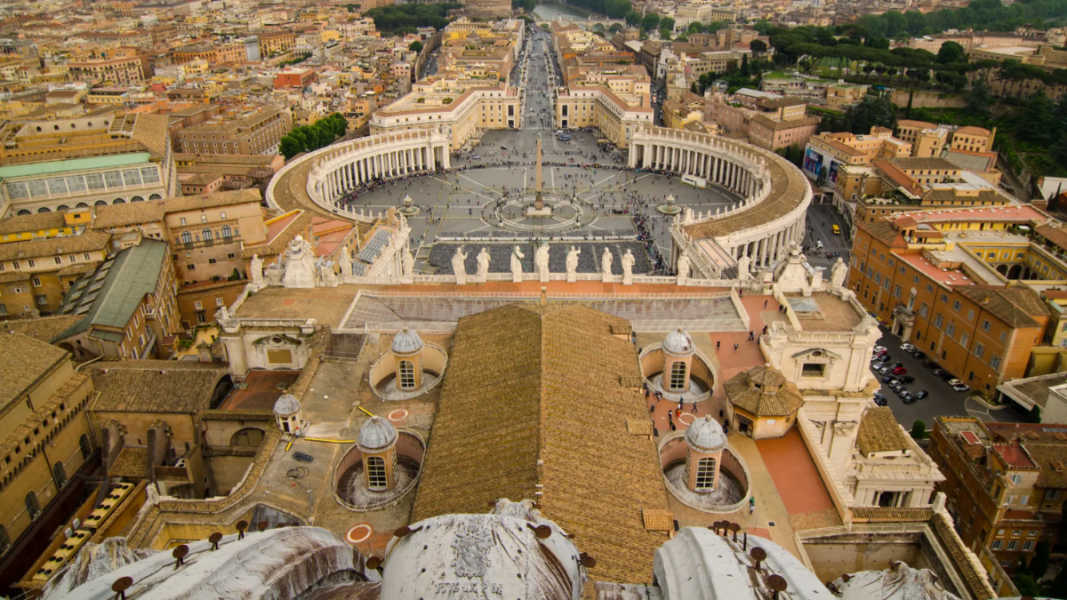
Yesterday, information began circulating in the media that the Vatican would be working on opening a bistro on the terrace of St. Peter’s Basilica, a space with privileged views over Rome and until now alien to commercial use. A few hours later, Vatican News disseminated an official clarification based on a statement from the Basilica’s Communications Office: it would not be a restaurant, but an expansion of the existing café. However, the nuance does not refute the essential element of the news.
The initial information was published by Il Giornale, where a project underway was described in detail to enable a restaurant on the large terrace located in front of the statues of the apostles, making use of old service premises used by the Sampietrini, the workers in charge of the maintenance of the basilica.
According to the Italian newspaper, the works would already be advanced, with the arrival of materials and furniture, although surrounded by maximum secrecy, to the point that even the canons of St. Peter would not have been formally informed. The project, incubated for some time and initially planned for the Jubilee, could see the light this same year on the occasion of the 400th anniversary of the consecration of the basilica, celebrated in 1626 under the pontificate of Urban VIII.
In that context, Vatican News published a clarifying note in which the opening of a bistro or restaurant as such was denied. The Basilica’s Communications Office specified that what is being studied is an expansion of the visitable surface of the terrace to cope with the growing number of visitors—who during the Jubilee reached peaks of up to 50,000 people daily, according to data cited in the article itself—and thus alleviate the pressure on the interior of the temple.
Nevertheless, the same clarification acknowledges that said expansion will include the current existing refreshment point on the terrace, a small bar located next to the exit of the dome’s elevator, very frequented especially in the summer months. What is denied, therefore, is not the creation of a new consumption space, but its denomination and formal scope.
The official note insists that any expansion will be carried out in a “sober” style, respectful of the sacredness of the place and oriented exclusively to meet the needs of pilgrims. However, neither the statement nor the subsequent information denies that new spaces dedicated to eating and drinking will be enabled in an area that until now was limited and of the highest symbolic value.