


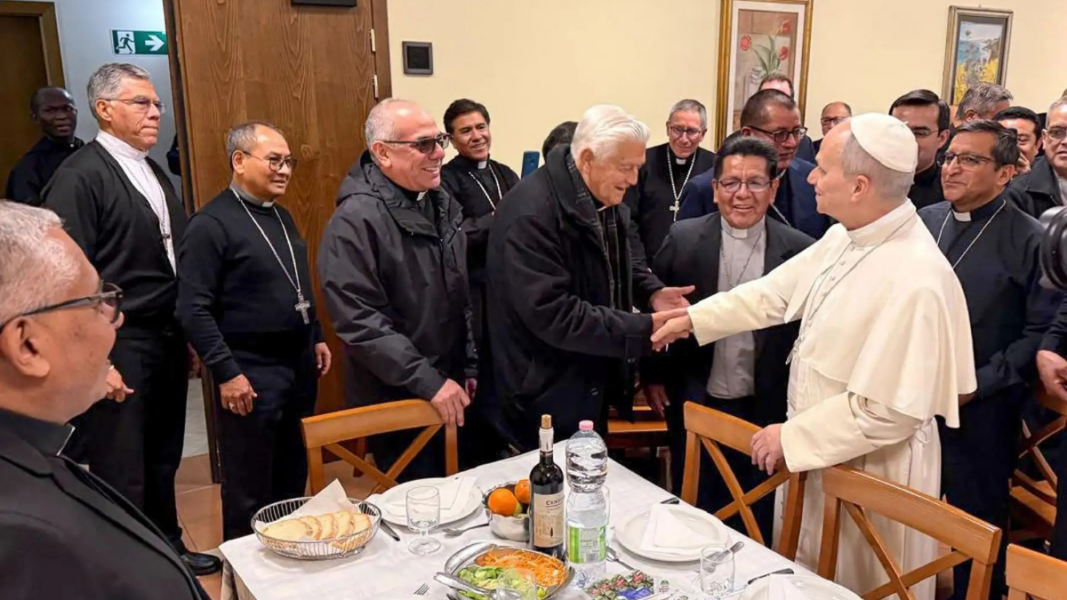
Pope Leo XIV received the bishops of Peru in audience this Friday within the framework of their Visit ad Limina Apostolorum, as reported by the official bulletin of the Holy See.
The central moment of the Visit ad Limina
The Visit ad Limina Apostolorum is a consolidated practice in the life of the Church, through which bishops periodically go to Rome to pray before the tombs of the apostles Saints Peter and Paul and to dialogue personally with the Pope about the spiritual, pastoral, and social situation of the particular Churches entrusted to them.
The audience with the Roman Pontiff is the most significant act of this visit, as it allows the pastors to share directly with the Successor of Peter the challenges they face, as well as to receive guidance and encouragement for their episcopal mission.
A gesture of closeness experienced the day before
Today’s audience was preceded by a gesture of special closeness on the part of Pope Leo XIV. On the previous day, the Pontiff appeared unexpectedly during the lunch of the Peruvian bishops in Rome, sharing with them a moment of fraternal fellowship.
According to Vatican News, the Peruvian Episcopal Conference described this informal encounter as a gesture of communion and pastoral accompaniment, valued by the prelates as a concrete expression of the Pope’s closeness to the Church in Peru.
Prayer for Peru and ecclesial communion
During that fraternal encounter, the president of the Peruvian Episcopal Conference, Monsignor Carlos García Camader, expressed that the bishops have brought to Rome the intention to pray for peace and the future of Peru, as well as the desire to strengthen the faith and unity of the faithful people.
Below we leave the words of Leo XIV pronounced during the audience:
Dear brothers in the episcopate:
I wish to give you all the most cordial welcome as you have come to Rome to carry out the Visita ad limina Apostolorum. [I thank the kind words that the president of the Episcopal Conference has addressed to me on behalf of all.] I ask you to remind my dear children of Peru that the Pope carries them in his heart and remembers them with affection, especially in prayer.
It seems providential to me that this visit takes place in the context of the 300th anniversary of the canonization of Saint Toribio de Mogrovejo. You, dear brothers, are the fruit of the evangelical seed that this saintly bishop sowed in those lands. For this reason, I want to propose to you that, supported by his example, we read the reality we face today with eyes of faith, which has been well captured in the reports you have sent me. Be assured that they have been read with attention.
How to respond to the multiple challenges that today present themselves to the Peruvian Church in its evangelizing task? The response may be that which appears in many writings of the first missionaries in America: to live ad instar Apostolorum, that is, in the manner of the Apostles, with simplicity, courage, and total availability to let ourselves be led by the Lord.
To live this way means, first of all, to guard and promote unity and communion. The Apostles, scattered throughout the world, remained united in one mind and in one mission. Today too, the credibility of our proclamation passes through a real and affective communion among the pastors, and between them and the People of God, overcoming divisions, protagonisms, and every form of isolation. A communion like that which Saint Toribio sought when promoting the Councils of Lima. This encounter is an eloquent sign of the living communion that unites us in faith and in mission, and it allows me to welcome with gratitude the adherence to Christ and to the Successor of Peter that you express in your ministry.
At the same time, the current challenges demand a renewed fidelity to the Gospel, which must be proclaimed integrally. Saint Toribio did not proclaim a word of his own, but a Word received, trusting in its transformative power. That same fidelity asks of us today a clear, courageous, and joyful proclamation, capable of dialoguing with culture without losing the Christian identity.
To live in the manner of the Apostles also implies a total dedication to the ministry entrusted to us. They reserved nothing for themselves, even going so far as martyrdom. In this same line is the witness of Saint Toribio, who faced dangers and sufferings for one sole reason: love for souls, to bring the love of Christ even to the most inaccessible places.
To live ad instar Apostolorum means to draw near to all those entrusted to us, to be interested in them, to share their life and their path. Like Saint Paul, who became all things to all people in order to win all to Christ (cf. 1 Co 9:22), we are called to go out to meet, to listen, to accompany, and to understand in order to lead all toward God.
This closeness embraces the presbyterate, the seminarians, consecrated life, and the entire People of God, with a special predilection for the most fragile and needy. A closeness so profound that it can be said of you what was said of Saint Toribio: that he felt for all “such love, that he carried them in his entrails as if he were father to each one” (cf. Pos. sup. virt., 503).
Dear brothers in the episcopate, Peru holds a special place in my heart. There I shared with you joys and hardships, I learned the simple faith of your people, and I experienced the strength of a Church that knows how to hope even amid trials. Because of that great affection, I encourage you to make fruitful in the today of the Church in Peru the heritage you have received from Saints Toribio, Rose, Martin, and John, among so many others.
I thank you for this encounter and for all that you do so that the Good News may resound in every heart. I entrust you to the maternal intercession of the Most Holy Virgin Mary of Mercy and gladly impart upon you the Apostolic Blessing, which I extend to the priests, to consecrated life, and to the entire dear Peruvian people, especially to those who most need strength and consolation. Thank you very much.