


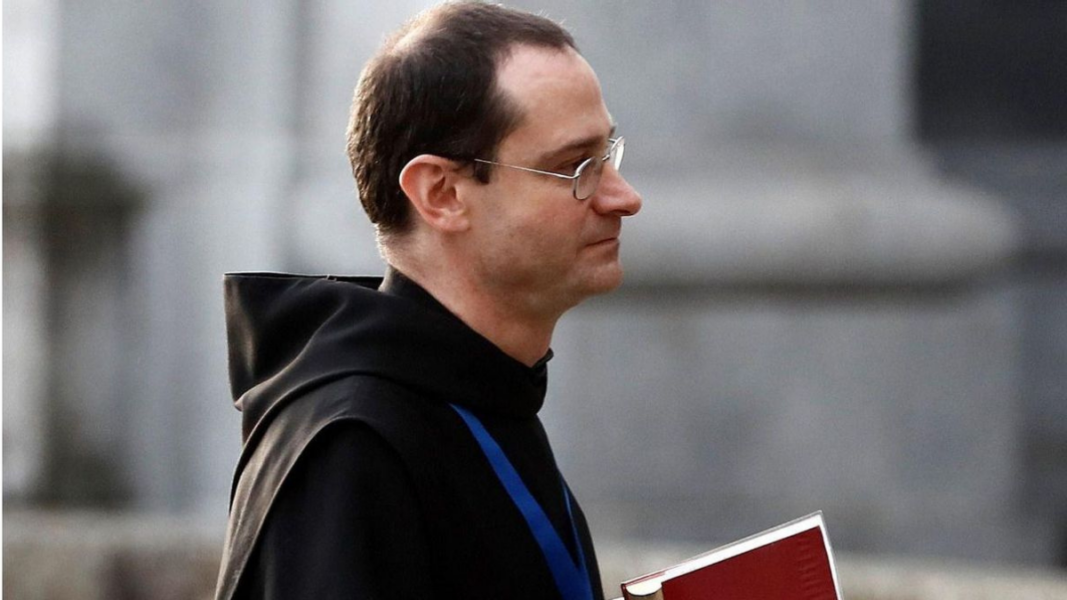
Words matter. And in the mouth of a cardinal, they matter even more. When in the transcription of the audios published by Infovaticana the Archbishop of Madrid, José Cobo, refers to the expulsion of Father Santiago Cantera from the Valley of the Fallen with an ambiguous “I don’t know if he had earned it or not,” we are not faced with an innocent or improvised phrase. It is a cynical, calculated, and deeply cowardly expression. One of those formulas that allow insinuating without affirming, slipping in suspicion while the one who pronounces it washes their hands. It is the rhetoric of power when it does not want to assume responsibility, but does want to leave a trace.
this was an original moment where a prior arrives, the former prior, and tells us: “They’re kicking us out.” I don’t know if he had earned it or not, but yes: “they’re kicking us out.”
That insinuation is not neutral. It deliberately suggests that a Benedictine monk, faithful to his vows, to his rule, and to his conscience, might have “deserved” an exile that forced him to abandon the community to which he had consecrated his life. Insinuating that is an unbearable exercise in cynicism. It is suggesting, without evidence or arguments, that fidelity can be guilt and that coherence can be a reason for punishment. It is accepting as plausible that an exemplary priest deserved to be removed for reasons that he does not dare to formulate clearly, because the only reason Father Cantera was removed was due to the imposition of immoral politicians.
Let us be clear and resolve the doubt for the Cardinal of Madrid: no, Father Santiago Cantera did not deserve it. He did not deserve it neither humanly, nor spiritually, nor ecclesiastically. Father Cantera is a faithful priest, an upright Benedictine monk, a man who has lived according to his vows and his faith, without duplicity or calculations. He possesses an intellectual, academic, doctrinal, and spiritual stature that should be a mirror for many, not the object of cowardly insinuations or off-the-record comments thrown in passing to please everyone and answer to no one.
It is especially hurtful that these words come from the one who occupies the see of Madrid not due to a generalized recognition of pastoral or intellectual merits, but as the fruit of a widely questioned appointment, alien to the judgment of many of his peers, the nuncio himself, and those who know his trajectory closely. It is not a gratuitous personal criticism; it is a constatation: mediocrity reveals itself when it seeks to belittle those who discomfort it with their coherence. When moral authority is lacking, resort is made to insinuation.
Who are you, José Cobo, to suggest that a Benedictine of the stature of Father Cantera “perhaps” deserved to be forced to break his vows through a covert exile? Who are you to slip in suspicion without showing your face, to tarnish without assuming responsibility, to protect yourself behind ambiguity while others bear the consequences? The Church does not need pastors who merely “pass through,” nor prelates who act as notaries of others’ decisions, nor cardinals who adopt the language of political power while emptying the language of faith of meaning.
What happened in the Valley of the Fallen is not a minor episode or an administrative misunderstanding. It is a test of character. And in this test, half-measures, cynical phrases, and washed hands do not absolve. Fidelity does not need tepid defense. It needs truth. And the truth, in this case, is simple and resounding: Father Santiago Cantera deserved none of what was done to him. Those who should give explanations are others.

Editor’s note: InfoVaticana does not consider itself ethically bound by the “off the record” nature of this meeting, having been excluded from the invitation despite being the ecclesial medium with the largest audience in Spain.