


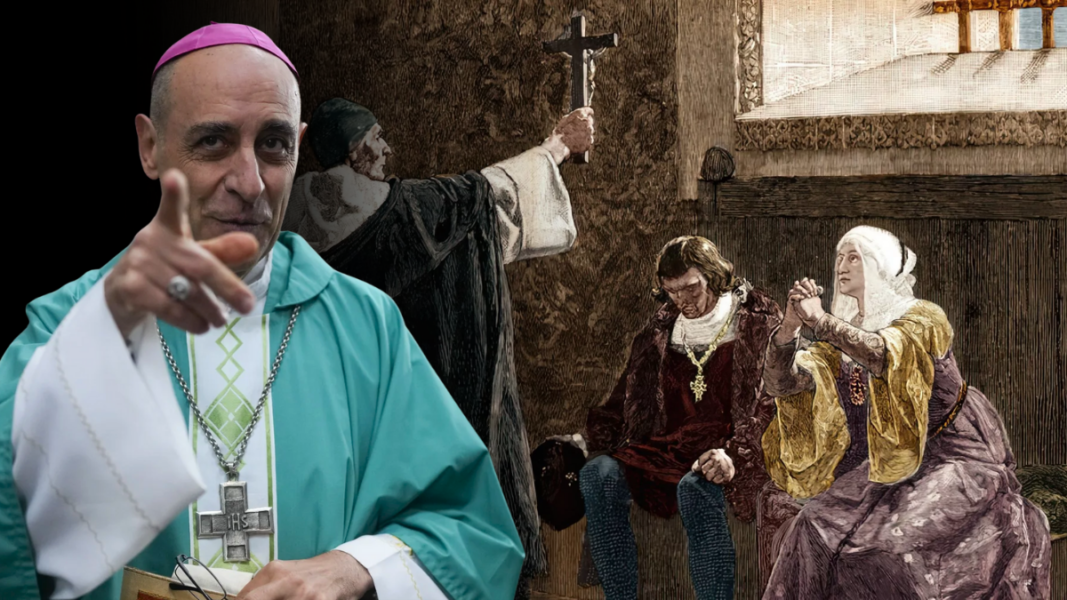
On Tuesday, January 27, during the plenary session of the Dicastery for the Doctrine of the Faith held in Vatican City, the controversial Argentine cardinal Víctor Manuel Fernández delivered an intervention in which he reflected on the need for “intellectual, spiritual, and theological humility” in the exercise of reason. The conference took place in the historic headquarters of the former Holy Office, an institution of which the current dicastery is the direct legal heir.
In that context, the prefect of the Dicastery for the Doctrine of the Faith cited various historical episodes that, in his view, would illustrate how the absolutization of one’s own reason or certain moral criteria can lead to serious abuses. Among the examples mentioned were the Inquisition, the world wars, and the Holocaust.
What exactly did Cardinal Fernández say
During his intervention, Fernández argued that throughout history, atrocities have been committed when human beings have believed they possess the truth in an absolute way, without recognizing limits or exercising the necessary humility. To illustrate this idea, he integrated various extreme historical episodes into a single moral reflection, including the Inquisition and the Holocaust.
The cardinal did not literally state that both phenomena are identical or morally equivalent. However, by placing them within the same explanatory category and attributing a common cause to them, he established an analogy that has generated debate due to its historical and institutional scope.
From where these words are pronounced
The relevance of these statements lies not only in their content but also in the position from which they are made. Fernández was not speaking as an external historian or independent analyst, but as the prefect of the Dicastery for the Doctrine of the Faith, an organism that, from a legal and institutional standpoint, is the direct successor to the former Holy Office, historically known as the Roman Inquisition.
The fact that these reflections were formulated precisely from the headquarters of the former Holy Office gives the analogy a particular symbolic meaning, as it is the institution historically identified with the defense of doctrinal orthodoxy in the Catholic Church.
An infamous equation
From a discursive point of view, the equation does not require explicitly stating that two realities are identical. It is enough to include them in the same moral category and explain them as the consequence of a common cause. By presenting the Inquisition and the Holocaust as examples of the excesses derived from truth imposed without limits, Tucho establishes a conceptual homologation that places them on the same explanatory plane.
This type of reasoning is common in contemporary moral discourses, but it is especially problematic when applied to radically different historical phenomena and, above all, when formulated from an institutional authority directly linked to one of them.
From a historical and legal perspective, the comparison raises serious difficulties. The Holy Office was an ecclesiastical tribunal integrated into the legal order of its time, with written procedures, typified accusations, the possibility of defense, and a fundamentally doctrinal and correctional purpose.
The Holocaust, on the other hand, was a modern, ideological, and racial state project aimed at the systematic physical elimination of millions of people simply for existing. There was no trial, no defense, no possible correction, but planned extermination. The difference between the two phenomena is not one of degree, but of nature.
The background of the Black Legend
The equation between the Inquisition and the 20th-century totalitarianism constitutes one of the classic axes of the so-called Black Legend. This narrative transposes contemporary moral categories onto institutions from other centuries to present them as direct antecedents of modern genocide.
Specialized historiography has shown that the Holy Office acted in many contexts as an instance of containment against uncontrolled civil violence and that the most severe penalties were exceptional and executed by secular power. Recognizing historical abuses does not require accepting analogies that distort the nature of institutions.
An institutional issue
Beyond Cardinal Fernández’s subjective intention, his words raise a fundamental issue. When the head of the dicastery heir to the Holy Office adopts, even implicitly, a conceptual framework that brings that institution closer to tragedies typical of modern totalitarianism, the effect is not only rhetorical but institutional.