


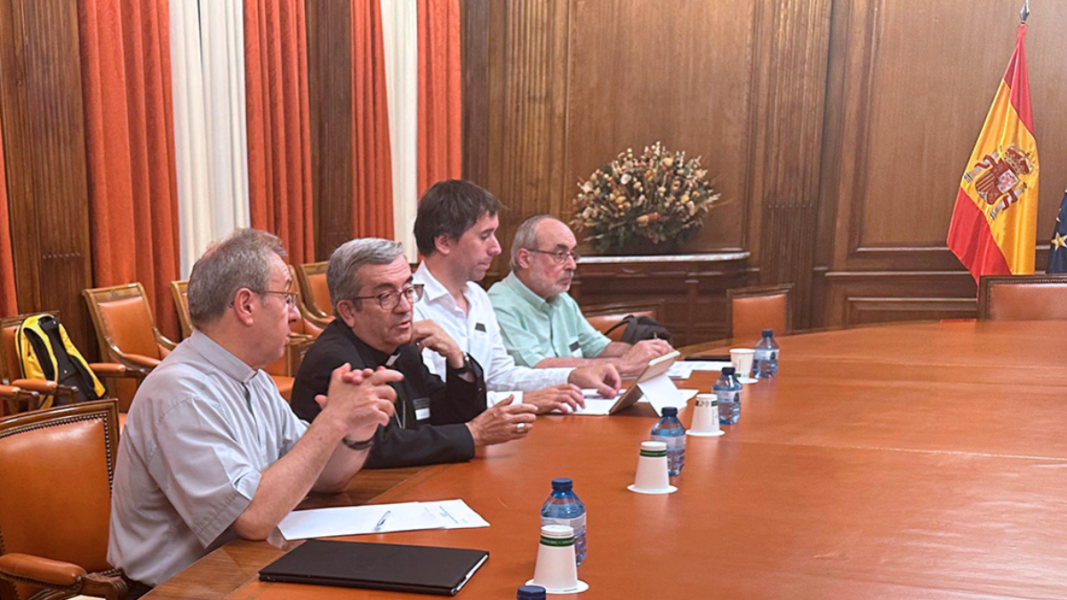
No, the Church does not support the mass regularization of illegal immigrants. Those who support it are a part of the Spanish episcopate. And confusing the two is not an innocent mistake: it is an ecclesiological falsification.
Every time a media outlet headlines that “the Church” backs a specific government measure, a conceptual trap is consummated that benefits everyone except the faithful. Because the Church is not the Episcopal Conference. Nor does the Episcopal Conference command the Church. Nor does it automatically speak in its name when it issues political opinions.
Catholic doctrine is clear and perfectly defined. In the Church, there is a distinction of missions. It is the bishops’ responsibility to teach the faith, safeguard the doctrine, sanctify through the sacraments, and govern in strictly ecclesial matters. To the laity, on the other hand, corresponds a specific and proper task: to order temporal realities according to the Gospel.
That includes politics, the economy, legislation, social organization. That is: precisely the terrain where today we see bishops occupying the space that does not correspond to them, while they de facto discredit—although they don’t say it—the laity who do have direct competence in those matters.
When a bishop presents a mass regularization decided by a specific government as morally indisputable, he is not exercising his magisterium. He is issuing a prudential opinion. And prudential opinions do not bind in conscience. Neither the faithful, nor the laity, nor anyone.
Even more: when that opinion coincides millimeter by millimeter with the ideological framework of a political power that legislates systematically against natural law and against the Catholic faith, the problem is no longer just one of competence, but of scandal.
Catholic laity are not called to repeat episcopal statements like pious parrots. They are called to judge political reality with reason enlightened by faith, to legitimately disagree when a measure harms the common good, and to defend different solutions without feeling guilty or disobedient.
Saying that “the Church supports regularization” is a crude way to silence that legitimate disagreement. It is to turn a debatable political option into a non-existent moral mandate. It is to use the cassock as an alibi.
It is advisable to remember this clearly, even if it bothers: the Church does not vote on decrees, does not draft BOE nor manage borders. And when some bishops seem to forget it, they are not speaking in the name of the Church, but in their own name.
Confusing the two is not communion. It is clericalism. And the bad kind.