


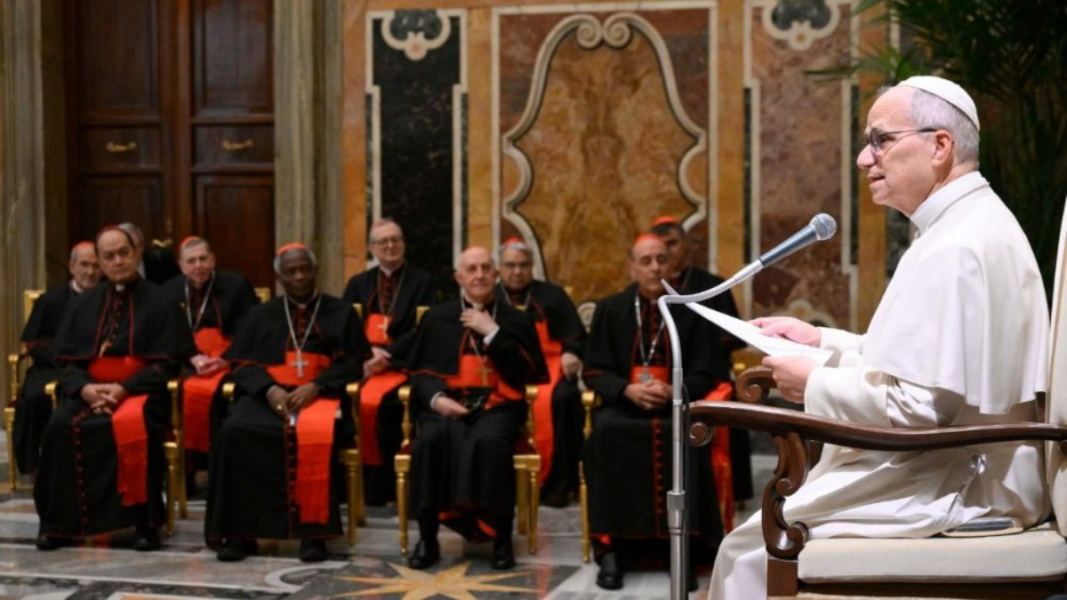
Pope Leo XIV received this Thursday, January 29, in the Vatican Apostolic Palace, the participants in the Plenary Session of the Dicastery for the Doctrine of the Faith, to whom he delivered a speech centered on the doctrinal mission of the organism, the urgency of transmitting the faith, and the pastoral challenges facing the Church in the current historical context.
During the audience, the Pontiff thanked the Dicastery for its service, recalling that its main task is to assist the Pope and the bishops in proclaiming the Gospel and in safeguarding the integrity of Catholic doctrine on matters of faith and morals, as established by the apostolic constitution Praedicate Evangelium.
Reference to the main recent documents
In his address, Leo XIV reviewed some of the most relevant documents published by the Dicastery in the last two years, emphasizing their pastoral and doctrinal usefulness. Among them, he mentioned the Note Gestis verbisque on the validity of the sacraments; the Declaration Dignitas infinita on human dignity; the Norms for the discernment of presumed supernatural phenomena, which included the Note on Medjugorje; the document Antiqua et nova on the relationship between artificial intelligence and human intelligence; the (controversial) Marian Note Mater Populi fidelis; and the doctrinal Note Una caro, dedicated to the value of monogamy and the unity of marriage between a man and a woman.
The Pope stated that this work offers the faithful a “prompt and clear” word from the Church, and provides guidance both to bishops in their pastoral action and to theologians in their work of study and evangelization.
The break in the transmission of the faith
One of the central axes of the speech was the concern for the break in the generational transmission of the Christian faith, especially in countries with an ancient Christian tradition. Leo XIV pointed out that more and more people—particularly among young people—are living without references to God or to the Church, a reality that, while causing pain, must impel us to rediscover the missionary dimension of the Church.
In this sense, he reiterated his desire for a Church that does not withdraw into itself, but is authentically missionary and proclaims the Gospel not so much through strategies, but through the power of attraction, recalling that it is Christ who attracts, not the Church in itself.
Humility and service in ecclesial life
The Pontiff insisted that the Church proclaims Christ without protagonisms or particularisms, and recalled that every ecclesial ministry must be lived from the consciousness of being a humble service, as “workers in the Lord’s vineyard”.
Before concluding, Leo XIV also thanked the Dicastery’s work in the accompaniment of bishops and general superiors in cases of offenses reserved to this organism, emphasizing the need for these processes to always respect the demands of justice, truth, and charity.
The Pope closed the audience by expressing his gratitude for the discreet and constant service of the Dicastery’s members, to whom he imparted his Apostolic Blessing.
We leave below the complete words of Leo XIV:
In the name of the Father, of the Son, and of the Holy Spirit.
Peace be with you.
Good morning and welcome!
Dear Cardinals,
dear brothers in the episcopate,
dear brothers and sisters,
I welcome you with joy on the occasion of your Plenary Session. I cordially greet and thank the Prefect of the Dicastery, along with the Superiors and Officials. I am well aware of the valuable service you provide, with the aim—as the Constitution Praedicate Evangelium states—of “helping the Roman Pontiff and the Bishops in the proclamation of the Gospel throughout the world, promoting and safeguarding the integrity of Catholic doctrine on faith and morals, drawing from the deposit of faith and also seeking an ever deeper understanding of it in the face of new questions” (n. 69).
Your task is to offer clarifications on the Church’s doctrine, through pastoral and theological indications on often very delicate issues. To this end, in the last two years the Dicastery has published various documents; I recall the main ones: the Note Gestis verbisque, on the validity of the Sacraments (February 2, 2024), which offered clear instructions to resolve doubtful cases related to their administration; the Declaration Dignitas infinita, on human dignity (April 2, 2024), which reaffirmed the infinite dignity of every human being, today gravely endangered, particularly by ongoing wars and by an economy that places profit first; the Norms for proceeding in the discernment of presumed supernatural phenomena (May 17, 2024), which have made it possible to resolve cases related to such events, including the one concerning the spiritual experience of Medjugorje, to which the Note The Queen of Peace (September 19, 2024) was specifically dedicated; the Note Antiqua et nova, prepared in collaboration with the Dicastery for Culture and Education (January 28, 2025), which offers a broad and precise consideration of the relationship between artificial intelligence and human intelligence; the doctrinal Note Mater Populi fidelis, on some Marian titles referring to Mary’s cooperation in the work of salvation (November 4, 2025), which fosters popular Marian devotion, deepening its biblical and theological foundations, and at the same time offers precise and important clarifications for Mariology; finally, the doctrinal Note Una caro. Praise of Monogamy, on the value of Marriage as an exclusive union and reciprocal belonging (November 25, 2025), which delves in an original way into the property of the unity of Marriage between a man and a woman.
All this work will undoubtedly be of great benefit to the spiritual growth of the holy and faithful People of God. In the context of the epochal change we are experiencing, it indeed offers the faithful a prompt and clear word from the Church, especially in relation to the numerous new phenomena emerging on the historical scene. It also provides valuable guidance to Bishops for the exercise of their pastoral action, as well as to theologians, in their service of study and evangelization.
I particularly appreciate that in this “Plenary” you have begun a fruitful reflection on the theme of the transmission of the faith, a matter of great urgency in our time. We cannot, in fact, “ignore that, in recent decades, a break has occurred in the generational transmission of the Christian faith in the Catholic people” [1] and that, especially in contexts of ancient evangelization, the number of those who no longer perceive the Gospel as a fundamental resource for their own existence is increasing, above all among new generations. There are not a few young people, in truth, who already live without any reference to God and to the Church and, if on the one hand this causes pain in us believers, on the other it must lead us to rediscover the “sweet and comforting joy of evangelizing” [2], which is at the very heart of the life and mission of Christ’s Bride.
As I recalled on the occasion of the recent extraordinary Consistory, we “want to be a Church that does not look only at itself, that is missionary, that looks beyond, to others”; [3] a Church that proclaims the Gospel, above all through the power of attraction, as my predecessors Benedict XVI and Francis have reiterated on various occasions. [4]
The foundation of the life of the Body of Christ is the love of the Father, revealed in the Son made man, present and active in us through the gift of the Spirit: for this reason “it is not the Church that attracts, but Christ, and if a Christian or an ecclesial community attracts it is because through that ‘channel’ the vital sap of Charity arrives that springs from the Heart of the Savior”. [5]
The Church proclaims Christ, without protagonisms or particularisms, and in it each one is and must always recognize himself solely as “a simple and humble worker in the Lord’s vineyard”. [6]
I would like to allude, before concluding, to a further service of yours, for which I thank you and which I commend to your solicitude: that of welcoming and accompanying, with all benevolence and discernment, Bishops and General Superiors called upon to deal with cases of offenses reserved to the Dicastery. It is a very delicate area of ministry, in which it is essential to ensure that the demands of justice, truth, and charity are always honored and respected.
Dearest ones, I finally renew my thanks to each one of you for the valuable contribution you offer to the life and work of the Dicastery and of the entire Church, especially when such contribution is offered in a humble and unassuming way. A sign of this gratitude of mine is the Apostolic Blessing that I impart from my heart to all of you and to your loved ones. Thank you.
_______
[1] Francis, Ap. Exhort. Evangelii gaudium (November 24, 2013), 70.
[2] Cf. St. Paul VI, Ap. Exhort. Evangelii nuntiandi (December 8, 1975), 80; cit. in Francis, Ap. Exhort. Evangelii gaudium (November 24, 2013), 10.
[3] “Improvised” words at the end of the first session of the extraordinary Consistory, January 8, 2026.
[4] Cf. Benedict XVI, Homily at the Holy Mass inaugurating the V General Conference of the Latin American and Caribbean Episcopate (May 13, 2007); Francis, Ap. Exhort. Evangelii gaudium (November 24, 2013), 14.
[5] Address on the occasion of the extraordinary Consistory (January 7, 2026).
[6] Benedict XVI, Apostolic Blessing “Urbi et orbi” and first greeting (April 19, 2005).