


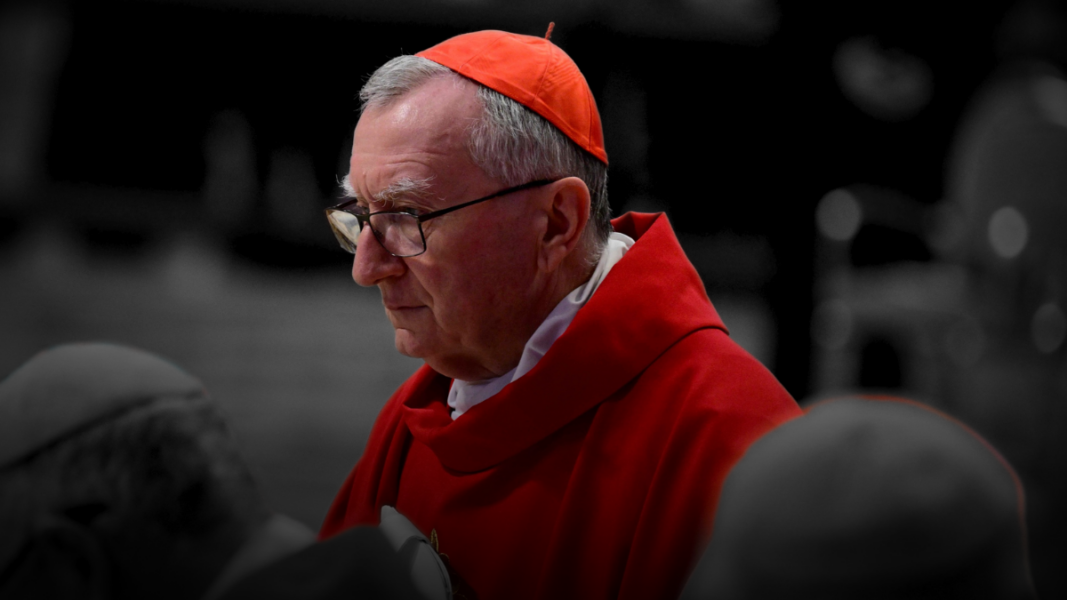
Cardinal José Cobo has explicitly placed all responsibility on the Vatican’s Secretariat of State, and particularly on Cardinal Pietro Parolin, for the decisions affecting the Valley of the Fallen basilica, within the framework of the temple profanation project promoted by the Sánchez Government.
He stated this during a meeting with journalists on January 23, whose literal transcription highlights a notable contradiction between his statements and the signed document from that time with the Government, in which specific conditions for intervention in the basilica were established. That document was published by El Debate and has generated intense controversy.
«If you talk to Parolin, and Parolin says nothing, it means he agrees,» Cobo affirmed in response to the journalists’ insistence on the real scope of the agreements and the consequences of the winning project, which envisages a profound transformation of the temple’s surroundings.
A contradiction with the signed document
The cardinal’s words contrast with the content of the document he himself signed, in which areas of action within the basilica were expressly delimited and which was recently revealed as an agreed framework to allow the Government’s intervention despite the signatory lacking jurisdiction.
However, during the meeting with journalists, Cobo repeatedly denied having authorized any specific type of intervention and maintained that «nothing is said» in that agreement, referring any effective decision to the Holy See. «I haven’t discussed that or intervened in it. That’s the negotiation between the Government and the Holy See,» he insisted.
This position has fueled the controversy that arose after the publication of the document by El Debate, leaving unclear whether the Archbishop of Madrid’s signature constituted or not an effective cession of competencies over the basilica’s interior.
«I can’t say if they put in a lightbulb or remove pews»
Throughout the conversation, Cobo emphasized that the Diocese of Madrid has no jurisdiction over either the Benedictine community or the basilica, limiting his role to strictly pastoral matters. «I can’t say if they put in a lightbulb or if they remove pews. That’s the community and the Holy See,» he affirmed.
When asked about the impact of the project on essential elements such as the staircase, access to the temple, or the adjacent chapels where thousands of human remains rest, including martyrs from the Civil War, he was categorical: «I’m not going to discuss that or have I intervened in it.»
As he explained, his intervention was limited to facilitating a «minimum framework» for there to be dialogue between the Government and the Holy See, in exchange for the Executive informing Rome. «The only thing we have allowed is for there to be dialogue and a minimum framework,» he noted.
Parolin’s silence as implicit approval
Cobo confirmed that Minister Félix Bolaños has gone to the Vatican on several occasions to meet with Cardinal Parolin and discuss directly the aspects related to the basilica. «They go to talk about the basilica,» he said, emphasizing that the final decision corresponds to the Secretariat of State.
In this context, the Archbishop of Madrid attributed to the Vatican’s silence a value of consent: «If you talk to Parolin, and Parolin says nothing, it means he agrees,» he affirmed, thus placing the final responsibility for the future of the Valley of the Fallen on the Holy See.
Distance from the Benedictines’ appeal
Regarding the administrative appeal announced by the Benedictine community, Cobo regretted that an attempt is now being made to build «a different narrative» for legal purposes, although he acknowledged that they are within their rights. Nevertheless, he again marked distances: «Everything related to the basilica should go to the Holy See.»
The cardinal defended that his priority was to avoid the expulsion of the community and preserve the sacred character of the temple, but he rejected any subsequent involvement in the project’s details. «I set the table for them to sit down and talk. I couldn’t do more,» he assured.
In this way, the transcription of the meeting exposes an unresolved tension between the Archbishop of Madrid’s current statements and the signed document that allowed the process to advance, a contradiction that continues to fuel the controversy surrounding the Church’s role in the resignification of the Valley of the Fallen.
Editor’s note: InfoVaticana does not consider itself ethically bound by the «off the record» nature of this meeting, having been excluded from the invitation despite being the ecclesial media with the largest audience in Spain.