


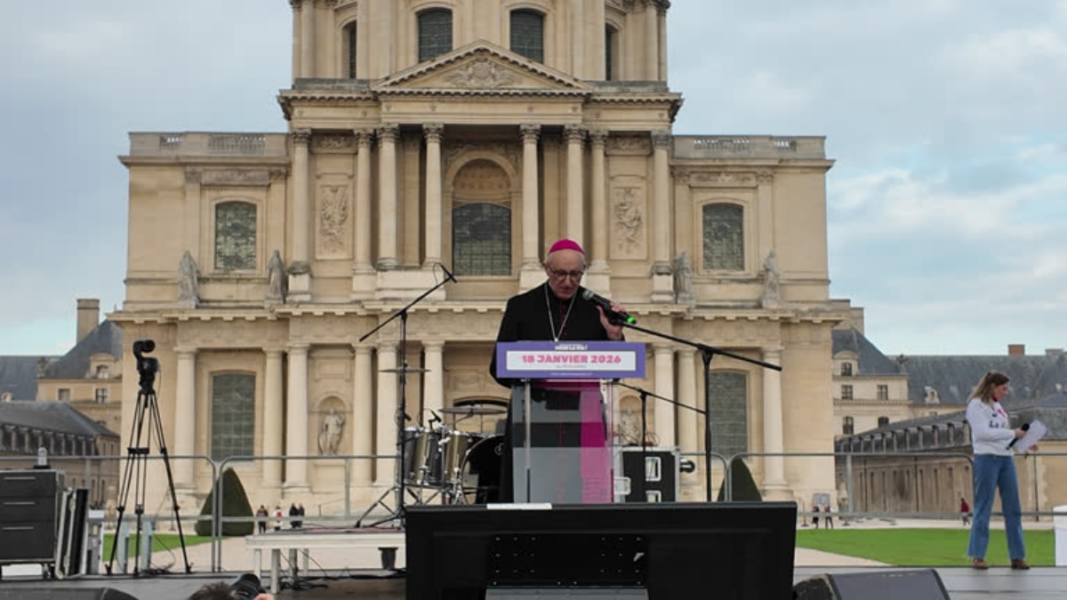
The emeritus bishop of Toulon, Mons. Dominique Rey, spoke on January 18 last during the March for Life held in Paris, becoming the first French bishop to publicly intervene in this event, traditionally supported by the faithful and pro-life associations, but from which the episcopate usually keeps its distance.
Mons. Rey’s participation breaks with the attitude of distancing adopted until now by the majority of French bishops regarding this demonstration, which is held annually in a political and social context particularly favorable to abortion and increasingly open to euthanasia.
This year’s March for Life took place in a country where, in 2024, the Constitution was amended to introduce the so-called “right” to abortion, a reform promoted by President Emmanuel Macron and approved by a wide parliamentary majority. This legal framework has reinforced, according to various observers, a markedly pro-abortion political culture.
Criticism of a “freedom that becomes liberticidal”
In his intervention, Mons. Rey denounced what he described as “deadly provisions” of French legislation and warned that the legitimization of abortion and euthanasia does not affect only individual cases, but the whole of society. In his view, these practices also represent a distortion of the role of the medical body, called upon to protect life and not to cause death.
The bishop stated that when life ceases to be considered inviolable, human freedom is profoundly altered, and he maintained that a freedom detached from moral limits can end up turning against man himself. In this sense, he criticized the use of expressions such as “helping to die with dignity,” considering that they conceal a lack of protection for life in situations of fragility.
An unusual gesture in the French episcopate
Mons. Rey’s intervention is particularly significant in the context of the French episcopate, which in recent years has issued critical statements on abortion or euthanasia, but without actively participating in the March for Life. The presence of the emeritus bishop of Toulon thus introduces a new element in the relationship between the hierarchy and the pro-life movement in France.
It should be remembered that Mons. Rey submitted his resignation as bishop of Toulon at the end of 2024, following an apostolic visitation, and that since then he maintains a pastoral and public activity centered on doctrinal and moral issues.
Recent evolution of the legislative debate
Three days after the March for Life, the French Senate rejected, by 144 votes against 123, the central article of the bill on aid in dying, which sought to recognize a “right” to assisted suicide and limit the conscience clause. Although this parliamentary setback does not end the legislative process, it does introduce an element of uncertainty in the processing of the law.
In this context, the intervention of Mons. Dominique Rey has been interpreted as a significant gesture in public defense of life, in a country where the debate on abortion and euthanasia continues to advance in the political and legislative sphere.