


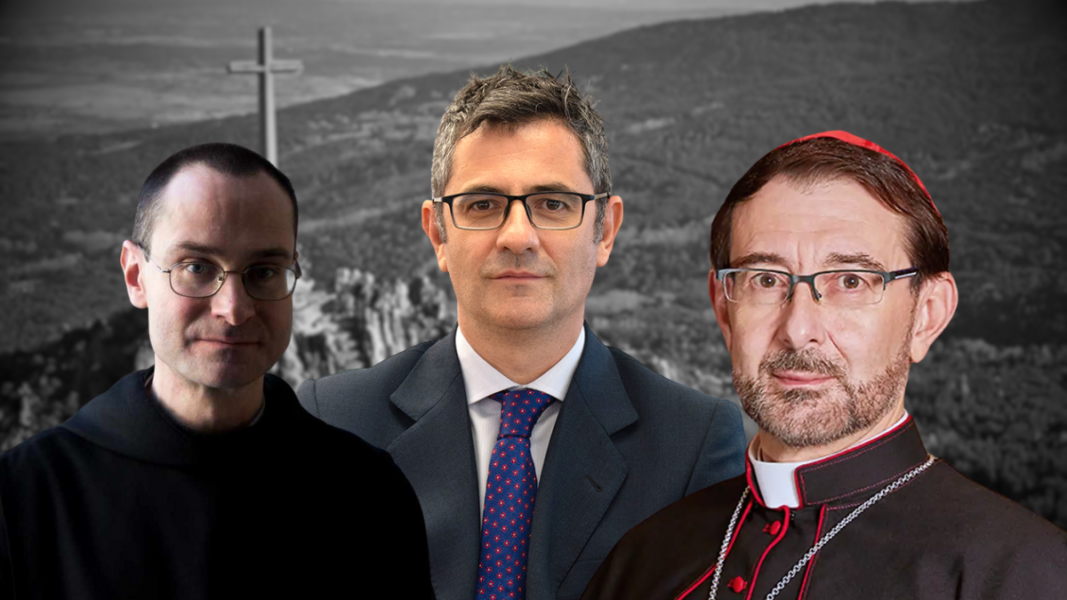
The Cardinal of Madrid, José Cobo, recently participated in an off the record meeting with selected journalists to which Infovaticana was not invited and, therefore, is not subject to any confidentiality commitment. This media outlet has had access to the full audio of said conversation and what is heard in it provides a context of enormous relevance to understand the role played by the Archbishop of Madrid in the Valley of the Fallen conflict.
In that audio, Cardinal Cobo himself explains in detail how the internal conversations unfolded regarding the possible expulsion of the Benedictine community and the government’s project to resignify the site. His words, reproduced literally, leave no room for forced interpretations or benevolent nuances. The cardinal says:
«Let’s see. It seems like the Valley of the Fallen or Cuelgamuros is the center of the Church’s life and for Madrid… I mean, for us, we just pass by there. I mean, the Diocese of Madrid just passes by there. I say because we have no jurisdiction and because this was an original moment when a prior arrives, the former prior, and tells us: ‘They’re kicking us out.’ I don’t know if he had earned it or not, but yes: ‘they’re kicking us out.’ No, I mean, because there’s a very strong tension. Well, I’m going to tell the story.»
Next, the cardinal recounts a key meeting in which the president of the Episcopal Conference, the apostolic nuncio, himself, and Prior Santiago Cantera participated. In his own words:
«So we met: the president of the Conference, the nuncio, this servant, and Prior Cantera. And then we say: ‘Hey, they’re kicking us out.’ And we say: let’s try two folders. Folder one: the community; and folder two.»
Immediately afterward, he introduces the political element:
«But besides kicking us out, for the basilica there’s a government project that they’ve called resignification—which for the government are different folders, eh—that is underway.»
It is at this point that the cardinal explains his interlocution with the Holy See and the nuncio, and where the phrase that concentrates the entire gravity of the matter appears:
«Well, let’s see. I speak with the Holy See, I speak with the nuncio. We need to achieve two things: first, that they don’t kick them out. And for that, I speak with them and tell them: ‘Look, if they don’t kick you out, I’ve been told that, if they don’t kick you out, you have to go through a conversion process.’ See you later, and I leave.»
The cardinal adds next:
«And they say: ‘We do a conversion process.’ Okay, they stay. But I have nothing to do with it anymore.»
The literality of the testimony is devastating. The Archbishop of Madrid himself acknowledges that the permanence of the Benedictines in the Valley was conditioned on the acceptance of a supposed «conversion process.» Obviously, it is a euphemism; the «conversion» transmitted by Cobo was not a spiritual exhortation or a call to inner renewal typical of Christian life, but a condition imposed as a bargaining chip to avoid expulsion. The question is inevitable and the audio offers no answer: conversion to what? By virtue of what authority is a conversion process demanded of Benedictine monks, Catholics, baptized, faithful to their rule, dedicated to prayer and contemplative life?
It is worth adding, moreover, an essential nuance: the Benedictine community of the Valley has not docilely accepted that blackmail nor assumed the imposed framework without question. Quite the contrary, the monks have remained firm in the legal defense of their rights, have appealed decisions they consider unjust, and are not giving in easily as Cobo’s sweetened narrative suggests. The supposed «conversion» that the archbishop boasts of is, at best, a unilateral and self-justifying interpretation from someone whose credibility is seriously damaged by the audio itself: he does not speak as a pastor concerned with the truth, but as an intermediary eager to present as a success a capitulation that, in reality, has not been consummated.
The political context clarifies the real meaning of the demand. That «conversion process» appears explicitly linked to Pedro Sánchez’s government’s project to resignify the Valley, an ideological and memorialist project alien to the Church’s mission and frontally hostile to the site’s historical and religious identity. Under ecclesial language is concealed what, in practice, amounts to a demand for submission: accept the socialist political power’s narrative framework or face the consequences. The grave and surreal thing is that the transmission belt for this criminal coercion was none other than the Cardinal of Madrid.
The cardinal himself also says that supposedly the community was experiencing strong internal tension and belligerence with the former prior, but at no point does he speak of doctrinal deviations, moral scandals, or canonical disobedience that could justify a demand for conversion in a theological sense. The demanded «conversion» does not refer to Christ, but to a change of attitude toward the government project. It is not an evangelical call, but a euphemism carefully chosen to clothe political pressure with spirituality.
The audio accessed by Infovaticana places Cardinal Cobo in a role hardly compatible with the pastoral function that corresponds to him. He does not act as a defender of a threatened religious community, but as an intermediary and transmission belt for explicit political blackmail. When a cardinal of the Church assumes the government’s logic as his own and translates it into the language of Christian conversion, we are not faced with a minor misunderstanding, but with a serious instrumentalization of the language of faith and a capitulation that demands a public and honest explanation before the faithful.
Editor’s note: InfoVaticana does not consider itself ethically bound by the «off the record» nature of this meeting, having been excluded from the invitation despite being the ecclesial media with the largest audience in Spain.