


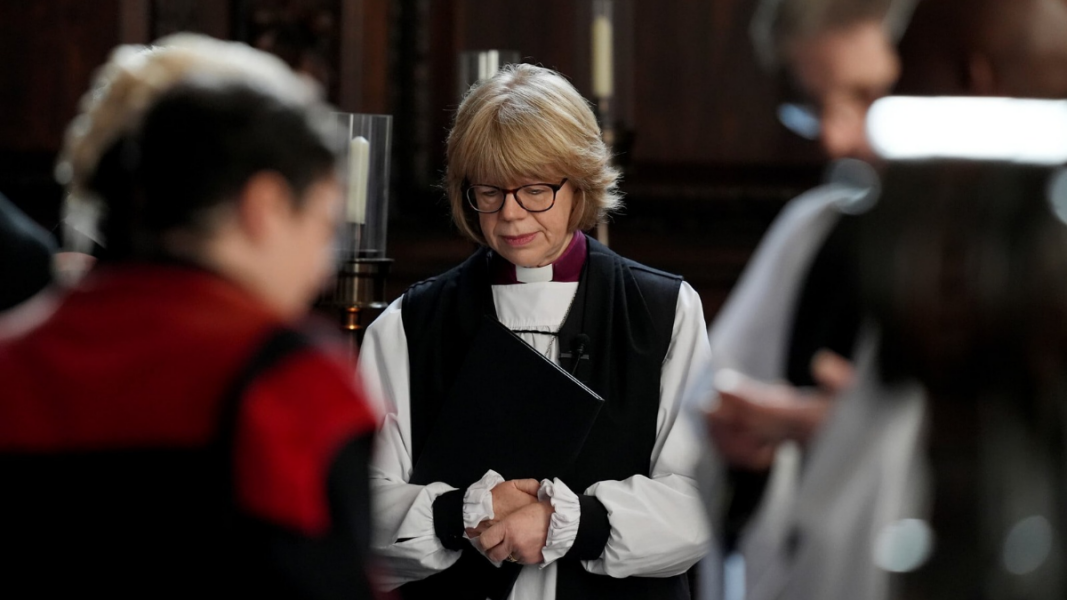
The official confirmation of Sarah Mullally as the new Anglican Archbishop of Canterbury, celebrated this week according to the rite of the Church of England, was marked by the interruption of the event by pastor Paul Williamson, who ended up being subdued and forcibly removed from the venue.
During the confirmation ceremony, the officiant publicly declared that “no one had appeared in opposition” to Mullally’s appointment. At that moment, pastor Paul Williamson stood up to assert that he had indeed submitted a formal objection, which—according to his own words—had been ignored by the ecclesiastical authorities.
Eyewitnesses and messages subsequently shared on social media indicate that Williamson was immobilized, handcuffed, and removed from the premises, without being allowed to continue his protest. The episode was noted by various observers as a police intervention in the context of an official religious event.
A Procedure Formally Provided For
Anglican regulations provide for, at least in theory, the possibility of presenting objections during the confirmation process of a bishop or archbishop, a remnant of the ancient canonical procedure inherited from English tradition. Precisely for this reason, the fact that an explicit objection was publicly denied and responded to with a forcible expulsion has raised criticisms regarding the management of internal dissent in the Church of England.
From conservative Anglican sectors, it has been pointed out that the episode calls into question the transparency of the process and the real willingness to listen to dissenting voices, especially when these are based on doctrinal objections.
The Background of the Appointment
Sarah Mullally, until now «Bishop» of London, has assumed the role of Primate of the Church of England in a context of strong internal divisions within the Anglican Communion. Her episcopal career has been marked by support for progressive positions on issues such as the ordination of women, the revision of sexual morality, and the blessing of same-sex couples, matters that have caused a growing distancing from Anglican churches in Africa and Asia.
Therefore, Williamson’s protest did not occur in a vacuum, but within a framework of accumulated doctrinal tension, where a part of the clergy and the faithful consider that the Anglican ecclesiastical structures have ceased to offer real channels for theological dissent.