


By Stephen P. White
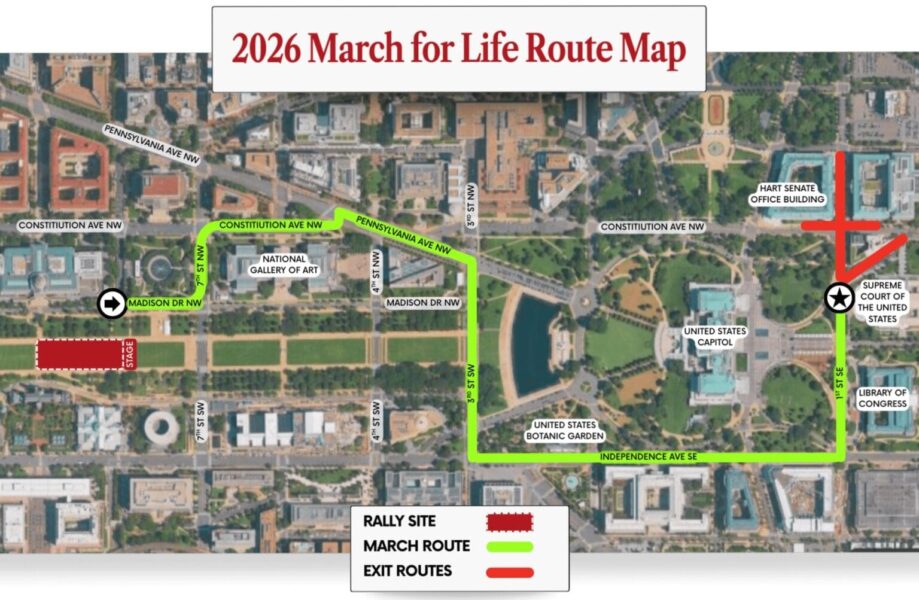
One of the advantages of living in the suburbs of Washington D. C. —and yes, there are some advantages— is that I can attend the March for Life almost every year. This year, while many potential participants wonder if their return flights will be canceled due to a massive winter storm, I don’t have that concern. I’ll be there again, marching and praying, and finding comfort in the tens of thousands of young and smiling faces, in the families, and in not a few friends.
The March offers an opportunity to reflect on what has been achieved in the defense of life, as well as an occasion to think about what still remains to be done. Often this work is understood in the context of our politics: pro-life politicians elected, laws changed, court cases decided, policies worthy of praise or reproach.
The pro-life movement, which arose in the wake of Roe v. Wade and has endured in this country for more than half a century, is a remarkable achievement of citizen activism. Few countries can boast of such a broad and enduring coalition in defense of the unborn as we have here in the United States.
Pope Leo recently emphasized the importance of this work, both for the lives involved and for the well-being of society as a whole:
«The protection of the right to life constitutes the indispensable foundation of all other human rights. A society is healthy and truly progresses only when it safeguards the sanctity of human life and works actively to promote it.»
Of course, the pro-life movement is more than political activism, as important as that is. Think, for example, of the vast networks of crisis pregnancy help centers that have done, and continue to do, such noble work for mothers and children across the country. Think of the Sisters of Life, who embody in a particular way the Catholic commitment to serve the smallest among us. Think of the countless pro-life parish ministries where thousands and thousands of rosaries are prayed each week for needy mothers and the protection of their children.
These immense and broad-based efforts in defense of life are also reinforced by the Church’s witness to the dignity of human life in other areas: in its defense of the elderly and the terminally ill; in its concern for the poor, the homeless, the imprisoned, and the stranger; in its care for sinners.
Each one of us is loved by God, a God who, even though we are sinners, loved us first. Recognizing this fundamental reality, this basic understanding of Christian life, is to know the two consolations of gratitude and humility. From that grace flows the imperative to love in imitation of Christ.
The imperative to love —which should inform the entire pro-life movement and which certainly manifests itself every January in the March— also leads us to reflect on the enormity of what abortion has wrought in this country. The cost in lives is almost incalculable —almost, but not entirely—: between 60 and 70 million abortions in the United States since 1973.
The cost to relationships between men and women, the desolation of families, the pain of regret and loss, the poisoning of our politics, the hardening of our nation’s soul. All these are real costs of the sin of abortion. They are spiritual costs that affect us all (even those who have never been directly touched by abortion), because they shape and deeply affect the families, communities, and even the Church to which we belong.
Mother Teresa, in her Nobel Peace Prize speech in 1979, spoke famously in defense of the unborn. But her words were not just a lament for abortion or a call to defend the most vulnerable among us (though she did both). She also pointed to the poverty —the greatest poverty— of those nations that had embraced the license of abortion:
«The greatest destroyer of peace today is the cry of the innocent unborn child. Because if a mother can kill her own child in her own womb, what is left for you and me but to kill each other? … For me, the nations that have legalized abortion are the poorest nations. They are afraid of the little one, they are afraid of the unborn child, and the child must die because they don’t want to feed one more child, educate one more child; the child must die.»
Legal abortion is not just a moral atrocity; it is a spiritual catastrophe of almost unimaginable magnitude. What can wash away the stain of all that blood? What has the power to heal the soul of a nation so twisted by decades of such evil? How can there be hope in our hearts when the gift of life itself is treated as a disease to be avoided or a threat to be eliminated?
The answer to those questions was given definitively by Jesus Christ two thousand years ago. We Catholics know that there is no sin so great that God’s grace cannot overcome. That is the source of all our hope. What other hope is there?
But Catholics also know that the work of salvation accomplished by Christ is expressed through time and space through the work of the Church, especially in the Mass. And this is also on my mind as the March for Life approaches, because the spiritual damage of abortion demands a response. Christ has given the definitive answer, but each one of us can unite our own small efforts to His through penance and reparation, prayer and fasting, for the spiritual scars that so mark the soul of our beloved nation.
So this week, especially: March for Life! Pray for the end of abortion! Act to change hearts, minds, and laws! Support those in need! And perhaps offer some penance, however small, for the good of our nation and unite it to the sacrifice of the Son of God Himself, in whom all our hope resides.
About the author:
Stephen P. White is executive director of The Catholic Project at The Catholic University of America and a fellow of Catholic Studies at the Ethics and Public Policy Center.