


By Fr. Raymond J. de Souza
The patron saint of journalists is St. Francis de Sales—whose feast is celebrated today, January 24. The Holy Father’s annual message for World Communications Day is dated in his honor.
St. Francis (1567-1622) was certainly a writer, but not every writer is a journalist. He received that patronage because, prevented by the Calvinist authorities from entering his own city of Geneva, the Catholic bishop used the means of communication of his time instead to reach his flock, writing pamphlets and spiritual letters—his Introduction to the Devout Life is a collection of them. While we await the proper patron saint of journalists—G. K. Chesterton—we already have unofficial patrons in St. Edith Stein… sorry, in St. Titus Brandsma and St. Maximilian Kolbe, who were true journalists as well as priests.
Saints Titus and Maximilian were priests who considered journalism not only compatible with their priesthood, but essential to their mission. Kolbe founded a magazine, Knight of the Immaculata, which reached an astonishing circulation of one million copies in 1938. Although the circumstances of his martyrdom in Auschwitz are not related to journalism, Kolbe was sent to Auschwitz largely because of his influence as a journalist.
Journalists and priests are both storytellers. We often think of “stories” as works of fiction, but journalists write non-fiction and present their “stories.” The priest, even more than the journalist, is a storyteller.
A recent mystery movie expressed it well.
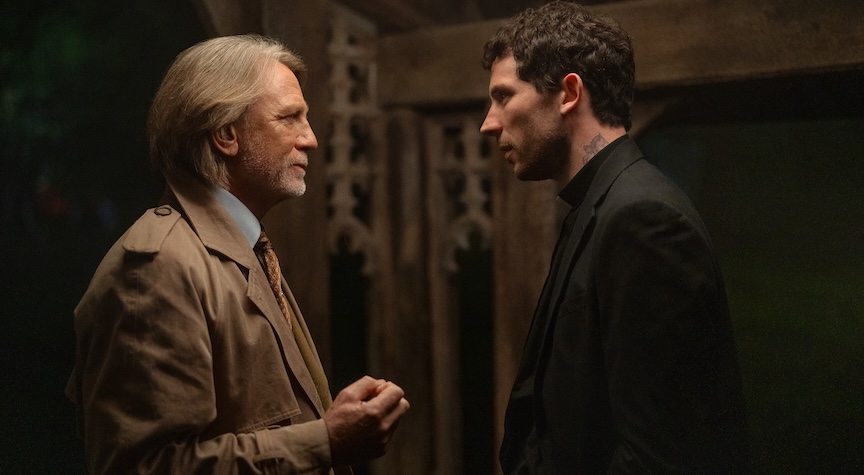
Wake Up Dead Man: A Knives Out Mystery premiered last September at the Toronto International Film Festival and then arrived on Netflix in December. It received considerable Catholic attention because the murder takes place in a parish in northern New York State—Our Lady of Perpetual Fortitude! The elderly monsignor is murdered, and the newly ordained young priest is a suspect.
In reality, it is not so much a mystery movie, as much of the film does not focus on the details of the crime. It is rather a character study of people struggling to understand the place of religion in a secular, even hostile, era. Since the two main characters are priests, many priests have commented on our cinematic representation.
All the priestly commentators I have seen focused on two scenes as keys to the movie: a phone conversation in which a distressed woman asks the priest to pray for her and, as expected, a dramatic confession scene. (The latter even includes the updated formula of absolution in the United States, so credit must be given to the screenwriters).
That is fine if we think of priests primarily as guides in prayer and ministers of the sacraments. Which we are. But if we are primarily storytellers—and if you prefer cinematic priests played by Robert De Niro rather than by Bing Crosby, like I do—then an introductory scene written by Rian Johnson is the most important.
Detective Benoit Blanc arrives after the murder of Monsignor Wicks. He meets Father Jud, the young priest, and introduces himself, in his way, when Father Jud asks if he is Catholic.
“No, not at all,” says Blanc. “Proud heretic. I kneel before the altar of reason.”
“The architecture, that interests me,” says Blanc about the church. “I feel the grandeur, the… the mystery, the sought-after emotional effect… And it’s as if someone is projecting a story on me that I don’t believe in. It is built on the empty promise of a childish tale full of malevolence and misogyny and homophobia and its countless justified acts of violence and cruelty, while at the same time, and still, hiding its own shameful acts. So, like a stubborn mule that kicks, I want to tear it apart, burst its perfidious bubble of belief and get to a truth that I can swallow without choking.”
In the face of that accusation of the Church as a great fantastic storyteller at odds with the truth, Father Jud speaks of the mystery at the very heart of the Church’s mission.
“You’re right,” he concedes. “It is storytelling. And this church is not medieval. We are in New York. It is nineteenth-century neo-Gothic. It has more in common with Disneyland than with Notre Dame… and the rites and rituals and vestments, all of it. It is storytelling. You’re right. I suppose the question is: do these stories convince us of a lie? Or do they resonate with something deep within us that is deeply true? Something we cannot express in any other way… except by telling stories.”
“Touché, Father,” Blanc replies. After all, what does a homicide detective do but allow the victim to tell the story of their own death?
The Church tells stories and the priest is its principal storyteller. There is no shame in that—quite the opposite!—if the stories are really true.
That crucial scene from Wake Up Dead Man led me to reread Presbyterorum Ordinis, the document of the Second Vatican Council on the priesthood. It was Catholic news last month; Pope Leo XIV published a letter on its sixtieth anniversary.
At the beginning it teaches that “presbyters have as their principal duty to preach the Gospel of God to all. In this way they fulfill the Lord’s command: ‘Go into all the world and preach the gospel to the whole creation.’”
It is my favorite phrase from that document, although not everyone gets excited about it. The priority of preaching, even over the sacraments, over presiding at worship that is truly worthy and just? That sounds pretty low-church Protestant.
It is not. We are storytellers. The fairy tales Blanc was talking about begin with “once upon a time” and Star Wars starts with “a long time ago in a galaxy far, far away,” neither of which is so different from “in the beginning.”
The objection to the primacy of preaching is that preaching on parables cannot be more important than offering Holy Mass. After all, didn’t the Church have generations of “simplex priests” who could celebrate Mass but not preach? Yes, it did, though it no longer does. Presbyterorum Ordinis practically put an end to that.
Storytelling and the sacraments should not be opposed. The sacraments are storytelling. So much so that the Church insists with great severity that the story be told exactly in the right way. We call that “valid form”; the priest must use the correct sacramental formula.
Calling a story “formulaic” is literary criticism, but not when the exact formula is required for the story to make real what the story narrates.
The Jews do that at Passover, when the child asks the elders to tell him a story: why is this night different from all other nights? The Jews know that telling the right kind of story in the right way makes that reality present. It is not fantastic at all. It is real.
The priest in the pulpit is certainly a storyteller. It is a pity if he is a bad storyteller. At the altar he will tell another story. Not exactly “in the beginning,” but “the day before he suffered” or “the night he was handed over.” The formula of absolution is a compendium of the entire history of salvation.
Not every priest is a journalist, but all are storytellers. How could it be otherwise, when, in the beginning, was the Word?
About the author:
Fr. Raymond J. de Souza is a Canadian priest, Catholic commentator, and Senior Fellow at Cardus.