


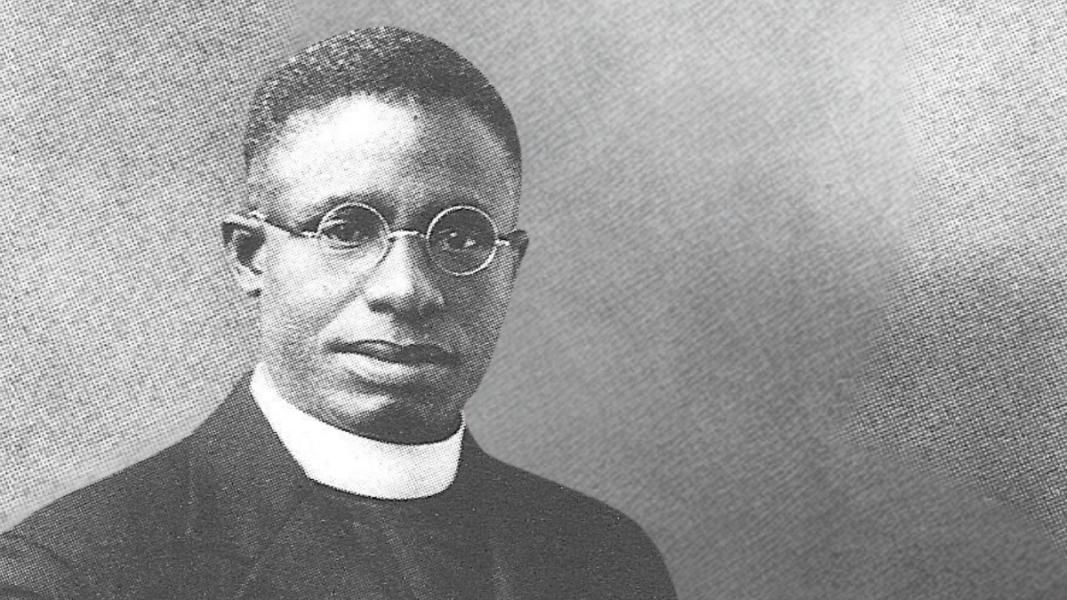
Nigeria, one of the countries with the largest number of Catholics and the most widespread religious practice in the world, could have a native saint for the first time if the cause of Blessed Cyprian Michael Iwene Tansi, a Nigerian priest known for his life of prayer, pastoral zeal, and austerity, prospers; his figure has recently been remembered by Cardinal Francis Arinze.
According to National Catholic Register, Cardinal Arinze, 93 years old, was baptized by Father Tansi in 1941, when he was nine years old, and assures that the priest decisively marked his Christian life and vocation. “He was the first priest I knew,” he explained in statements to EWTN News. “He introduced me to the Church: baptism, first communion, and preparation for confirmation”.
Nigeria currently has about 35 million Catholics and records one of the highest Mass attendance rates in the world. However, despite the growth of Catholicism, the African country has not had any canonized saints until now. Blessed Tansi, beatified in 1998 by St. John Paul II, needs a new miracle attributed to his intercession to be raised to the altars.
A priest with a lasting influence
Cardinal Arinze remembers Tansi as a tireless priest, with an intense life of prayer, who traveled wide areas of eastern Nigeria by bicycle or motorcycle to pastorally attend to very extensive communities. “He was practically a parish priest alone in what today are about 40 parishes,” he stated.
According to Arinze, the fruits of that ministry are still visible decades later: hundreds of priests, several bishops, one cardinal, and numerous religious vocations have emerged in the areas where Father Tansi worked. “He was like fire: if you are close, you cannot remain indifferent,” he noted.
A life marked by sacrifice
Cyprian Michael Iwene Tansi was born in 1903 into a poor, non-Christian family in southeastern Nigeria. His childhood was marked by tragedy: his mother died after being accused of causing deaths in the village and sentenced to ingest poison. Later, his father sent him to study at a school run by the Holy Ghost Fathers, where he came into contact with Christianity.
He was baptized in 1913 and, years later, entered St. Paul’s Seminary in Igbariam, one of the first seminaries in the region. He was ordained a priest on December 19, 1937, for the Archdiocese of Onitsha, forming part of the first groups of Nigerian priests in that area of the country.
In addition to his parish work, he directed boarding schools for boys, where discipline, prayer, and service at the altar were part of daily life. Cardinal Arinze recalls that “seeing him celebrate Mass was in itself a preaching.”
Asceticism and monastic life
According to the Dicastery for the Causes of Saints, Father Tansi lived with greater austerity than the people he served, promoted the dignity of women, chastity, and education, especially for girls. His ascetic life was known to those who lived with him, marked by fasting, mortification, and long hours of prayer.
In 1950, attracted by monastic life, he entered the Trappist abbey of Mount St. Bernard in England, where he took the name Cyprian. His desire to found a monastery in Africa could not be realized due to his fragile health. He died on January 20, 1964, at the age of 61, and later his remains were transferred to the cathedral of Onitsha.
He was beatified by St. John Paul II on March 22, 1998, becoming the first blessed of West Africa.
The absence of Nigerian saints
Cardinal Arinze considers that the lack of canonized saints in Nigeria is not due to Rome, but to the fact that beatification causes have not been a pastoral priority for the local Church. In his opinion, more emphasis has been placed on building structures than on promoting causes of holiness.
He also emphasizes the importance of promoting lay causes, to avoid the impression that holiness is exclusive to the clergy. In this regard, he recalled the opening in 2023 of the cause of Vivian Ogu, a Nigerian teenager murdered in 2009 after resisting a sexual assault.
“Causes do not advance only by logic, but by prayer and by miracles,” the cardinal concluded. “If there is no miracle, there is no beatification. That is why we must pray.”