


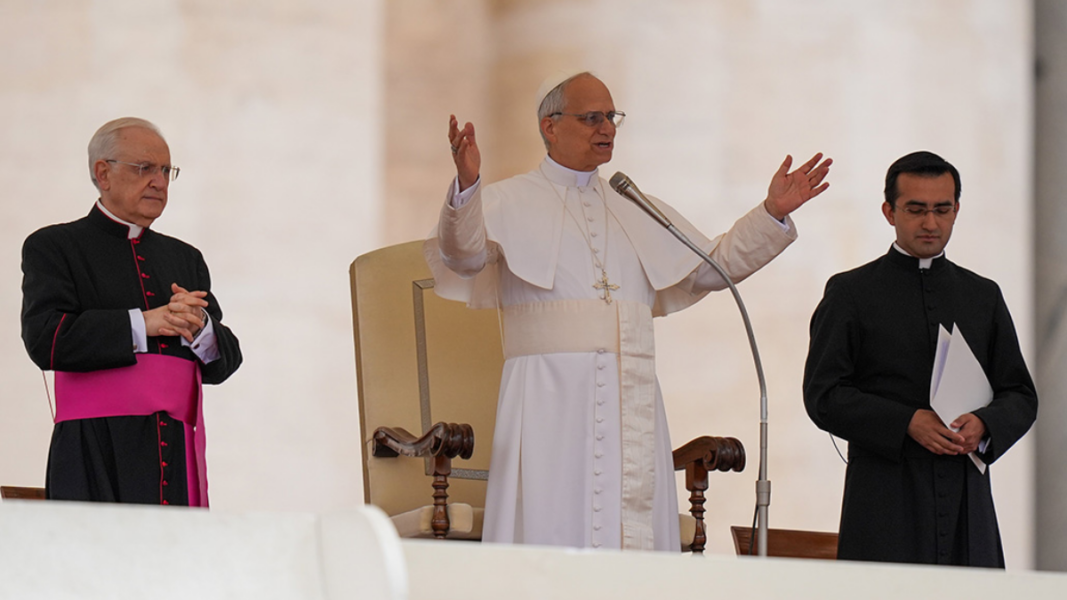
In the General Audience held this Wednesday, January 28, in the Paul VI Hall, Pope Leo XIV continued his cycle of catechesis dedicated to the documents of the Second Vatican Council, centering his teaching on the Dogmatic Constitution Dei Verbum and, in particular, on the inseparable bond between Sacred Scripture and Tradition as the unique deposit of the Word of God entrusted to the Church.
The Pontiff emphasized that Revelation is not transmitted only through a written text, but through a living Tradition, assisted by the Holy Spirit, which guards, interprets, and faithfully transmits the Word received from Christ. Drawing on the Gospel of Saint John and the missionary mandate of the Risen One, Leo XIV recalled that Scripture and Tradition spring from the same divine source and walk together throughout history, under the guidance of the Magisterium, without being able to separate or oppose each other.
The Pope insisted that this “deposit” is not a static reality, but living and organic, which grows in the Church’s understanding without losing its identity, and warned of the responsibility of all—pastors and faithful—to guard the faith received intact, especially in a historical context marked by doctrinal confusion and the fragmentation of the Christian message.
We leave below the complete catechesis of Leo XIV:
Dear brothers and sisters, good morning and welcome!
Continuing with the reading of the conciliar Constitution Dei Verbum on divine Revelation, today we reflect on the relationship between Sacred Scripture and Tradition. We can take as background two evangelical scenes. In the first, which takes place in the Upper Room, Jesus, in his great discourse-testament addressed to the disciples, states: “I have said these things to you while I am still with you. But the Paraclete, the Holy Spirit whom the Father will send in my name, will teach you everything and remind you of all that I have said to you. […] When he comes, the Spirit of truth, he will guide you to all truth” (Jn 14,25-26; 16,13).
The second scene takes us, instead, to the hills of Galilee. The risen Jesus appears to the disciples, who are surprised and doubtful, and gives them a command: “Go therefore and make disciples of all nations, […] teaching them to observe all that I have commanded you” (Mt 28,19-20). In both scenes, the intimate relationship between the word spoken by Christ and its diffusion through the centuries is evident.
This is what the Second Vatican Council affirms by resorting to a suggestive image: “Sacred Scripture and Sacred Tradition are closely bound together and communicate with each other. Since both flow from the same divine source, they form in some way a single whole and tend to the same end” (Dei Verbum, 9). The ecclesial Tradition branches out through history through the Church, which guards, interprets, and embodies the Word of God. The Catechism of the Catholic Church (cf. n. 113) refers, in this regard, to a motto of the Church Fathers: “Sacred Scripture is written in the heart of the Church before it is written on material instruments,” that is, in the sacred text.
Following the words of Christ that we quoted earlier, the Council states that “the Tradition that comes from the Apostles progresses in the Church with the help of the Holy Spirit” (DV, 8). This occurs with full understanding through “the reflection and study of the believers,” through the experience that arises from “a deeper intelligence of spiritual things” and, above all, with the preaching of the successors of the apostles who have received “a sure charism of truth.” In summary, “the Church, in her doctrine, life, and worship, perpetuates and hands on to all generations all that she believes” (ibid.).
Famous in this regard is the expression of Saint Gregory the Great: “Sacred Scripture grows with those who read it.” [1] And Saint Augustine had already affirmed that “there is one discourse of God that unfolds throughout all of Scripture and one Word that resounds in the mouth of so many saints.” [2] The Word of God, therefore, is not fossilized, but is a living and organic reality that develops and grows in Tradition. The latter, thanks to the Holy Spirit, understands it in the richness of its truth and embodies it in the changing coordinates of history.
Suggestive, in this line, is what the holy Doctor of the Church John Henry Newman proposed, in his work entitled The Development of Christian Doctrine. He affirmed that Christianity, both as a communal experience and as doctrine, is a dynamic reality, just as Jesus himself indicated with the parables of the seed (cf. Mc 4,26-29): a living reality that develops thanks to an inner vital force. [3]
The Apostle Paul repeatedly exhorts his disciple and collaborator Timothy: “Timothy, guard the deposit that has been entrusted to you” (1 Tm 6,20; cf. 2 Tm 1,12.14). The Dogmatic Constitution Dei Verbum echoes this Pauline text when it says: “Sacred Tradition and Sacred Scripture constitute a single deposit of the Word of God entrusted to the Church,” interpreted by “the living Magisterium of the Church, whose authority is exercised in the name of Jesus Christ” (n. 10). “Deposit” is a term that, in its original matrix, is of a legal nature and imposes on the depositary the duty to preserve the content, which in this case is the faith, and to transmit it intact.
The “deposit” of the Word of God is also today in the hands of the Church and all of us, in the various ecclesial ministries, must continue to guard it in its integrity, like a polar star for our journey in the complexity of history and existence.
In conclusion, dear brothers and sisters, let us listen again to the Dei Verbum, which exalts the interconnection between Sacred Scripture and Tradition: both— it affirms—are so united and intertwined with each other that they cannot subsist independently, and together, in their own way, under the action of a single Holy Spirit, effectively contribute to the salvation of souls (cf. n. 10).
______________________________________________
[1] Homilies on Ezekiel I, VII, 8: PL 76, 843D.
[2] Enarrationes in Psalmos 103, IV, 1
[3] Cf. J.H. Newman, The Development of Christian Doctrine, Milan 2003, p. 104.