


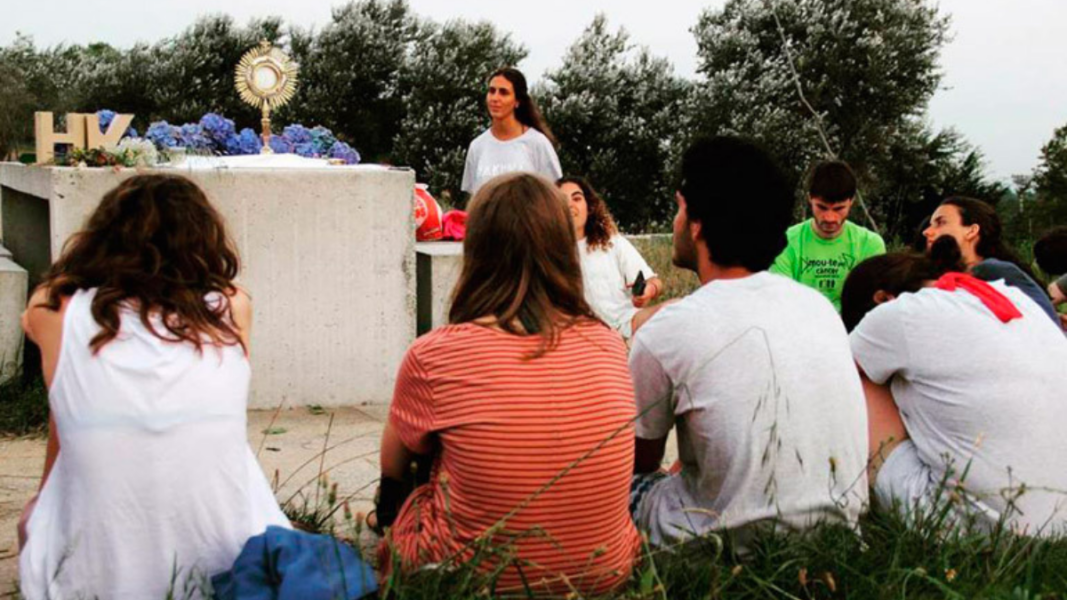
Hakuna is already considered a Church movement. Its members, baptized as pringados, don’t exactly have rules. They have something like a hippie decalogue that covers everything from smiling and greeting, looking into the eyes—what our parents taught us when we learned to communicate—, offering the day, “caring for a Tabernacle”—yes, the verb ‘to care for’, as if God were a being who needed our care and not, rather, our adoration—, spiritual reading…
“Prohibited not to enjoy following Christ, especially in parties and spaces of fun,” reads said decalogue.
And if there’s something that precisely characterizes the hakuners it’s that: the revelry.
There’s revelry wherever they go. Spiritual retreat—or God Stop, in the slang jargon—? Drinks. Pringados gathering—they call it PAM—? Big revelry. Summer trip—getaway, because it seems like you always have to escape from reality and its tedium—? Double revelry, with themes and costumes. All very celebrated.
It gives the impression that they didn’t burn through the camp stage. And that, at twenty or thirty years old—and some even with grandchildren—they need to keep feeling that adrenaline of belonging to a group, of emotional unity, of shared emotivism, and of late boy scout. A spirituality with a fabric bracelet and a group photo.
It happens in a particular way with those who go to live at the estudio: that convent where some nuns used to live and which Jose Pedro bought to make it his home and that of other young people. There ends up cohabiting a bit of everything: young people from outside Madrid, professionals who emancipate themselves from their family for a few months to “live the experience,” people who come from afar to see the cradle of Hakuna. They eat together, celebrate Mass, sleep each in their own room, have a schedule—supposedly, although anyone who knows Hakuna a bit more knows that they quite like chaos. Boys on one side, girls on the other—although it’s known that coexistence between sexes is not scrupulously monitored in general in Hakuna. They dance, make many plans, welcome those who go to the estudio for a visit or to work. A full-fledged community. A family replacement with a sectarian touch that, curiously, has raised suspicions for almost no one.
Some priest went through that experience believing one thing and ran away. And, if that weren’t enough, they even have their own pet: some dogs that have accompanied Josepe since he was a solitary priest who doesn’t belong to either Opus Dei or the diocese in purist terms.
Because the Church was not born to entertain anyone. It was born—for what an inconvenience—to convert. Not to fill weekends, nor to anesthetize loneliness with music, nor to replace the family with an amiable, young, and well-decorated community. Christianity is not a perpetual camp nor an emotional extension of adolescence: it is a Cross planted in the middle of the world.
Christ did not say “come and have fun,” but “come and follow me.” And follow me is a much less comfortable word and quite less fun. Christian joy exists, of course, but it is not that of programmed revelry nor that of collective enthusiasm: it is the one that comes after renunciation, silence, sacrifice, Adoration—not “care”—of God. When faith is confused with fun, it stops demanding; and when it stops demanding, it also stops transforming. Then we are no longer before a path of conversion, but before an experience more: well organized, well sung… and perfectly dispensable.