


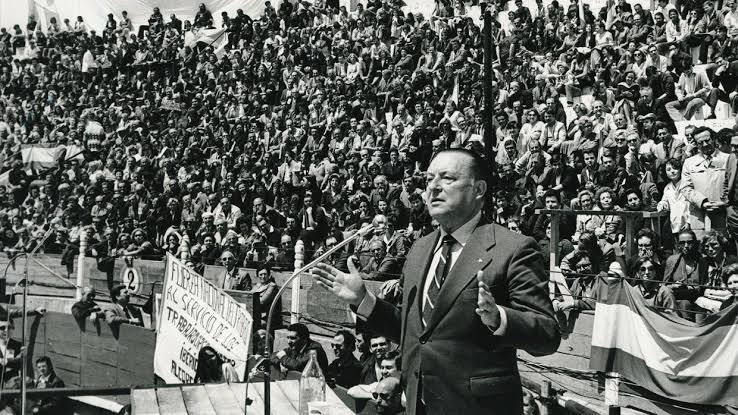
On the twelfth anniversary of his death, Infovaticana delves into the figure of a key Spaniard to understand the recent history of Spain and of the Church.
The figure of Blas Piñar cannot be understood without the Church. Not as a mere backdrop, but as the backbone of his entire life. His thought, his work, his public action, even his final solitude, can only be explained from a deep Catholic faith, lived with constant piety and with full awareness of the role assumed in the defense of the truth. In this sense, Blas Piñar embodies like few others the great paradox of contemporary Spanish Catholicism: to be fully a man of the Church, and to be so in a public, prominent, and faithful manner, and, at the same time, to end up being marginalized by a significant part of its hierarchy when the storm, with hurricane-force winds, assailed—and continues to assail—the bark of Peter.
Blas Piñar, man of the Church
Blas Piñar was, first and foremost, a Catholic from head to toe. His faith was not sociological or circumstantial, but interior, demanding, and sustained by an intense spiritual life from a very young age until the end of his days. A man of daily Mass and rosary, long periods of prayer and spiritual reading, he maintained until the end an ascetic tension that did not break, nor even diminish or soften in the moments of greatest trial.
His Christian formation has its roots in Catholic Action, where he was a leader in his youth alongside Antonio Rivera, the “Angel of the Alcázar” (whose beatification process has already been concluded). There he soon assumed that faith demands public witness. It is not anecdotal that, at just fourteen years old, he delivered a lecture in Toledo on the religious persecution by Mexican president Plutarco Elías Calles, convened by the Youth of Catholic Action. Closing his intervention with the cry of the Cristeros—Viva Cristo Rey!—he provoked riots promoted by the Federación Universitaria Escolar (FUE), his police detention, and a fine equivalent to his father’s monthly salary (100 pesetas), who at the time was an infantry captain. This event, as a boy, would mark his entire life, and we could say that there his spirit was forged and the unalterable commitment to defend the truth, preached opportunely and inopportunely, was sealed. The episode had a symbolic resonance that time took care to underline. Twenty-five years later, already as director of the Instituto de Cultura Hispánica, a group of Mexican university students came to visit him to return, in Mexican pesos, the amount of that fine. It was an act of historical gratitude, but also the recognition of a coherence assumed with courage.
His intellectual output sprang from his spiritual depth, channeled and enhanced by the great virtues that sustain enduring works.
Blas Piñar was a layman of enormous doctrinal formation, author of delicate and profound studies on “The Controversy of the One and Triune God,” on the “Church, People of God and Mystical Body of Christ,” “Eucharist and Holy Sacrifice of the Mass,” or “Christocentric Theology of Saint Paul.” Works on the priesthood, the sacraments, or on the angels, of whom he was a great devotee. Essays on marriage and the family, published alongside Father José Ramón Bidagor SJ. His Lenten talks, such as those given at the events organized by the Hermandades del Trabajo in the Palacio de Deportes in Madrid in 1967, before thousands of people, with the presence of Archbishop Casimiro Morcillo, were followed by the press and radio and formed part of the parish bulletins of the time. Several diocesan seminaries invited Blas Piñar to give Lenten talks when bishops boasted of their friendship with him before future priests.
The Lady, the Most Holy Virgin, was not only a fundamental pillar in his life of faith and piety, but a spring to which he resorted permanently. As a soul in love, he delved into the virtues of the Virgin and the Marian dogmas. Surely no one like him has spoken in our times with such inner knowledge and such outward passion about “the Assumption of the Virgin,” “the Immaculate Conception,” “the Virginity of Mary,” and “the Divine Maternity.” Or about “the Queen of America,” linking the Christianization of what would be Spain with the Virgin of the Pillar, and the evangelization of America with the apparition of the Virgin of Guadalupe to the Indian Juan Diego. “Singer of the Glories of Mary” was the appellation bestowed upon him by Father José María Alba Cereceda S.J. after the lecture “The Virgin was called Mary” that Blas Piñar delivered at the Corazón Inmaculado de María school in Sentmenat (Barcelona) before six hundred people.
The word of Blas Piñar, his unequaled oratory, to proclaim and defend the greatnesses of Mary, was not enough. Blas Piñar was fully aware that the commitment acquired with the faith extends to all orders and all fronts in life. It was that unalterable commitment that led him on June 20, 1985, to the doors of the Renoir cinema in Madrid to take the lead in the protests that Catholics carried out over the premiere of the blasphemous film “Hail Mary.” There too, and in what way, amid the police batons, he sang the glories of Mary in the face of those who sought to outrage her, while the hierarchy denounced the film “for being contrary to the Spanish Constitution.”
Blas Piñar, a man for the Church
But Blas Piñar was not only a man of the Church; he was also a man for the Church. For decades he put his prestige, his intelligence, his gifts, his time, his estate, his ability to convene at the service of the Catholic faith in the public space and in the institutional sphere.
The most relevant lay figure in Spanish Catholicism of the second half of the 20th century is undoubtedly Blas Piñar. Let some anniversaries serve to support this, by way of illustration and not exhaustively. On April 5, 1960, in the Teatro Español, he delivered the proclamation of Holy Week in Madrid. In 1962, the IV Centenary of the Reform of Saint Teresa was commemorated, and Blas Piñar was invited to deliver the inaugural lecture of the “Holy Year Teresiano” and also the final proclamation, before the highest authorities of the Spanish hierarchy and of the Order of Carmel. In the Cathedral of Tarragona, on January 24, 1963, the Pauline Year began in commemoration of the 1,900 years since the arrival in Spain of the Apostle Saint Paul, with the presence of the then Archbishop of Tarragona Don Benjamín Arriba y Castro, the Nuncio of His Holiness, dozens of bishops from all over Spain, several government ministers, and with live broadcast by Radio Nacional de España. The proclamation that inaugurated the Pauline Year in the Cathedral of Tarragona was delivered by Blas Piñar.
In May 1967, the Law on Religious Freedom was debated in the Spanish Cortes, at the behest of the Vatican under the pretext of the conciliar declaration Dignitatis humanae. The new currents, or the storm unleashed against traditional doctrine and the Church’s magisterium, sought to modify Article 6 of the Fuero de los Españoles, which established “the official protection of the Catholic religion as that of the State, guaranteeing private religious freedom and limiting the public manifestations of other cults, which required governmental authorization.”
Blas Piñar led the group of twenty procurators in the Cortes who opposed said law, being the youngest of them all, and was in charge of presenting each and every one of the amendments and committing to defend them. Around Blas Piñar, the Archbishop of Valencia Don Marcelino Olaechea, one of the few bishops who opposed this reform, asked Blas Piñar to assume this role and created a commission of experts in the matter to advise him, formed by two Dominicans, Victorino Rodríguez and Alonso Lobo; two Jesuits, Eustaquio Guerrero and Baltasar Pérez Argos; a Passionist, Bernardo Monsegú, and a secular priest, Enrique Valcarce Alfayate.
Blas Piñar was pressured to withdraw from the debate. The pressures came from several bishops and even from the Minister of Justice Antonio María de Oriol y Urquijo, not to mention countless threats and insults from progressivism. The flag could not be lowered, and Blas Piñar kept it flying in the wind. It is enough to go to the newspaper archives and see the chronicles of that debate. Absolutely all of them focus on Blas Piñar, from those of ABC by José María Ruíz Gallardón or Torcuato Luca de Tena, to those of Diario Ya, Pueblo, Informaciones, or Arriba. He led with his preparation, his knowledge, his oratory, and his faith that group of men who, tenaciously, and against wind and tide, continued to defend the traditional doctrine of the Church in the civil, legal, and political field.
On May 13, 1967, after the debate on the Law on Religious Freedom, Father Victorino Rodríguez said to him in a letter:
Dear friend: After the magnificent treatment of the Bill on religious freedom in the Cortes, carried out so principally and at such a height by you, we congratulate you and thank you, this servant and many other Professors of this Theological Faculty (Fr. Arturo Alonso Lobo, Fr. Santiago Ramírez, Fr. G. Fraile, Fr. B. Marina, etc.) who have commented in common on your interventions in the debates: with such a healthy and brave faith, with such intelligence and dialectical acuity, with such a sense of Catholic and Spanish responsibility. The future Catholic of Spain will thank you for it. God reward you. A very strong hug. Fr. Victorino Rodríguez. OP.
In addition, Blas Piñar represented Spain at international congresses of Lay Apostolate and Marian, where he was a witness to the smoke that was beginning to enter the Church.
Blas Piñar and the hierarchy of the Church
For years, Blas Piñar enjoyed the respect and closeness of numerous bishops and priests, such as Cardinal Enrique Pla y Deniel, under whose primacy of Spain he founded the Hispanoamerican Chapter of Knights of the Corpus Christi of Toledo. But that relationship broke, except with a handful of faithful ones, when a significant part of the Spanish episcopate chose to accommodate itself to the new political and cultural system born of the Transition. While Blas Piñar warned in the midst of the desert of the evils that were approaching, the hierarchy bargained its silence before laws and openly anti-Christian policies: divorce, abortion, homosexual marriage, and radical secularization.
Nevertheless, the friendship remained among those who did not change position, nor adapt to the new times, nor change shirts, nor retire the cassock: Cardinal Giuseppe Siri or Cardinal Don Marcelo; Archbishop Marcel Lefebvre, to whom Blas Piñar generously ceded the headquarters of Fuerza Nueva in 1978 for a lecture when he was informed that all churches and even hotels in Madrid had been closed to the French prelate; his very close friendship, by mutual identification, with Don José Guerra Campos, holy and wise bishop of Cuenca; or with the priests of the Spanish Priestly Brotherhood Miguel Oltra, Venancio Marcos, José María Alba, and so many others. Many came to him not only to thank him for his public courage, but to find a firm pillar that did not betray the doctrine when the hierarchy began to waver.
The case of Cardinal Vicente Enrique y Tarancón is paradigmatic. As a priest, he had said in some spiritual exercises attended by Blas Piñar: “What does God want from the men of Spain when He has gifted them with the treasure of the Victory?” Years later, aligned with ecclesial progressivism, Tarancón embodied a rupture that Blas Piñar denounced rigorously in his book My Reply to Cardinal Tarancón, where he documented how the hierarchy had contributed to the dismantling of Catholicism in Spain.
The end of his life was also revealing. Ill, silenced, and practically forgotten by many of those who had previously invited him and displayed their friendship, he received in the hospital the charitable visit of an African archbishop who wished to meet him: the Archbishop of Malabo. Other Spanish prelates did not even reply to his letters when he sent them, for example, photocopies of approved Catholic religion schoolbooks by the Episcopal Conference in which they illustrated with a photograph of our protagonist a topic titled “anti-Christian ideologies.”
Blas Piñar died faithful. Faithful to the Church of always, faithful to the truth, faithful to Christ the King Whom he always proclaimed as a continuation of the thunderous echo of the martyrs who cry out for valor in the contest and courage in adversity. And, precisely for that reason, Blas Piñar proved uncomfortable for a Church that, in too many moments, preferred to bargain rather than confess.
Miguel Menéndez Piñar