



This is not moral theology. It’s kindergarten catechism. And not even the good kind.
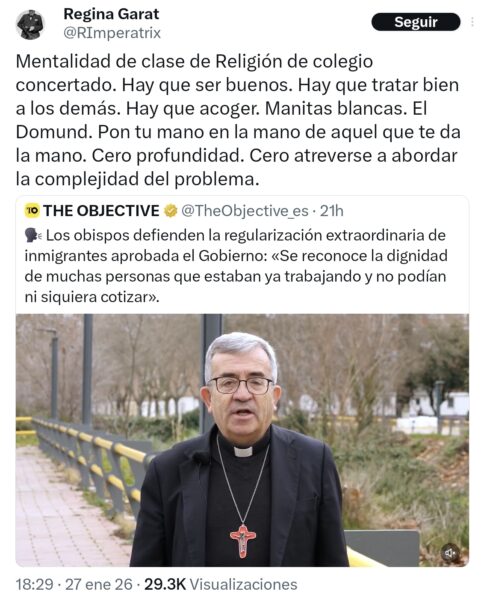
The speech of the president of the Spanish Episcopal Conference regarding the Government’s decree on the mass regularization of illegal immigrants is not only politically aligned; it is intellectually indigent. A rosary of commonplaces—welcoming, dignity, common good, democratic health—pronounced as if repeating nice words were enough to solve complex problems.
The scene is familiar. Concerted school Religion class mentality: we must be good, we must treat others well, we must shake hands, we must welcome. White hands. The Domund. “Put your hand in the hand of the one who gives you a hand.” Zero conflict. Zero tragedy. Zero reality.
But Catholic moral doctrine does not work that way. It is not built on sentimental slogans or emotional impulses. It demands prudence, discernment, a hierarchy of goods and, above all, acknowledging that not every good intention produces a good result. Denying that is not charity: it is irresponsibility.
The Church has always recognized the duty to welcome the needy. It has also taught, with the same clarity, the right and duty of nations to regulate migratory flows, protect the common good, and preserve social cohesion. Presenting a mass regularization as if it were a morally indisputable act is deliberately falsifying that tradition.
The serious thing is not that a bishop has a specific prudential opinion. The serious thing is that the president of the episcopate speaks like the spokesperson for ideologized NGOs, using exactly the same conceptual framework as a Government that legislates against natural law and Catholic faith without respite.
There is no analysis of consequences here. No reference to the pull effect. Not a single word about security, about pressure on public services, about degraded neighborhoods, about poor Spanish workers expelled from the labor market. All that disappears under a cloud of soft vocabulary.
And meanwhile, the faithful people watch in astonishment. Not because they are cruel or insensitive, but because they know that reality is not governed with breakfast mug phrases. The faithful do not ask for hard speeches: they ask for true speeches. They ask for shepherds who do not treat them like children to whom it is enough to say “be good” for everything to fit.
Mercy without truth is sentimentalism. And sentimentalism elevated to ecclesial policy ends up being cruel: with real poor people, with concrete societies, and with the faithful themselves, who are demanded obedience while their intelligence is denied.
No, moral theology cannot be done at the level of “my mommy pampers me.” And when it is attempted, the result is not gospel: it is propaganda with a clerical collar.