


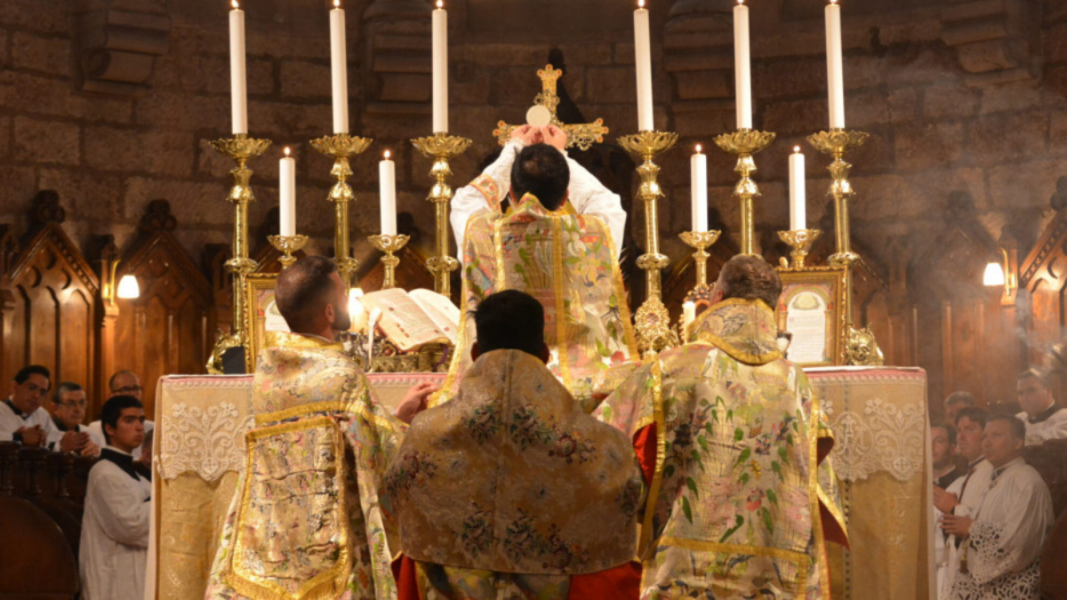
The recent document from the prefect of the Dicastery for Divine Worship, prepared for the last consistory of cardinals, has reignited the debate on the true state of the liturgical reform. Criticisms have not been long in coming, and not only from circles traditionally reluctant to the reform, but also from sectors that demand a faithful reading of what the Second Vatican Council itself established.
Read also: Roche’s document on the liturgy is revealed
Among those reactions, the analysis published by The Catholic Herald stands out, which focuses on a key statement from the prefect himself: the liturgical reform «has suffered and continues to suffer from a lack of formation.» A recognition that, although formulated almost in passing, is difficult to ignore, as it touches the central nerve of the problem.
The Council’s warning, forgotten for decades
The constitution Sacrosanctum Concilium was clear on this point: the full and active participation of the faithful in the liturgy—the oft-cited actuosa participatio—could not be achieved without solid liturgical formation, starting with the clergy. The conciliar fathers expressly warned that any hope of reform would be illusory if the proper foundations were not laid first.
However, more than sixty years later, the diagnosis is eloquent. Religious practice in much of the West has plummeted, and the data show that a majority of the baptized simply do not participate in the Sunday liturgy.
The reformed liturgy and the reality of empty pews
The reasons for the abandonment are multiple, but the fact is hard to avoid: the reformed liturgy, presented for decades as the instrument capable of revitalizing ecclesial life and attracting modern man, has not managed to reverse the loss of the faithful. The contrast between the expectations generated and the results obtained remains one of the most uncomfortable points in the debate.
In the face of this situation, the Dicastery now proposes a response that, for many, is insufficient: the organization of seminars and training programs.
Liturgical formation is not theoretical instruction
The underlying problem, as the analysis points out, is confusing liturgical formation with academic teaching. The liturgy is not learned like a subject nor internalized through lectures. The liturgy forms when it is lived, when it is celebrated with continuity, reverence, and coherence.
The Church’s tradition confirms this. For centuries, priests and faithful were formed liturgically not through courses, but through progressive immersion in the rites, gestures, silences, sacred language, and the proper rhythm of ecclesial prayer. That silent pedagogy was what shaped entire generations of Catholics.
Ratzinger and the living experience of the liturgy
It is no coincidence that Joseph Ratzinger described his own liturgical awakening as a vital and organic process, born from direct contact with the liturgy and not from external explanations. For him, the liturgy was not a product elaborated by experts, but a living reality, received, developed over the centuries, and charged with faith, history, and mystery.
From this perspective, the current insistence on technical solutions—seminars, plans, documents—seems to ignore a fundamental evidence: the liturgy forms when it is celebrated well.
The ars celebrandi as the forgotten key
The ars celebrandi is not an aesthetic luxury nor a rubricist obsession. It is the necessary condition for the liturgy to truly be a source of spiritual life. When the celebration loses density, coherence, and sacrality, it ceases to form, even if explanations are multiplied.
At this point, documents from the pontificate of Benedict XVI such as Sacramentum Caritatis and Summorum Pontificum acquire special relevance, which emphasized that fidelity to the liturgical tradition is not a brake on renewal, but its firmest foundation.
The decisive factor: a formation that no longer exists
The analysis also recalls a frequently silenced fact: those who designed the liturgical reform had been formed for decades in the traditional rites. That prior formation allowed them to imagine simplifications without foreseeing that, deprived of that humus, new generations would lack the necessary elements to assimilate the spirit of the liturgy.
The result has been a progressive «thinness» in the liturgy that no longer forms or sustains the faith of many faithful.
More than seminars, celebrations that form
It is not a matter of going backward or idealizing the past, but of honestly recognizing that a reform without formation is structurally fragile. And that authentic formation is not decreed or improvised: it is cultivated through reverent celebrations, faithful to the living tradition of the Church and capable of introducing the faithful into the mystery being celebrated.
The proliferation of seminars may be reassuring at an institutional level, but it hardly addresses the underlying problem. The liturgy does not need to be constantly explained; it needs to be celebrated as what it is: the act of Christ and his Church.
An open question that demands honesty
The debate remains open, but one conclusion imposes itself with clarity: without a liturgy lived with depth, no reform—no matter how well-intentioned—will cease to be sterile. Only a liturgy that forms by itself can once again be, as the Council desired, the source and summit of Christian life.