


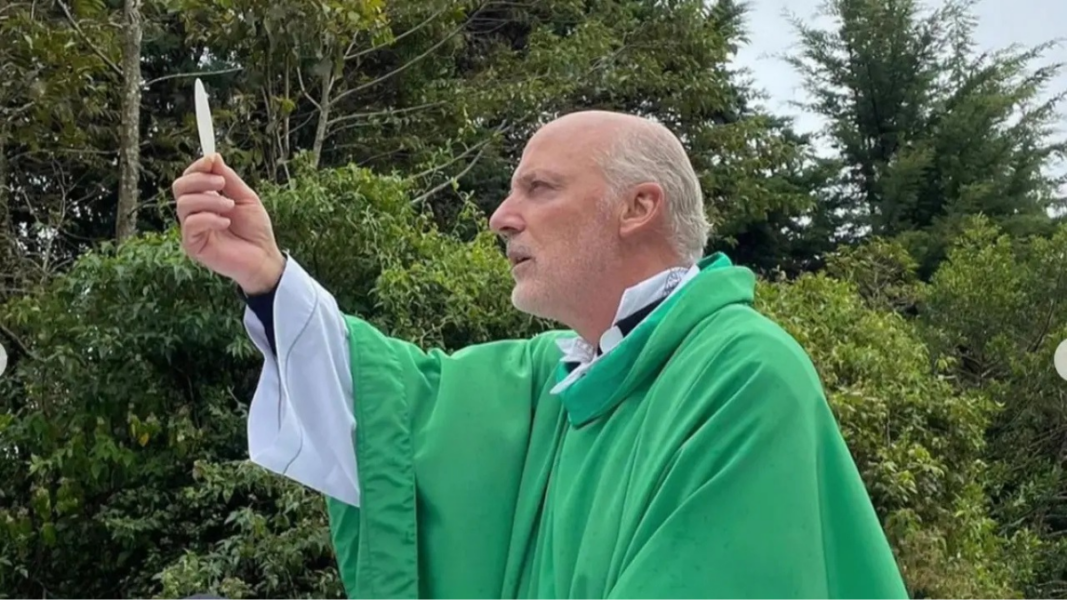
I receive via WhatsApp the latest message from José Pedro Manglano to his followers, whom he calls “suckers” in Hakuna slang, that internal dialect that mixes emotional camaraderie, camp spirituality, and an alarming lack of theological rigor.
Full text sent by José Pedro Manglano to his followers:
Look at Christ, sucker, in every Mass:
“Take and eat my body, take and drink my blood.” Take it, dispose of it, any of you. No need to show merits, there’s no requirement at all, nor will I demand anything from you. If it suits you, take me, use me, chew me, crush me. I would like you to know that I freely offer myself and put myself at your disposal because I want you to have “rights” over me, and I don’t want any rights over you. I live in obedient submission to whatever is good for each one of you.
Every Mass lately, when I raise his Body and Blood in the consecration, the need comes to me to tell him that I too want to offer myself, as he does, to all people. I hope I live like this. I hope we live like this: in love with Jesus Christ, sucker, offered and without rights, in this madness of the last place, in this madness of renouncing any right or recognition. How beautiful this poverty is that reserves nothing!
Let’s ask him every day: Am I letting you live in me the madness of the last place?
A hug from Río Negro, Colombia: a few days of touching God in the stories of some and others. I’ll tell you about it.
Go everyone, and enjoy
josepe
That’s the end of the quote. Now, the problem. Or rather: the problems.
The text wants to be mystical and ends up being childish; it pretends to be bold and turns out confusing; it aspires to sound profound and ends up seeming like discarded lyrics from a Hakuna song with pretensions of a spiritual treatise. It’s not just a matter of style—which is poor enough—but of substance: the way the Eucharist is spoken of here is not simply clumsy, it is theologically disfigured.
Christ is not “sucker.” Christ is not a disposable mass, nor a sentimental object that allows itself to be “used,” “chewed,” or “crushed” according to the emotional state of the faithful. That language, presented as evangelical radicality, shamelessly introduces a complete inversion of the sacramental order: the sovereign subject becomes man, and Christ is reduced to manipulable material for the religious experience of the moment. There is no adoration, no sacrifice, no altar. There is consumption, psychological appropriation, self-complacent emotivity. And it’s worth remembering, since it’s claimed that “there’s no requirement at all,” that the Church has always taught that to receive Communion one must be in a state of grace: not out of scruple or spiritual elitism, but because the Eucharist is not an automatic right or an expressive gesture. St. Paul states it clearly: whoever eats and drinks unworthily eats and drinks his own condemnation. If there was no requirement at all, it would have been good if they had warned us.
The key phrase—and the most serious—is this: Christ “doesn’t want any rights over you.” Here we are no longer faced with a simple unfortunate metaphor, but with a seriously damaged Christology. Christ does have rights over man, because he is his Lord. To deny it is not humility or evangelical poverty: it is to erase the Kyrios of the Gospel and replace him with a domesticated, soft figure without authority or lordship, whose function is to confirm the believer in his own desire. That is not Christianity: it is emotional self-help dressed in liturgical language.
The obsessive insistence on “without rights,” on “renouncing any recognition,” on “total availability,” does not remotely refer to St. Paul, nor to the Church Fathers, nor to the Catholic ascetic tradition. It refers, rather, to a horizontalized, sentimental, and therapeutic spirituality, where the redemptive sacrifice disappears and the Eucharist is reduced to a symbolic gesture that inspires nice attitudes and catchy songs.
And the priestly slip is even more concerning. When Manglano states that, upon elevating the Body and Blood, he feels the need to say “I too want to offer myself, as he does,” the confusion is already frontal. The priest does not offer himself as Christ. He does not consecrate himself. He does not become sacramental matter or redemptive prolongation. His mission is not to duplicate the sacrifice, but to act in persona Christi. To confuse this is not a minor nuance: it is to blur the ministerial priesthood and replace it with an emotivist spirituality of “me too.”
The entire text exudes a poorly digested theology of the “last place,” turned into an emotional slogan, repeated like a chorus and emptied of all doctrinal density. The result is a Christ without majesty, without judgment, without lordship, reduced to a “sucker” icon that legitimizes any subjective appropriation of the Mystery.
We are not faced with formal heresy. We are faced with something more dangerous and much more widespread: a language that borders on blasphemy, not because it explicitly denies dogmas, but because it dilutes them, infantilizes them, and makes them unrecognizable. And that, in the Church, usually does more damage than open heresy.