


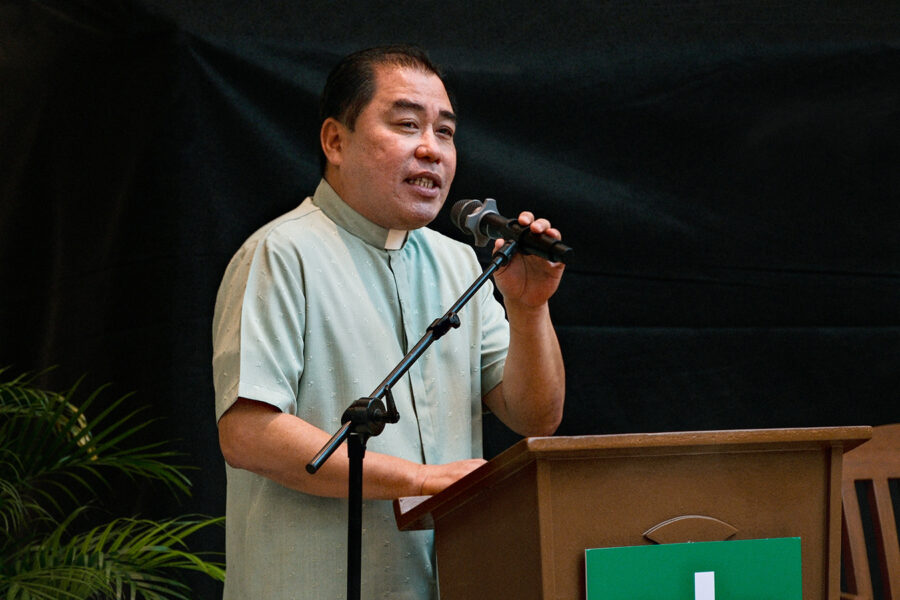
The appointment of Cyril Villareal as bishop of Kalibo, Philippines, decreed by Pope Leo XIV, raises serious doctrinal and pastoral concerns in light of the texts that the appointee himself left in writing in his academic thesis. This is not about an isolated phrase or an ambiguous formulation: Villareal directly questions the content of Catholic teaching on contraception, presents as “difficult to accept” a core point of Catholic marital morality, and expressly suggests that the Church should “update” this doctrine. A bishop, called to safeguard the faith and to teach with authority in communion with the magisterium, cannot afford this approach without causing grave confusion among the faithful.
It is worth emphasizing the context in which these statements were made. We are not dealing with improvised comments or youthful writings. The texts come from a thesis presented in 2011 at the University of Vienna for the degree of master in theology, when Villareal was already a priest with a consolidated career. The work deliberately compiles two moments: the re-edition of his 2000 licentiate thesis and a second block added more than a decade later, titled “Current Visions on Marriage and Sexuality.” In other words, not only did he not correct his initial approaches, but he developed and radicalized them over time.
The gravity of the matter is not merely “disciplinary” or a matter of “theological style.” Catholic doctrine has consistently reiterated that contraception is morally inadmissible and contrary to the Church’s magisterium. Presenting it as an “illogical” demand, or insinuating that the Church “imposes” on the laity a continence equivalent to that of the clergy, is not a legitimate academic discussion: it is a direct challenge to a binding teaching, which shifts the responsibility from the resisting conscience to the teaching Church.
In his thesis, Villareal does not limit himself to expressing a personal difficulty. He goes so far as to attribute part of the “blame” to the Church for the practical incoherence of the faithful, as if the solution lay in lowering moral truth to avoid conflicts of conscience. This approach inverts the Catholic order of Christian life: it is not the doctrine that adapts to human weakness, but life that must convert, with grace, to the truth taught. When the one who is to be bishop adopts an interpretive framework in which the magisterium appears as an abstract and compulsive burden, the result is predictable: doctrinal relativization, division, and scandal.
So that the reader can accurately assess the real scope of what was written, we reproduce below, in full and translated into Spanish, the most significant passages from Villareal’s thesis.
“I do not wish to go against this Church. I only wish that it come to formulate a reasonable teaching for its people. Cannot the Church update its teaching on sexual morality in light of the enormous changes that have affected our society?”
“On the one hand, there is the Church’s magisterium imposing its teaching on sexuality, which invokes the power of natural law as proceeding from divine law and, therefore, divinely approved, according to which all and every marital act must be open to procreation. I have no problem with the teaching that the sexual act must always be performed within marriage, for the stable institution of marriage can truly safeguard the dignity of sexuality, of human persons, and of the children resulting from the sexual act. What is difficult to accept is that every marital act must be open to procreation, a way of saying that procreation is given primacy, despite the Church’s justifications that such a hierarchy of the ends of marriage was already modified in the document of the Second Vatican Council, Gaudium et Spes”
“In the process of maintaining these teachings, the Church is also putting the relationships of marriages at risk. In marriage, the sexual act is very important as a means to deepen the couple’s relationship. And they often perform said act with the intention of avoiding pregnancy for various valid reasons, such as financial, social, or even medical limitations. The sexual act is a means to express their mutual love. Of course, the Church will say that, if that is the case, they should perform the act when the woman is infertile. But this seems something abstract and even illogical, to delay the moment when the couple expresses their love and also their needs”
“Why should the Church impose on marriages the same continence that it has imposed on the clergy? Is this not a way of clericalizing marriages, forcing them to live like ordained ministers, when in reality they are not and have a totally different way of life?”
“If this is the scenario, who is to blame? The Church, as teacher, has its share of blame. In a certain way, it can be said that the Church develops and tolerates this dichotomy”
That these statements belong to an academic work does not mitigate their gravity; on the contrary, it aggravates it. They reveal an elaborated, sustained, and consciously defended approach that collides head-on with the Church’s magisterium on marital morality. The episcopate is not a doctrinal laboratory nor a space to suggest that the Church must make “more reasonable” what it has always taught about openness to life.
If the one who has been appointed bishop does not publicly and clearly rectify these theses, the appointment runs the risk of becoming a permanent focus of confusion precisely in an area—the family, marriage, and the transmission of life—in which the Church is called to offer clarity, fidelity, and truth, not accommodations to the spirit of the times.
The question that arises is, therefore, inevitable: how can the mission of teaching and sanctifying be sustained when the bishop himself has presented as “difficult to accept” a constant moral teaching and has asked the Church to “update” what it has always affirmed. Charity toward the faithful demands saying it clearly: in a pastor, this type of positioning is not a mere “sensitivity,” but a serious problem of fidelity to the deposit of faith and to the magisterium that he is obliged to safeguard.