


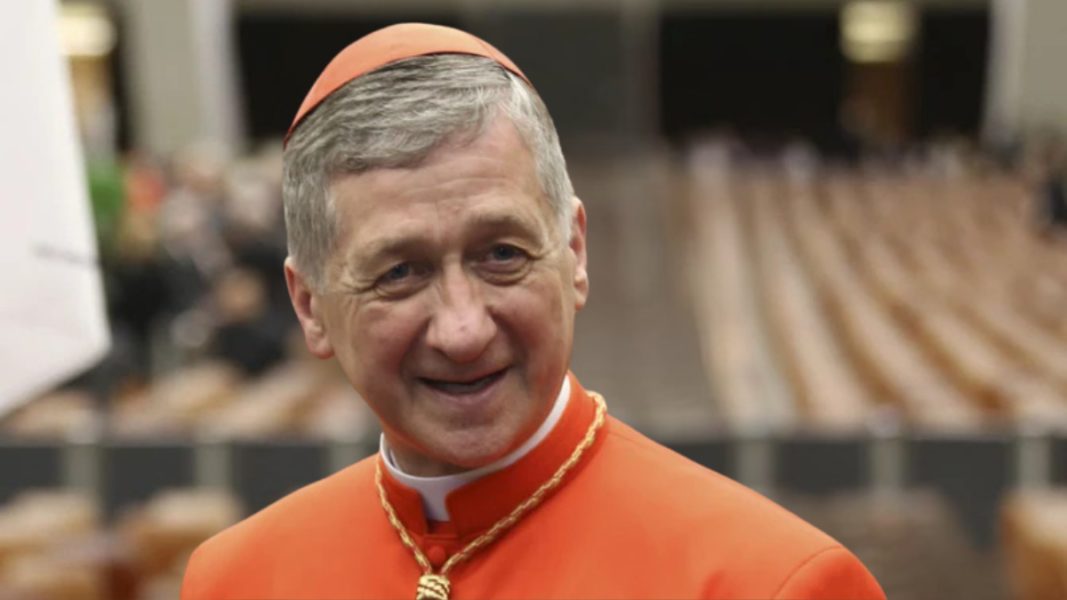
Cardinal Blase J. Cupich, Archbishop of Chicago, has intervened in the liturgical debate with a reflection published in Chicago Catholic following his participation in the consistory convened by Pope Leo XIV.
Under pastoral language, the cardinal proposes a reading of the tradition and liturgical reform that, far from appeasing tensions, once again places the liturgy at the center of an unresolved ideological dispute in the Church.
Cupich starts from the premise that the liturgy is not a static reality, but a living reality that has undergone reforms throughout history. However, the way he develops this assertion reveals a conception of tradition that can be considered reductive. Tradition is presented almost exclusively as a process of cultural adaptation, minimizing its normative, received, and binding dimension.
Tradition as a “living river”: an ambiguous image
The cardinal resorts to an expression common in post-conciliar discourse—the tradition as a “living river”—to justify the permanent need for liturgical reform. The problem is not with the image itself, but with the use made of it. In his approach, tradition seems to become an elastic concept, defined more by the present than by the received heritage.
This reading omits a fundamental fact: historical liturgical reforms, including those of Trent and Vatican II, were always understood as organic developments that respected the substantial continuity of the rite, not as abrupt substitutions or breaks with the preceding form. With the generic appeal to the “history of reform,” Cupich seeks to justify any change, even those that impoverish the liturgical experience and break the living transmission of the faith.
Vatican II as an endpoint, not a starting point
One of the axes of his article is the assertion that the liturgical reform following the Second Vatican Council constitutes the unique expression of the lex orandi of the Roman Rite, an idea closely aligned with the logic of Traditionis Custodes. Cupich defends that the unity of the Church requires a single rite and that the coexistence of different liturgical forms endangers that unity.
However, this thesis ignores an evident reality: for centuries, the Church coexisted with multiple uses and rites without this compromising ecclesial communion. Moreover, it was Pope Benedict XVI who explicitly stated that the traditional liturgical form had never been juridically abolished and that its existence could enrich the Church as a whole.
Reducing unity to liturgical uniformity implies a impoverished reading of catholicity, which historically has known how to integrate ritual diversity under the same faith.
The liturgy as a disciplinary instrument
Another striking aspect of the text is the emphasis on the liturgy as a factor of unity understood almost exclusively in disciplinary terms. The liturgy thus appears not so much as an expression of the received mystery, but as a tool to order and control ecclesial life.
This approach leaves in the background a key issue: the profound liturgical and spiritual uprooting experienced by broad sectors of the faithful people for decades. The crisis of participation, the banalization of worship, and the loss of the sense of the sacred are not explained by an excess of ritual diversity, but by a deficient application and, in many cases, ideologized implementation of the reform.
Silence on the real fruits of the reform
It is striking that Cupich’s article does not mention at any point the concrete fruits of the liturgical reform as it has been applied. There is no reference to the declining religious practice, nor to the generational rupture, nor to the growing attraction that traditional liturgy exerts on young people and families.
An honest reflection on the liturgy cannot be limited to abstract principles; it must confront pastoral reality. Ignoring the data amounts to evading the core debate.
Unity without truth is not unity
The unity of the Church is not built by suppressing legitimate expressions of tradition, but by rooting the faithful in the received faith. When the liturgy ceases to be a place of clear transmission of the deposit of faith, it becomes a space of permanent conflict.
Cardinal Cupich’s text ultimately reflects a conception of liturgical reform as a closed and non-revisable process, where any questioning is perceived as a threat. But precisely that attitude is what keeps alive the liturgical fracture that is intended to overcome.
True unity is not imposed; it is cultivated. And it can only do so through a liturgy that, more than adapting to the world, leads the faithful toward God.
We leave the full letter below:
This month I want to offer some reflections following my participation in the consistory to which Pope Leo asked all cardinals to attend in Rome.
As reported, the Holy Father proposed four themes for debate in the consistory. These were the Church’s evangelizing mission, with special attention to Pope Francis’s apostolic letter Evangelii Gaudium; the reform of the service of the Holy See and the Roman Curia, which Pope Francis outlined in Praedicate Evangelium; synodality and the liturgy.
Pope Leo asked four Curia cardinals to prepare working documents that could help focus our discussions on these themes. Once in Rome, Pope Leo asked us to choose two of the four, which were finally the Church’s evangelizing mission and synodality.
Although the themes of the liturgy and the reform of the Curia were not selected, all the cardinals received the working documents prepared on these matters by Cardinals Arthur Roche and Víctor Manuel Fernández, respectively.
Given the importance of the role of the liturgy in the life of the Church, I want to share with you some of the points that Cardinal Roche, prefect of the Dicastery for Divine Worship and the Discipline of the Sacraments, presented in the working document he prepared.
He reminded us that, from the earliest days of the Church, the liturgy has always undergone reforms. As he noted: “The history of the Liturgy, we might say, is the history of its continuous ‘reforming’ in a process of organic development.”
Why is permanent reform so central to the liturgy? Because the ritual component of the liturgy is characterized by cultural elements that change over time and according to places. Thus, with the passage of time and changes in culture, there is always a need to reform the liturgy.
However, as Pope Benedict wrote, reforms such as those carried out at the Council of Trent and at the Second Vatican Council do not threaten fidelity to the Church’s tradition, since tradition is not a matter of “the transmission of things or words, a collection of dead things,” but “the living river that links us to the origins, the living river in which the origins are always present” (General Audience, April 26, 2006).
Consequently, Cardinal Roche notes, “we can affirm with certainty that the reform of the Liturgy, desired by the Second Vatican Council, is not only in full harmony with the true meaning of Tradition, but constitutes a singular way of placing oneself at the service of Tradition, because the latter is like a great river that leads us to the gates of eternity.”
Another observation that I found particularly convincing was Cardinal Roche’s reference to the motivation of St. Pius V to reform the liturgical books in accordance with the mandate of the Council of Trent. His desire was to preserve the unity of the Church. In promulgating the Roman Missal of 1570, the holy pontiff stated that “just as in the Church of God there is one way of reciting the psalms, so too there must be a single rite for celebrating Mass.”
This principle of ecclesial unity is particularly significant for understanding the reasons why Pope Francis promulgated Traditionis Custodes. He stated that he wanted to make it clear that the reform of the liturgy requested by the Second Vatican Council is the unique expression of the lex orandi of the Roman Rite. Again, in continuity with his predecessor St. Pius V, there must be a single rite as a means to preserve the unity of the Church.
Pope Francis addressed this issue again in Desiderio Desideravi, where he analyzed the refusal to accept the liturgical reforms of the Second Vatican Council as a threat to the unity of the Church. “If the liturgy,” he wrote, “is ‘the summit toward which the action of the Church tends and, at the same time, the source from which all its strength flows’ (Sacrosanctum Concilium, n. 10), then we can understand what is at stake in the liturgical question. It would be trivial to interpret the tensions, unfortunately present around the celebration, as a simple divergence between different tastes regarding a particular ritual form. The issue is primarily ecclesiological. I do not see how it is possible to say that one recognizes the validity of the Council—though it astonishes me that a Catholic could presume not to do so—and, at the same time, not accept the liturgical reform born of Sacrosanctum Concilium, a document that expresses the reality of the Liturgy intimately united to the vision of the Church so admirably described in Lumen gentium.”
The two main conclusions from reading Cardinal Roche’s observations are, first, that the very nature of the liturgy demands continuous reform and, second, that accepting the reform authorized by the Church is a matter of preserving the unity of the Church, as St. Pius V affirmed, a truth recalled by the late Pope Francis.
The cardinals accomplished much in the short time we were together, largely thanks to the preparatory work done by some of our brother cardinals who serve in the Roman Curia. I plan to share information about some of the other working documents in future columns.