


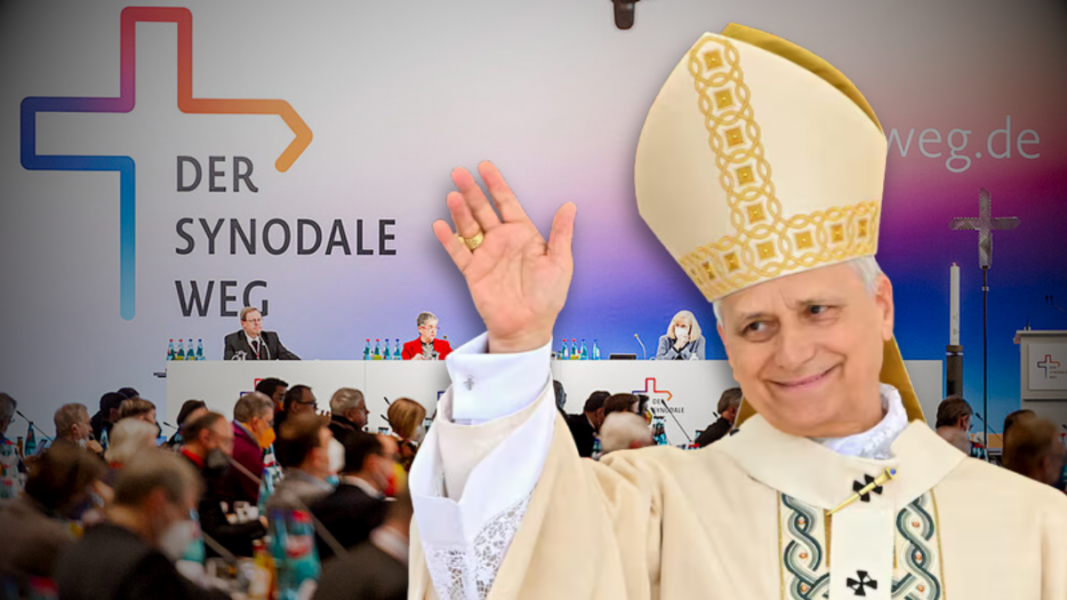
ABC headlines that “the German synod will force the first unpopular decision from Leo XIV”. And just with that, it already portrays itself. Not for what it reports, but for what it takes for granted. It’s very revealing: for a good part of the mainstream media-ecclesial establishment, stopping a doctrinal and ecclesiological nonsense would be “unpopular”. That is, going against the so-called German Synodal Way, that hybrid artifact of bishops and laity with quasi-parliamentary pretensions, would be a decision against the sentiment of the “people”. There’s the basic error.
What ABC presents as a risky dilemma for the Pope—approving or rejecting an organism that openly divides the Church in Germany—in reality has nothing unpopular about it outside that self-referential bubble. On the contrary: it’s exactly what the faithful people have been waiting for years. Not the apparatuses, not the hypertrophied episcopal conferences, not the synodal committees with inclusive language and liquid theology. The real people. The ones who go to Mass. The ones who believe what the Church has always believed. The ones who are fed up with being taken for fools while being sold as “progress” what is nothing more than rupture.
But these analyses stem from an interested confusion: they identify the people with four media dinosaurs, always the same ones, who have spent decades occupying sets, columns, and offices, convinced that they are the Church. They are irrelevant, but they make noise. They get angry, they indignantly threaten schisms that only exist in their imagination and abandonments that no one would lament. They are like that over-the-top lady who keeps wandering the street when dawn has already broken, refusing to accept that the party ended hours ago and that no one is watching her.
Reality is different. The vast majority of the faithful do not want German experiments, nor heresies disguised as synodality, nor parallel structures to the sacramental order of the Church. They want a Pope who acts like a Pope. Who confirms in the faith. Who says no when it’s time to say no. Who reminds that the Church is not a deliberative NGO nor a federation of national churches with their own agenda. That is not unpopular: it is literally the minimum required.
Calling “unpopular decision” to putting a brake on a schismatic drift says much more about the one who writes it than about the Church. It reveals to what extent some live enclosed in a fictional mainstream, where they believe that the four emaciated dinosaurs who still resist dying represent the people of God. They do not represent them. They never have. And less and less so.
If Leo XIV decides to stand up to the German synodal monster, he will not be challenging the faithful people. He will be, finally, listening to them. And that, although it costs some to accept it, is not unpopular. It is water in May.