


By Robert Royal
The late American Catholic novelist Walker Percy once observed that the contemporary vision of the human being is that of a brain connected to a pair of «genitals» (the exact term he used is a bit too risqué for this site). It seems there’s nothing in between for us. C. S. Lewis, another great Christian writer, called us «men without chests.» Other things that once made us human—wisdom, courage, self-discipline, sacrifice, loyalty, and above all love (its entire spectrum, not just sex)—barely have a name among us anymore.
Last week, for example, we witnessed two comic dramas in the capital of the world’s only superpower. Naturally, they involved sex. Lawyers argued before our Supreme Court that «trans» girls (i.e., boys) have the «right» to play in women’s sports. When asked how to define «boy» or «girl,» the expensive legal spokespeople suddenly fell silent. In some circles now, it’s taken as evidence (i.e., no explanation needed) that «gender» means something different from «sex assigned at birth,» a ridiculous expression suggesting that some nefarious power is trying to preempt a baby’s right to choose its sexual identity.
Similarly, in a congressional hearing last week, Senator Josh Hawley asked Dr. Nisha Verma, an obstetrician and gynecologist, if men can get pregnant. She too immediately lost her composure. If she said yes, she knew full well she’d be affirming something that anyone not brain-damaged by gender ideology knows is false. If she said no, she risked her career, no less from her colleagues subjected to the woke in the medical profession. So she dodged the answer, suggesting that asking the question was «divisive.»
Walker Percy, who was a doctor and possessed a mordant Southern sense of humor, satirized what he foresaw as the imminent collapse of medicine, law, and the whole culture. That’s why he once explained that he converted to Catholicism because «what else is left?».
The Church is the living incarnation of a tradition that includes both the great ancient philosophical legacy and the metaphysical vision of the Old and New Testaments. It is the only institution in the Western world that still retains enough substance and pure vitality—despite spectacular failures—to counter the emptiness and meaninglessness surrounding us.
Provided our leaders rise to the challenge. Which is urgent. It is not the Church’s task to «make the world a better place.» That’s best left to former student council presidents and graduation speakers. Its mission is much greater: to lead us to Heaven. However, there are many necessary things in the meantime to set us on the right path.
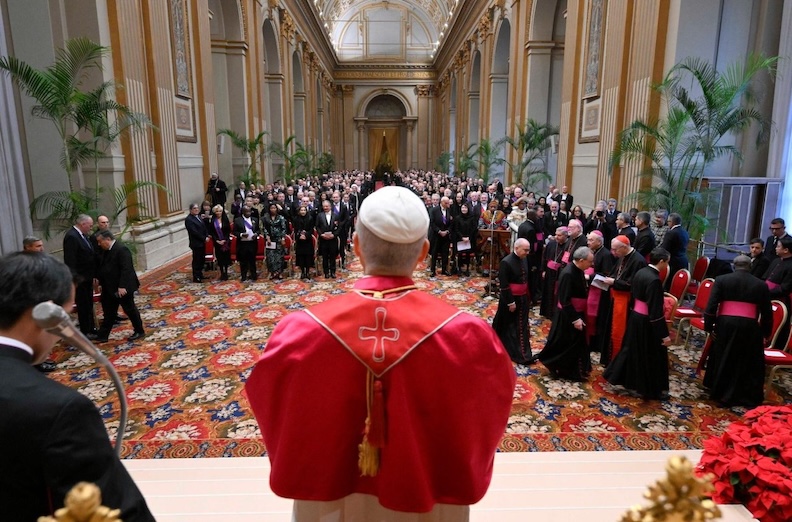
Pope Leo, in a recent speech to the Vatican diplomatic corps, struck a new and very necessary note that, unlike many papal speeches, directly addresses our current situation:
It is painful to see how, especially in the West, the space for authentic freedom of expression is rapidly shrinking. At the same time, a new Orwellian-style language is developing that, in its attempt to be ever more inclusive, ends up excluding those who do not conform to the ideologies that feed it.
The excluded are, often and notably, Christians and other sane people.
But the Pope went even further, explicitly criticizing abortion and even surrogacy: «By transforming gestation into a negotiable service, the dignity of both the child, reduced to a ‘product,’ and the mother, exploiting her body and the generative process, and distorting the original relational vocation of the family, is violated.»
Our American bishops have done the same, along with the trans assault on the very notion of truth and falsehood. In November, the U.S. bishops overwhelmingly voted to ban so-called «gender-affirming treatments» in Catholic hospitals. And good for them. Because much of the world is paralyzed by the false claim that not «affirming» the current social madness will lead to numerous suicides.
But we need follow-up. We have a pro-life movement, various ministries for people with same-sex attraction. Where is the same sense of urgency to protect thousands of confused young people from taking puberty blockers and undergoing surgeries—with or without parental consent—that not only lie about the nature of reality but condemn our youth to deeply shattered lives, sexually and otherwise?
In contrast, at the Extraordinary Consistory of Cardinals, also during these turbulent weeks, Cardinal Víctor Emmanuel («Tucho») Fernández, prefect of the Vatican’s doctrinal dicastery, while claiming to echo Pope Leo, warned: «We often end up talking about the same doctrinal, moral, bioethical, and political issues,» adding that these carry serious risks: that the Gospel message «will not resonate» or that «only certain topics are presented outside the broader context of the Church’s spiritual and social teaching.»
Pope Francis also used to say that Catholics should stop «obsessing» and «insisting» solely on hot-button moral issues like abortion and homosexuality.
But does anyone really do that, and is that the greatest danger?
Pro-life and pro-family leaders around the world, precisely from that broader Christian vision, have sacrificed—sometimes even their own livelihoods—to stop the slaughters induced by the sexual revolution. Sixty million children are killed annually worldwide in the womb through abortion. It’s as if the entire populations of California and the state of New York were massacred, year after year. Or the populations of the United Kingdom, France, Italy. Is it narrow obsession to warn of death on that scale?
Our most recent Doctor of the Church, St. John Henry Newman, advocated «holiness before peace.» It’s hard not to think that many people prefer to look away from current horrors because they would disturb the peace. But we need to focus efforts, however difficult, on the points where attacks on humanity are most intense. Doing otherwise would be like confining Christian defenders to parade grounds while the Turks assaulted Vienna.
Pope Leo has sounded some new notes in the Church’s public witness. Let us hope he takes them seriously, pursues them vigorously, and gets the rest of the Vatican to follow.
About the author
Robert Royal is editor-in-chief of The Catholic Thing and president of the Faith & Reason Institute in Washington, D. C. His most recent books are The Martyrs of the New Millennium: The Global Persecution of Christians in the Twenty-First Century, Columbus and the Crisis of the West y A Deeper Vision: The Catholic Intellectual Tradition in the Twentieth Century.