


By Dominic V. Cassella
With Christmas now behind us and as we enter the «Ordinary Time», we have the opportunity to contemplate the full and extraordinary mystery of God’s descent into human life and our ascent to the divine. The Church Fathers called this descent synkatabasis: literally, «walking down with», a condescension to the level of those below. One of the clearest representations of this divine condescension is found in the nighttime conversation between Jesus and Nicodemus.
In the Gospel of John, Nicodemus comes to Jesus in the darkness of the night. Jesus tells him that he must «be born again» if he wishes to enter the Kingdom of God. To which Nicodemus asks how a man can be born again: «Can he enter the womb of his mother a second time and be born?». Jesus explains: «No one has ascended into heaven except the one who descended from heaven, the Son of Man». And that this ascent is prefigured in death on the Cross. (John 3:1-15)
In this brief exchange, Baptism and the Cross are juxtaposed. Both illustrate the ascent to Heaven and the assumption of eternal life. The language of ascent and descent that Jesus uses here has two extremes: birth and death on the Cross. In these few lines, the complete mystery of our own life in Christ is revealed, for life in Christ is a reflection of the life of Christ.
The 13th-century theologian Nicholas Cabasilas taught that Christ’s ascent and descent—which begin with the mystery of his conception and Nativity, continue throughout his life and ministry, and culminate in his death and resurrection—are the same ladder by which we are called to become «other Christs».
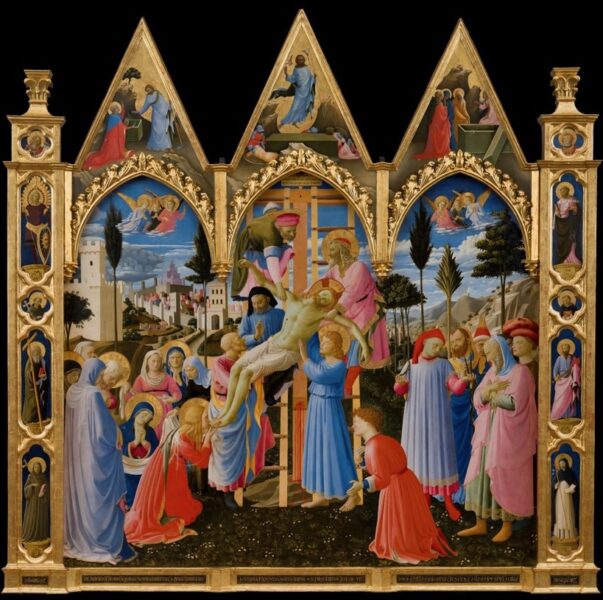
Cabasilas describes this ladder as formed by three rungs. If Jesus Christ is the eternal Word, his descent from Heaven begins with the Incarnation, and this is the top rung of the ladder. His life and ministry are the middle rung, and his death and resurrection constitute the bottom rung. The three-rung ladder can be paired with the classic Byzantine cross, which in turn has three bars: one for Jesus’ feet, another for his hands, and the third that bears the inscription «Jesus of Nazareth, King of the Jews».
The ladder of ascent to Heaven is the Cross that each of us is called to take up. (Matthew 10:38; Mark 8:34; Luke 9:23) Consequently, if the bottom rung in the life of Christ—the lowest bar of the Cross—is his death and resurrection, this is the first step in our path of ascension to Heaven.
This «death and resurrection», the first rung for living a life in Christ, is Baptism and the new birth that Jesus wanted to teach Nicodemus that night. Thus, St. Paul can say: «Do you not know that all of us who have been baptized into Christ Jesus were baptized into his death?» (Romans 6:3). At the foot of the Cross, on the first bar, we can «rise again», as implied by the Greek word for resurrection (ana-stasis).
Having been reborn in Christ, we must now assume the «mind of Christ». This, of course, is achieved through the gifts of the Spirit. (1 Corinthians 2:12-16) Through the sacrament of Confirmation, the Church teaches, we are strengthened, made mature, and equipped to live a true life. This is the second rung of the ascent to Heaven, through which «the Spirit of truth» comes and guides us «to all truth». (John 16:13) Through him we live a life of evangelization, spreading the Good News and being witnesses. We live our life in Christ and become witnesses to the life of Christ. Where Christ’s hands are nailed to the Cross, we ascend to the task of doing the work of his hands.
The top rung in the ascent (the first in the descent of the Only Begotten Son) is the Word becoming flesh, the mystery of the Incarnation, where Christ, eternal King, is born and becomes man. In the order of our life in Christ, this is our participation in the Body and Blood of Christ. It is our reception and adoration of the Eucharist. Here, on the upper bar of the Cross, we are united to the head: as St. Paul says, it was God’s will «to bring all things into one head in Christ». (Ephesians 1:10)
The story of Jesus’ Nativity points us to this eucharistic culmination. In traditional iconography, the Child Jesus is depicted in a manger between an ox and a donkey: symbols of the Jews and the Gentiles, respectively. Jesus has made himself food and sustenance for all, and our participation in the Eucharist is participation in him, in whom «the whole fullness of deity dwells bodily». (Colossians 2:9)
The life of Christ is a gift given through his sacraments, which enable every Catholic to live a life in Christ, to be other Christs. In Jesus Christ, «we live and move and have our being» (Acts 17:28); we are brought to life by his Cross in Baptism, moved by his will through Confirmation, and receive our being in divine splendor by participating in the Eucharist. By doing what the Son does, by living a life in Christ, we show that Christ is fully alive in us: by their fruit you will know the vine.
We are now reminded that the Son’s descent inaugurates the ascent of the children of God. Through the sacraments, his life becomes the very principle of ours. The Christian life is not a formula, but a participation in a life: the Life of Jesus Christ. The life of the crucified and risen Jesus Christ (1 Corinthians 1:23) is the mold into which every Christian is introduced. And only through that participation can we, as «other Christs», bear witness to the Truth. (John 18:37)
The Word became flesh, so that we may carry the Word in our flesh.
About the author
Dominic V. Cassella is a husband, father, and doctoral student at The Catholic University of America. Mr. Cassella is also an editorial and online assistant at The Catholic Thing.