


By Casey Chalk
One of the strangest things about my evangelical upbringing was the catechesis I received on creationism. Due to a certain hyperliteralist interpretation of the Book of Genesis, the evangelical churches my family attended periodically preached about the errors of Darwin, trying to provide the faithful with arguments about dinosaurs, carbon-14 dating, and various phenomena that evolutionary theory struggled to explain. All of us, enthusiastic evangelicals, supposedly trained to speak with authority on scientific matters.
Of course, few of us were actually capable of doing so. The idea that an evangelical who learned science in church could confront a hard sciences student or a professional scientist and tell them that, in fact, the Earth is 10,000 years old is ridiculous. In fact, just as Christians criticize religious skeptics for various philosophical presuppositions—like that miracles don’t happen—a anti-evolutionary stance derived from a peculiar reading of Genesis is equally unfounded.
The more I learned about the contentious history between religion and science, the more I realized that the battle was largely the result of a colossal confusion, often perpetuated by atheists and fundamentalists. Science deals with empirical data, with what can be observed and tested in the natural world; religion deals with metaphysical realities, some of which can be logically deduced and articulated, but cannot be subjected to empirical testing. Claiming that natural selection somehow refutes the existence of God is equivalent to claiming that, since human behavior is sometimes predictable, free will does not exist.
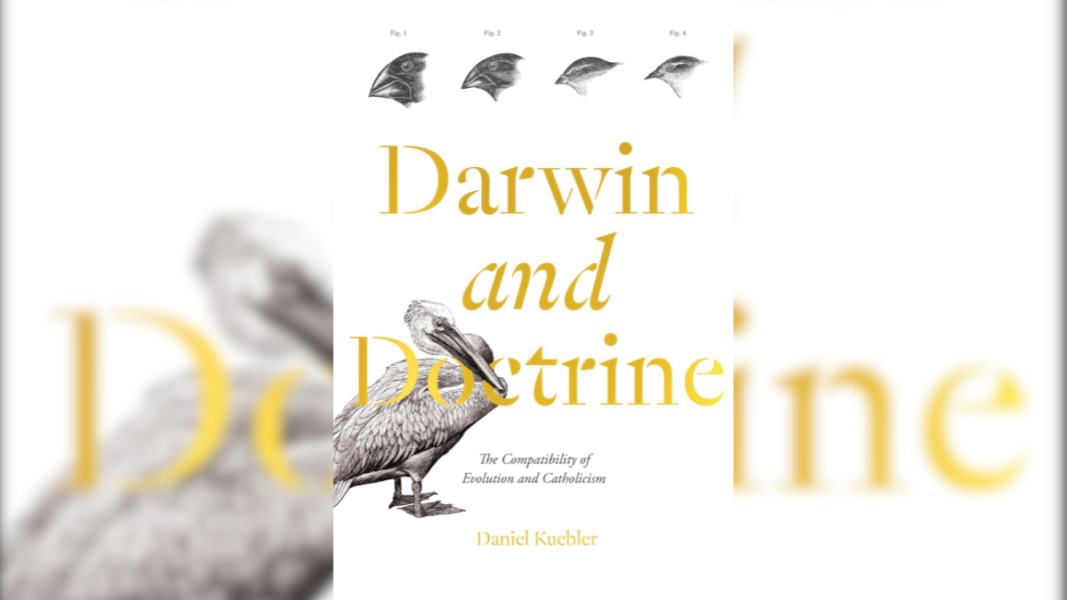
That’s why I felt grateful to discover that the Catholic Church understands the theory of evolution not as a malevolent straw man, but—as with any other aspect of modern thought—as something that must be considered in the light of philosophical truth and a correct understanding of divine revelation. Darwin and Doctrine: The Compatibility of Evolution and Catholicism, by biology professor Daniel Keubler, fits squarely into this balanced Catholic tradition, carefully analyzing the philosophical and metaphysical claims. He writes: «Over the years, I have gone from struggling to understand how evolution could fit with Catholicism to exploring how an evolutionary understanding can illuminate our understanding of how God relates to his creation.»
The Catholic Church does not actually have a position on the science of evolution, because its mission is to determine the truth related to divine revelation, not to judge the validity of various scientific theories. When the Church has spoken about science, it has focused its attention on what St. John Paul II called «theories [pseudoscientific] of evolution that, according to the philosophies that inspire them, consider the spirit as emerging from the forces of living matter or as a mere epiphenomenon of this matter.»
Therefore, Catholics are free to hold a wide range of positions regarding evolution, from rejecting it entirely as incompatible with Genesis, to accepting virtually the entire evolutionary theory except for that which denies the formal teaching of the Church, such as the claim that Creation can be explained solely by natural processes.
Keubler is convinced that the available data is sufficient to conclude that life on Earth has evolved over the past 3.8 billion years. However, he also believes that God has created a wonderful natural order, «a rare universe in which evolution through natural processes is, in fact, possible.» Catholics, he argues, do not have to choose between the Church and properly understood evolutionary science, particularly between the elements that have strong evidentiary support and those that remain subject to debate within the scientific community. Keubler succeeds admirably on both fronts.
First, he presents an account of how the Church has understood Creation and of the philosophical confusion responsible for the common misconception that science and religion are incompatible. He explains the prevalence of scientism, the belief that science is the only means to acquire true knowledge, and its fatal flaws. As the Catholic philosopher Ed Feser argues, «the claim that scientism is true is not itself a scientific claim, nor something that can be established by scientific methods.»
The Church’s concern regarding evolution, therefore, does not come from science itself, but from those who tie it to a materialist worldview that excludes the divine. John Paul II and Benedict XVI have offered Catholics a framework for understanding evolution and Creation as two complementary modes of considering reality. As the Catechism teaches, whatever our opinions on evolution, we must believe that God is the Creator of an ordered universe; that he made man as a being both physical and spiritual; and that Creation orients us toward God and reflects his power and wisdom.
Keubler then goes on to explain evolution in language that even those without scientific training will find accessible. He explains how the genetic code is probably the best evidence of universal common origin. He points out that the Aristotelian-Thomistic understanding of primary and secondary causality serves as a useful way to understand how random changes can occur in the natural world—which, by the way, is highly ordered in many respects—without abandoning belief in God as Creator.
In the Summa Theologiae, St. Thomas Aquinas—more than half a millennium before Darwin—considers the possibility that new species may arise over time. Keubler’s presentation of the origin of man, in which he correlates what we know about the evolution of hominid species with theories about how and when man acquired a soul and then fell into sin, is important for preserving the doctrine of original sin and is particularly fascinating.
A healthy intellectual humility must underlie these speculations, allowing us to suspend judgment on theories of human development—or any other aspect of evolution—as new evidence and theories emerge.
St. John Henry Newman, recently proclaimed Doctor of the Church, was a contemporary of Charles Darwin and wrote: «Mr. Darwin’s theory need not be atheistic, be it true or not; it may simply be suggesting a wider idea of divine foreknowledge and skill.»
Keubler’s excellent book, likewise, helps us understand how evolutionary science does not have to be antagonistic to religious faith, but can be a means to deepen our awe at God’s creative genius over millions of years.
About the Author
Casey Chalk is the author of The Obscurity of Scripture and The Persecuted. He contributes to Crisis Magazine, The American Conservative and New Oxford Review. He holds a bachelor’s degree in History and Education from the University of Virginia and a master’s in Theology from Christendom College.