


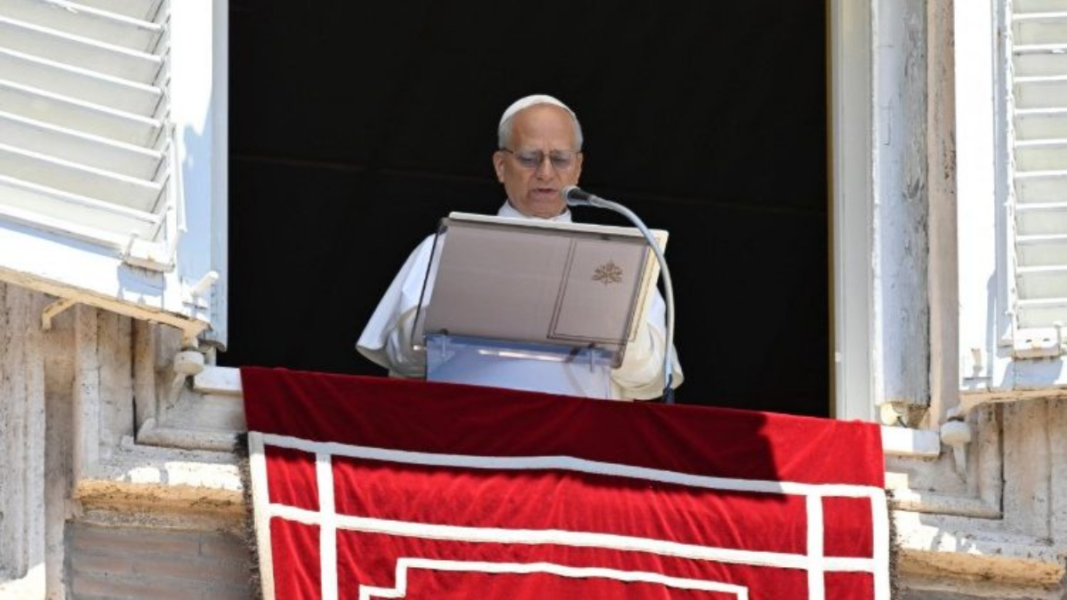
As he appeared this Sunday at the window of the Apostolic Palace to pray the Angelus with the faithful gathered in St. Peter’s Square, Leo XIV centered his message on the beginning of Jesus’ public preaching and applied it clearly to the life of the Church and of each Christian: not to wait for “the perfect moment” to announce the Gospel and not to shut oneself away, but to go out to all environments.
Commenting on the passage from St. Matthew about the call of the first disciples, the Pope emphasized that Jesus begins his mission precisely when John the Baptist has been arrested, in an adverse context, and recalled that today too there is the temptation to be paralyzed by resistances or by excessive prudence. Furthermore, he highlighted that Jesus chooses Galilee and Capernaum, a land of passage and “multicultural”, as a sign that God draws near to all and excludes no one; for this reason, he exhorted Christians to announce and live the Gospel in any circumstance to be leaven of fraternity and peace among peoples, cultures, and religions.
Here is the complete message of Leo XIV:
Brothers and sisters: Happy Sunday!
After receiving baptism, Jesus begins his preaching and calls the first disciples: Simon, called Peter, Andrew, James, and John (cf. Mt 4,12-22). By observing this scene from today’s Gospel closely, we can ask ourselves two questions: one about the moment when Jesus begins his mission and another about the place he chooses to preach and call the apostles. Let us ask ourselves: When does he begin?, where does he begin?
First of all, the evangelist tells us that Jesus began his preaching “when he heard that John had been arrested” (v. 12). Therefore, it happens at a moment that does not seem the most suitable: the Baptist has just been arrested and, therefore, the leaders of the people are little inclined to welcome the novelty of the Messiah. It is a moment that would suggest prudence, but precisely in this dark situation Jesus begins to bring the light of the good news: “the Kingdom of Heaven is at hand” (v. 17).
Also in our personal and ecclesial life, sometimes due to internal resistances or circumstances that we do not consider favorable, we think that it is not the right moment to announce the Gospel, to make a decision, to make a choice, to change a situation. However, the risk is to remain blocked in indecision or prisoners of excessive prudence, while the Gospel asks us to take the risk of trusting; God works at every moment and every moment is good for the Lord, even if we do not feel prepared or the situation does not seem the best.
The Gospel narrative also shows us the place from which Jesus begins his public mission: “And leaving Nazareth, he went and lived in Capernaum” (v. 13). He remains, in any case, in Galilee, a territory mainly inhabited by pagans, which due to trade is also a land of passage and encounters; we could say that it is a multicultural territory traversed by people of different origins and religious affiliations. In this way, the Gospel tells us that the Messiah comes from Israel, but crosses the borders of his land to announce the God who draws near to all, who excludes no one, who has not come only for the pure, but on the contrary, mixes in situations and human relationships. Therefore, we Christians too must overcome the temptation to close ourselves off. The Gospel, in fact, must be announced and lived in all circumstances and in all environments, so that it may be leaven of fraternity and peace among people, among cultures, religions, and peoples.
Brothers and sisters, like the first disciples, we are called to welcome the Lord’s call, with the joy of knowing that every moment and every place in our life are visited by Him and traversed by his love. Let us pray to the Virgin Mary that she may grant us this interior trust and accompany us on the way.