


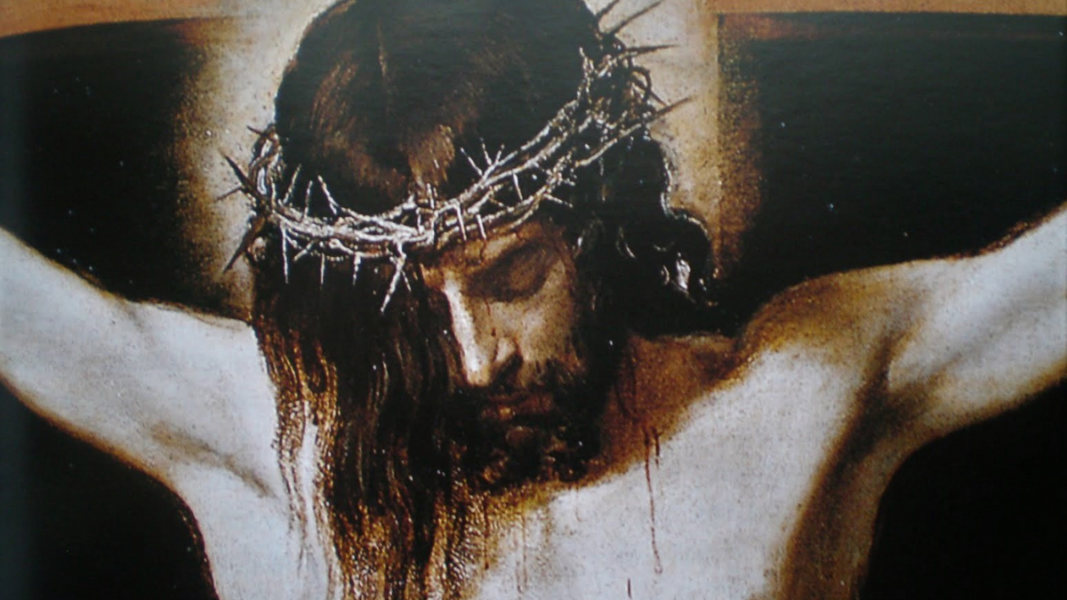
If we accept that redemption comes through Christ’s total surrender, there remains one decisive objection: why a cruel death, and precisely on a Roman cross? This last part addresses the link between the cross and human suffering: not only death, but also pain, humiliation, and loneliness are assumed so that no one can say that God has abandoned them.
IV
But a new objection still lingers, and there will be more because we can never fully comprehend the extent and intensity of that love of God. Let us admit that “to die for” is a sublime act of love, and that God was faithful to his promise through everything he did through the Son:
“It was written that the Messiah would suffer and rise from the dead on the third day, and that repentance and forgiveness of sins would be preached in his name to all nations” (Lk. 24:46-47).
Now, why through a cruel death, and specifically by means of a terrible Roman cross? An execution defined by Cicero as “crudelissimum taeterrimunque supplicium” “the most cruel and horrible punishment that exists”. Thus, a question arises. If Jesus had died peacefully and naturally, like so many other great men in history after a life of doing good, would the same salvific effects be produced for the human race as those brought to us by his agony and death on a cross?
Undoubtedly yes. But there would still be a loose end, that of human suffering caused by sin. If God incarnates to give his life for all, and only solidarizes with them in death, but leaves aside all the pains of humanity, Heaven would be opened for men, yes, but his commitment to humanity, wounded by sin, would not have been complete. That is why the Epistle to the Hebrews says that it was “fitting to perfect through sufferings the one who was going to open the way of salvation” (Heb. 2:10), so that “having been tested himself through what he suffered, he might be able to help those who are being tested” (Heb. 2:18).
It might then be thought that Christ chose the cross (the most ignominious instrument of death of his time) precisely for that reason, for being “the most cruel and horrible that exists”. An explanation that, in my judgment, is more dramatic and sentimental than real.
I think he did not choose it for that. Rather, he did so because that punishment represented for the Jew the figure of sin (“Cursed is the one who hangs on a tree” Dt. 21:23), and for the Roman the drain of the most infamous part of society (gallows for slaves, bandits, and rebels). In Jesus’ cross, therefore, the demons of the two worlds converge: from the Hebrew world, sin, and from the pagan universe, evil. Redemption thus embraces—with the open arms of the crucified—all the hell of fallen man, whether Jew or pagan. Christ did not want to assume only death, but also physical pain and—above all—moral pain: to suffer in his flesh the state of fallen man despite being He the incarnate Holiness. That is, to embrace all and every one of the direct or indirect effects of human sin, without any aspect left out. God’s commitment to man encompasses everything; the hell that a man can suffer, He endured. He gave us everything, and was struck by all. Literally “he was pierced for our transgressions”.
The cross, as the perfect icon of pain, humiliation, loneliness, and death, has ultimately been God’s response, called “Emmanuel, which means God with us” (Mt. 1:23), to the problem of man and his freedom, whose most harmful consequence is our world with a structure of sin that separates us from God. We already know that God is “with us”, but above all—while we suffer pain and injustice—he is hanged on the cross. The cross wanted, in this way, to serve as a reference for every suffering person, immersed in the greatest physical and moral anguish, tempted to think that they have been forgotten by God and that they cannot fall any lower. Hence the psalmist’s complaint: “My God, by day I cry out and you do not answer; by night and there is no response for me” (…) But I am a worm, not a man, the shame of all, the scorn of the people” (Ps. 22).
This is how Job also reflected, the prototype of the suffering man before the cross of Christ. But after he has been among us, nailed to a tree, the great question for every Christian is the following: what do we prefer, not to suffer pain in any case or to assume it gallantly with the absolute certainty that my God and my Savior has suffered for me. And that, united to that of the crucified Christ, I truly save myself, and I can even save many, linking myself to his redemptive cross. Of course, the Christian is not a masochist; he must not seek pain for pain’s sake because Christ himself prayed to his Father in Gethsemane to spare him from it. But once in it, our gaze must always be fixed on the crucified one. Pain, in short, is the definitive test, the thermometer that measures the warmth and authenticity of our faith.
Therefore, starting from the crucified Jesus, no one who “from the depths, cries out to you, Yahweh” (Ps. 130), can think that God is not with them, and that he has abandoned them. That is why Jesus exclaimed on the cross the abandonment by the Father, so that no man feels tempted to do so, not even in the most dramatic and adverse circumstances. He forgave our sins through his death and resurrection; he established himself as the definitive reference for sinful and sick humanity through the instrument of the cross, and filled with hope the terrible ordeal of inevitable human suffering. Pain no longer has the last word of despair. The Christian who welcomes their suffering with faith becomes Christ-like. That is, they are divinized, the paradox of paradoxes.
In short, in the cross we observe evil from a rational and political perspective (pagan point of view) but also religious (Hebrew perspective). God wanted, therefore, to encompass through the reality and symbolism of the cross, the vast geography of human hell in its multiple facets: the rejection and condemnation by all legitimate authorities, religious and political; the betrayal and cowardice of friends, the cruel relentlessness of enemies, the suffering until dying of pain, and absolute loneliness. Not a single bodily or moral affliction was left out so that before any facet of human suffering, it can be taken as a reference, not to a God enthroned in his heavenly omnipotence, but nailed to a cross and mocked. That is why Saint Paul, who understood through his mystical experiences (2 Cor. 12:2-4) even the last nooks and crannies of this “madness,” would come to say that “may I never boast except in the cross of our Lord Jesus Christ” (Gal. 6:14). Therefore, before the scandal and madness of the cross, every Christian must lift their eyes to heaven and feel such an overabundance of gratitude that leads them to begin a new life in which they can exclaim, like Paul: “I have been crucified with Christ, and I no longer live, but Christ lives in me”.