


Written by the Protestant theologian Philip Melanchthon and presented in 1530 to Emperor Charles V, the Confessio Augustana is not a pious pamphlet nor an exercise in “common search”: it is one of the foundational texts of Lutheranism, that is, a document born to stand up to Rome on core issues of faith and sacramental life. Well, now it turns out that in the Vatican there are those who propose it as a “model” for rediscovering common ground among Christians, with an eye on an ecumenical commemoration scheduled for 2030.
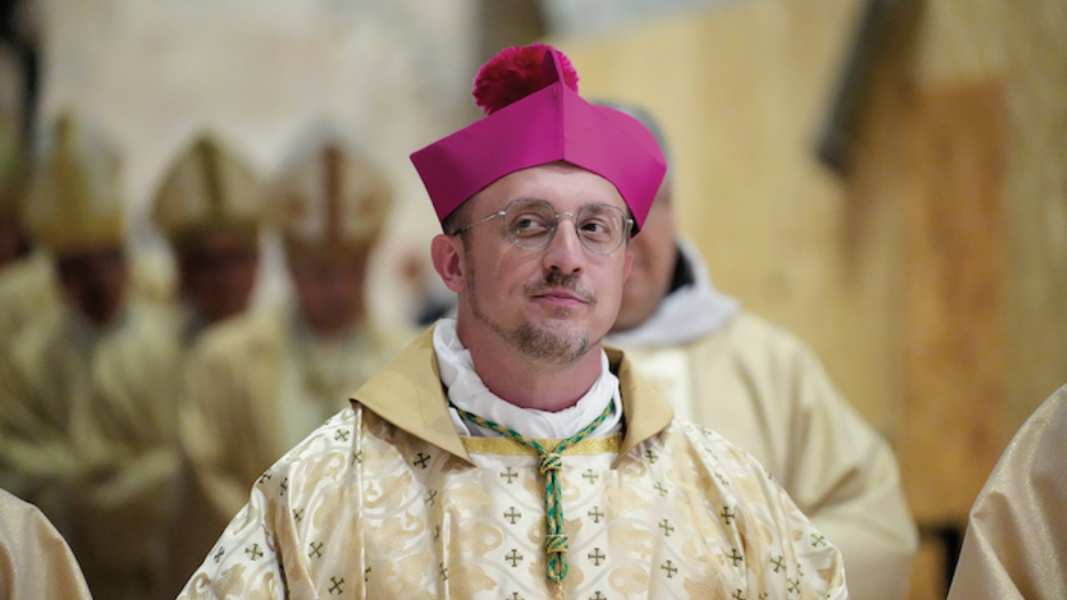
This January 22, the secretary of the Dicastery for Promoting Christian Unity, Archbishop Flavio Pace (in photo), allowed himself the gesture in an interview with Vatican News, clad in the usual language of this desk ecumenism: “After the crisis with Martin Luther, an attempt was made to find a meeting point, a shared profession of faith… It is important to commemorate that text to rediscover a common foundation…”. That is: a writing that was precisely drafted to deny —or erode— essential aspects of Catholicism is taken as a positive reference.
A document born to confront the Catholic faith
The Confessio Augustana is not a “bridge” document in the Catholic sense. In it, among other things, the understanding of the Mass as sacrifice, the discipline and theology of penance, the traditional view of confession, priestly celibacy and other matters that are not peripheral, but touch the nerve of Catholic identity are questioned. It is not about “historical nuances” that can be overcome with good will. It is about points of rupture.
And that is why, at the time, the Church did not respond with diplomatic smiles, but with doctrine. The Confutatio Augustana, drawn up by pontifical theologians, refuted the Lutheran theses in detail and demanded a return to the integral Roman Catholic faith intact. That doctrinal clash did not remain on paper: it was taken up and developed precisely in the Council of Trent, which clearly defined what was at stake. That is history, yes, but it is also magisterium.
The normalization in the Church’s discourse
The disturbing thing about the episode is not only Pace’s praise, but the framework in which it fits: the idea —already installed— that unity is built from a “common minimum” and that the rest can remain as “controversies” with an expiration date. In that line, Leo XIV himself has given eloquent signals. In his apostolic letter In Unitate Fidei he would have minimized the Filioque, describing it as a theological controversy that has “lost its reason for being”. If a truth of faith can be presented like that, as a dispute from another time, the rest follows: any difference can be downgraded to “misunderstanding” if it hinders the ecumenical narrative.
Facing 2030, the question is not whether another anniversary will be celebrated with photos and symbolic gestures. The question is what exactly is intended to be commemorated, a historical attempt by the reformers to justify themselves before the Emperor… or the Catholic truth that responded forcefully and was later affirmed in Trent? Because, if a text that was born to challenge Catholicism is taken as a “model”, the risk is not only diplomatic. It is doctrinal and pastoral. Accustoming the faithful to what yesterday was error today being presented as “common foundation”.