


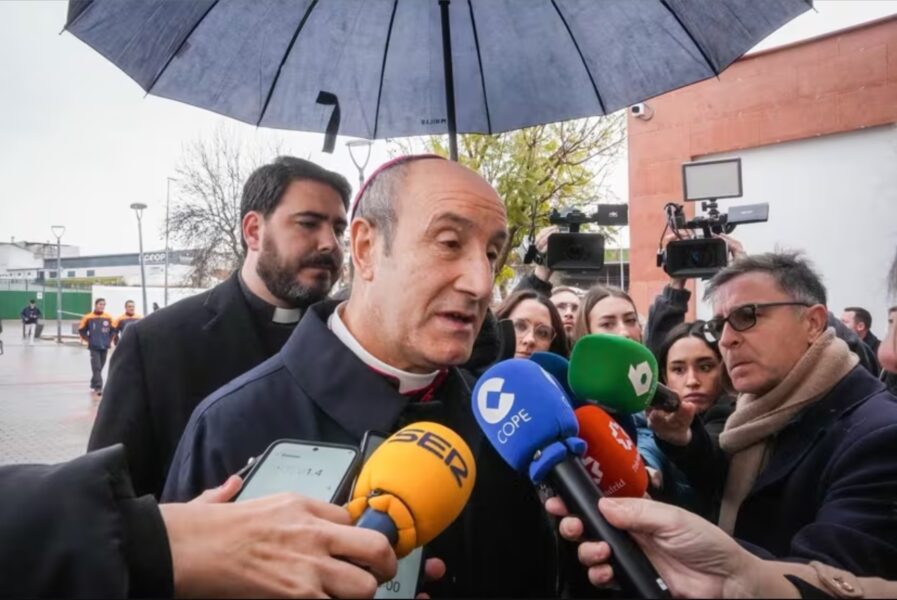
The Bishop of Córdoba, Jesús Fernández, lamented this Sunday in Adamuz that the “confusion” existing between the different authorities prevented the priests who had traveled to the site of the train accident from administering the last sacraments to the injured. He expressed this in statements to the media before presiding over the funeral mass in memory of the 45 fatal victims of the crash that occurred on January 18.
As the prelate explained, it was an extraordinarily complex moment, marked by a situation to which neither the emergency services nor the authorities themselves are accustomed. In that context, he pointed out that possibly the option of allowing the priests access to the scene to spiritually attend to the victims was not taken into account, understanding that the deceased had already died and that the injured could only be helped from a health perspective. In his opinion, that lack of understanding of the spiritual dimension caused a general confusion that left those in serious condition without sacramental care.
The bishop’s words allow us to emphasize a reality that is often relegated in emergency situations: the Church’s own mission is not only to accompany or console, but to offer the sacraments, especially when life is in danger. Confession, the anointing of the sick, and communion are not secondary gestures, but the center of pastoral action in moments when the human being faces death.
The fact that there were priests who traveled and tried to access the accident site is a clear sign of a Church present from the first moment, aware of its pastoral responsibility and willing to act even in the midst of chaos. Far from an absent or passive Church, what happened shows a real willingness to be on the front lines, where suffering is most intense and spiritual need most urgent.
The bishop himself wanted to highlight, along with this shortcoming, the rapid response of the Adamuz parish and the neighbors of the municipality, underscoring the “impressive deployment” carried out to attend to the victims and also help those who arrived later to understand the magnitude of what had happened. Likewise, he recounted how from the diocese they tried to be present from the first moment, first through the parish priest and then personally, when many families were still waiting for news of their loved ones amid a hope that was fading with the passing hours.
In his pastoral message, Monsignor Fernández insisted on the need to now accompany the families, to embrace them and to lift our gaze to heaven with the memory of the deceased, appealing to faith, communion, and fraternity as the only ways to continue after a tragedy of such magnitude. In that line, he recalled that while healthcare workers attend to the injured and many try to console the relatives, it is the Church’s specific task to pray for the dead and offer them the spiritual aid that Catholic faith considers essential.
What happened in Adamuz highlights an increasingly widespread misunderstanding of the Church’s role in the public sphere, especially in extreme situations. Preventing the priests’ access was not only an operational decision, but the reflection of a society that has been losing awareness of the value of the sacraments and the transcendent dimension of life and death. In the face of this, the numerous testimonies of faith that have emerged around this tragedy show that a significant part of the people continues to demand an authentically Christian response, very different from civil tributes and secular ceremonies that, for many, seem insufficient and alien to their pain.