


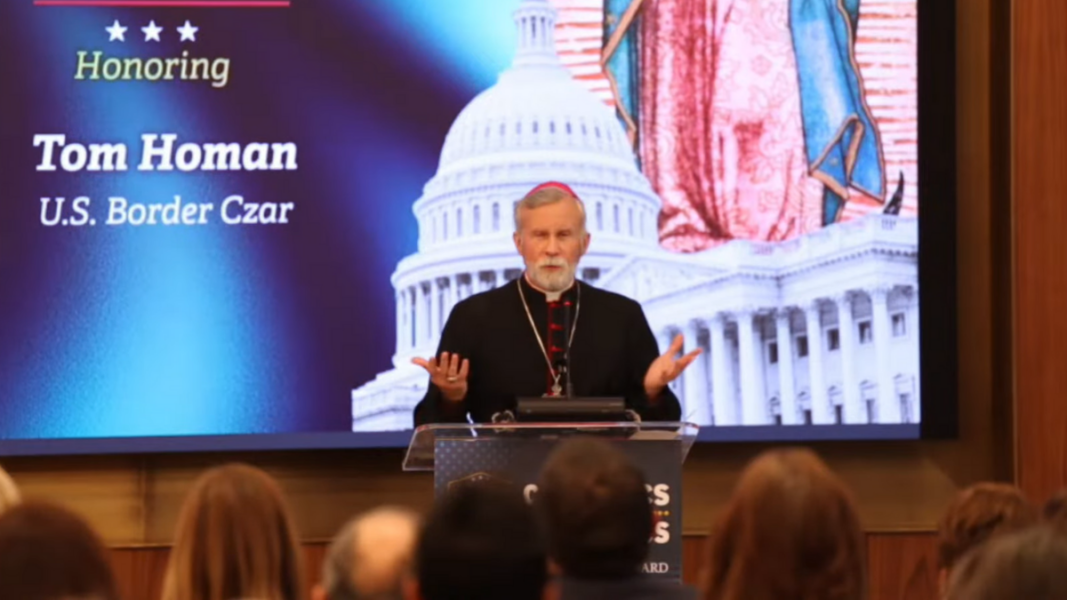
Bishop Joseph Strickland spoke during an event by Catholics for Catholics, at an awards ceremony in honor of Tom Homan, presented as responsible for having contributed to rescuing more than 62,000 children from trafficking networks. In that context, the bishop focused on a figure that, due to its magnitude, allows no euphemisms: some 250,000 minors would still be “lost” after border crossings during the Joe Biden administration. The denunciation, as he formulated it, is twofold: the phenomenon exists and is massive; and, moreover, it is not receiving a proportionate moral response. In this context,Strickland launched a direct accusation against the American Catholic hierarchy regarding the silence in the face of the drama of trafficked minors after illegally crossing the border.
The prelate insisted that the issue cannot be reduced to political slogans or sentimentalisms about “welcoming” detached from reality. “We cannot pretend that open borders are a blessing for anyone”, he affirmed, underscoring that without law and without truth the result is chaos. And when chaos takes hold, those who first fall prey to predators are the children. In his reading, the tragedy is not accidental; it is a consequence of a framework that, by normalizing irregularity, multiplies spaces of impunity for mafias.
Strickland warned that when “ministries” depend on state funding “to the point of silence,” the Church’s prophetic voice weakens. And he affirmed that “the Church must never profit from the suffering of others”. It is a criticism that points, without mincing words, to the temptation to turn charitable action into an administrative cog that, through subsidies, ends up neutralizing denunciation.
The bishop did not exonerate the Christian people. He spoke of complacency, of that ease with which one learns to live with the intolerable when the harm does not strike at one’s own door. And he linked this crisis to a deeper one: if a society accepts that the unborn does not deserve protection, “threats against children spread” afterward in all stages of life. It is not a strategic argument, but one of moral coherence: when the principle is broken, the rest falls by domino effect.
His final message was a call to conversion and prayer. He asked for the daily recitation of the rosary and demanded a special supplication for the shepherds—“from Rome to the USCCB”—so that they be true shepherds and not “politicians” or “CEOs of a large corporation”.
At the same event, the president of Catholics for Catholics, John Yep, hammered home the idea from a classic criterion: the judgment of a nation is measured by how it treats the most vulnerable, especially those who have no voice. And he placed the debate in a historical key: on the doorstep of the country’s 250th anniversary, he said, the United States is being “judged” by what it does—or fails to do—regarding these minors.