


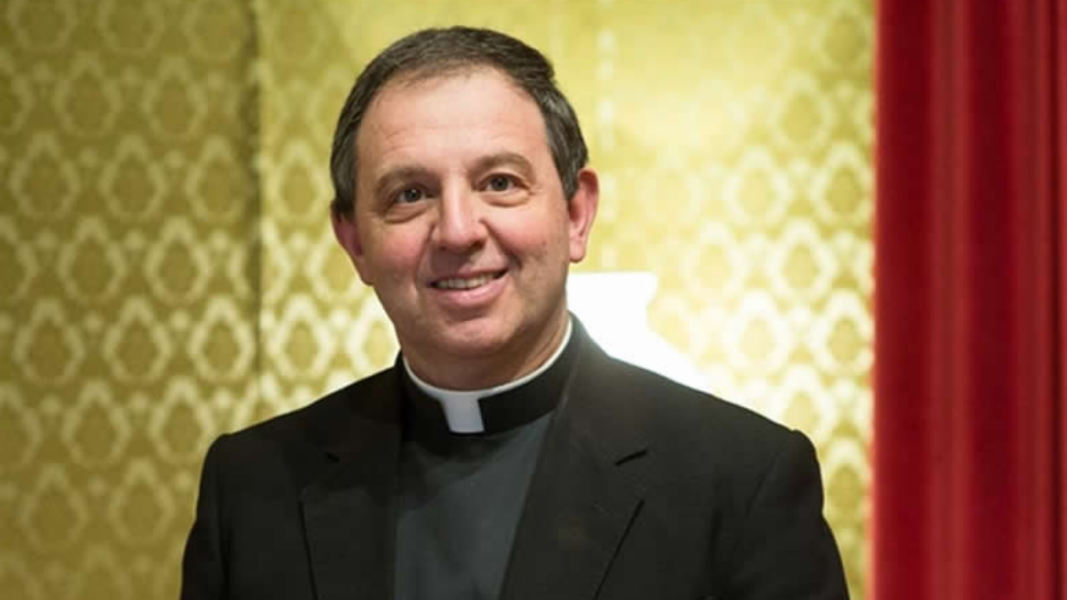
The bishop of Ventimiglia–San Remo (Italy), Monsignor Antonio Suetta, has spoken out about the political and media offensive against the initiative of the bell for life that rings every day at 20:00 from the episcopal seat of Sanremo in memory of unborn children. The gesture, far from going unnoticed, has unleashed a furious reaction from the CGIL (Italian union), which accuses it of “patriarchy”, “violence”, and “blaming women”. Suetta responded on TV Verità that the goal is not to point fingers at anyone, but to recall a basic principle: “thou shalt not kill”.
Read also: A bell for life, a scandal for the Italian left
The bell —explains the prelate— is not a last-minute occurrence. The initiative was born in 2021 within the “40 days for life” that the diocese carries out every year as preparation for the Day for Life, which in Italy is celebrated on the first Sunday of February. The bell was cast in 2021, blessed and presented on February 5, 2022, but due to works at the episcopal seat it had not been able to be placed stably. This year, finally, it was installed in the turret of Villa Giovanna d’Arco, seat of the curia in the center of San Remo, and began to ring on December 28, feast of the Holy Innocents.
A bell to pray… and to awaken consciences
Suetta insists on the religious and moral meaning of the gesture. First of all, he says, it is a call to prayer for all those involved in “the great drama”: the children who did not come to be born —both from induced and spontaneous abortions—, mothers, families, doctors, healthcare workers, and society as a whole. Secondly, the bell acts as “a warning for the conscience”: not to “point the finger”, but to recall a principle that he qualifies as “sacrosanct”: human life is not disposable.
The CGIL’s accusation: “And why not for migrants, wars, or murdered women?”
The union has responded with the classic reproach of “why not…?”, listing tragedies: migrants dead at sea, feminicides, war conflicts. Suetta rejects that logic —he openly calls it “benaltrism”— and specifies that, as a diocese and personally, he has been involved and is involved in actions of solidarity and prayer for many of those realities, especially in a border area like his, where the migratory phenomenon is everyday.
On this topic, he says, “voluntarily the conspiracy of silence has fallen”, explains Suetta, and adds that the controversy, in the end, seems useful to him because it amplifies what one wants to hide.
“Patriarchy” and “mercy”: the ideological clash
The CGIL accuses him of supporting “patriarchal culture” and of imposing his vision on a community, in contradiction —they say— with religious mercy. For Suetta, as for the Catholic Church, patriarchy has nothing to do with the core of the problem; the center is “the aborted”, a human being. Everything else can exist around it, but it cannot displace the principle. Life is sacred and inviolable.
He also adds that the first mercy must be directed toward innocent and defenseless life that is eliminated. And he recalls that the Church, in its experience, has extended a hand in multiple ways to women in difficulty, both to those who fear motherhood and to those who have aborted and carry guilt or trauma.
“It is not a right: it is a crime”
Regarding the international pressure —including the European debate— to present abortion as a “right”, Suetta states that “it is not a right, but a crime”. The shift from understanding it as an “extreme” resource to elevating it to a banner of emancipation and female promotion is the cultural drift of our times. He cites as an example the recognition of abortion in the French Constitution and speaks of a “mistaken anthropology”, a “de-structuring of man”, and a rejection of Christian principles —and even of simple reason—.
The bell will continue to ring “always”
The bell is not a one-time gesture for a campaign, but a permanent signal. Suetta confirms that it will continue to ring every day, in a stable manner, and claims the need for parrhesia: calling things by their name, with clarity, without fear. And he admits that in the Church there is sometimes “timidity”: understanding and accompanying is necessary, he says, but when the moment comes, one must indicate the direction.