


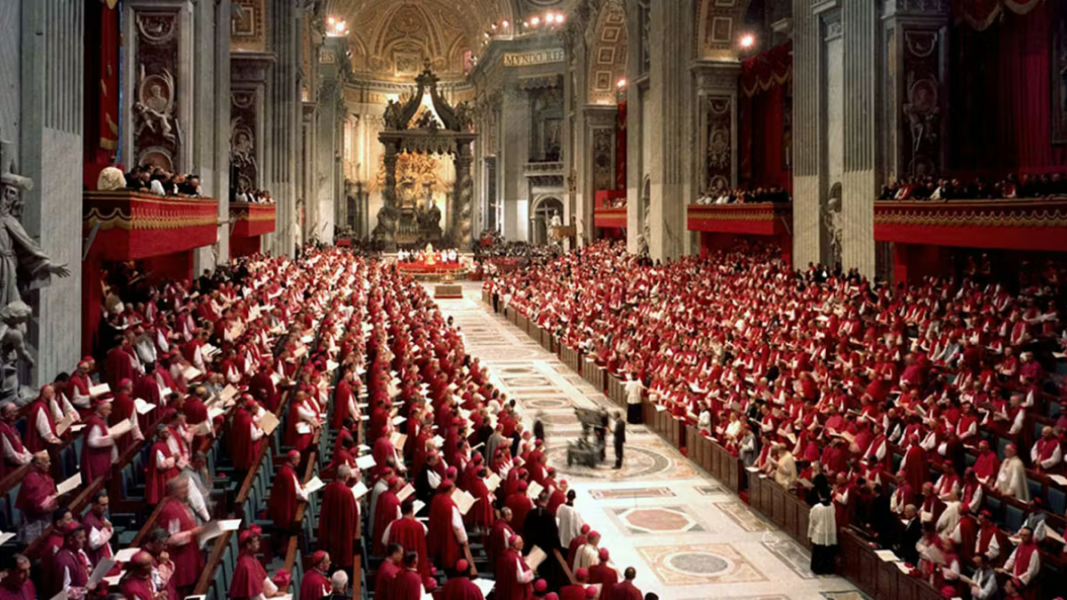
We have to admit it: thank goodness the Second Vatican Council arrived. Because until 1965, it seems, the Church wasn’t entirely clear whether God had become man, a bookshelf, or a minor constellation in the solar system. The Gospel was there, yes, but it needed a conciliar firmware update to become understandable.
This is explained by Gabriel Richi, Professor of Ecclesiology at the San Dámaso Ecclesiastical University, in a grave tone and scholarly demeanor: «The central message of the Second Vatican Council is that God wanted to make us participants in his life by sending us his Son». Shocking. Revelatory. Unprecedented. Two thousand years of Christianity, four Gospels, creeds, councils, martyrs, and Church Fathers… waiting for someone in the sixties to finally clarify it for us.
Because of course, without Vatican II, who would have suspected that God became incarnate? St. John? Over the top. St. Paul? Confusing. Nicaea? Too metaphysical. What was needed was Gaudium et Spes and an interview on COPE for everything to fall into place.
There’s no confusion here, as some naively think. It’s not that the Council is confused with the Gospel. It’s something more serious: they are identified. Vatican II doesn’t explain the Gospel; it replaces it, rewrites it, and, along the way, places itself above it. Christianity starts to become intelligible in 1965. Before that, darkness, incense, and Saturn.
Hence the triumphalist tone, almost salvific: thank goodness for the Council. Thank goodness. Because without it, we would still be thinking that God hadn’t become man. Or that the Church had nothing to say to the world. Or that faith didn’t need to adapt to modern times, like an obsolete operating system.
What is truly fascinating is not the statement itself, but the naturalness with which it is said. Without irony. Without embarrassment. As if it were obvious that the center of Christianity is not Christ, but a pastoral council of the 20th century. As if the Incarnation needed conciliar approval to exist.
And then they wonder why some speak of a conciliar Church. Not as an insult, but as a description. Because when Vatican II stops being a council and becomes the Gospel itself, when it is elevated to the ultimate criterion of truth, then we are not faced with a poor formulation. We are faced with something else.
It’s scary, some say. No. It’s laughable. A bitter laugh, to be sure. The laugh of realizing that, for certain ecclesial sectors, the Good News is not that the Word became flesh, but that in the sixties someone remembered it on television.