


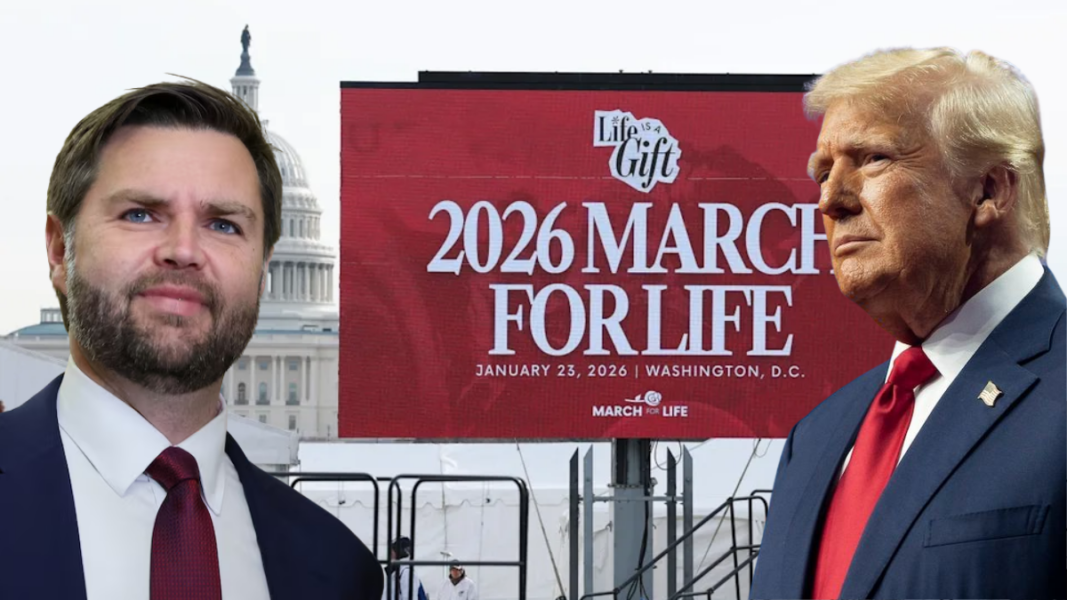
The March for Life 2026, held on January 23 in Washington, D.C., once again placed abortion at the center of the American political debate. This year’s edition combined two planes: on one hand, the institutional push from the White House to reaffirm a pro-life message; on the other, growing pressure within the movement itself for the Government to act against the expansion of chemical abortion.
Trump, on the eve: “voice of the voiceless”
On January 22, on the occasion of the National Sanctity of Human Life Day, President Donald Trump disseminated a message in which he promised to “always be a voice for the voiceless” and said he would not tire of “protecting the intrinsic dignity of every child, born and unborn.” The text adopted a moral and religious framework—the human life as the image and likeness of God—and included a call to support women with unexpected pregnancies, in addition to reinforcing welcome and adoption.
Vance warns against paganism
In his speech on January 23, Vice President J.D. Vance hardened the cultural and religious tone, arguing that the debate is not only political, but civilizational.
“As important as all this politics stuff is, it’s about whether we’re going to remain a civilization under God or whether we finally go back to the paganism that dominated the past.”
Vance insisted that the United States must beware of “returning to paganism” and framed abortion within a cultural drift that, in his view, normalizes contempt for life.
“Life is a gift”: criticism of the culture that discourages family and children
The vice president argued that certain dominant discourses push young people to see family as an obstacle. According to Vance:
“Today, the extreme left in this country tells our young people that marriage and children are obstacles, that it’s irresponsible, even immoral, because of climate change or some other reason…”
In response to that logic, he replied:
“They tell us that life itself is a burden, but we here, in this march, know that’s a lie. We know that life is a gift.”
And he added, defending the concrete value of children:
“We know that babies are precious because we know them and love them, and we see the way they can transform our families.”
The family as “God’s design”
In another segment, Vance argued that the family is not just a private option, but a social good that responds to an order desired by God:
“We know that family is not just the source of great joy, but it’s part of God’s design for men and women, a design that extends outward from the family to our neighborhoods, to our communities, and to the United States of America.”
The Mayan sacrifices
Vance compared the left’s obsession with abortion to the Mayan child sacrifices and stated that every child is “wonderfully made by God.” The phrase sought to emphasize abortion as a moral regression toward ancient forms of contempt for life, contrasted with a Christian view of human dignity.
The point that remains open: chemical abortion and abortion pill
Even with Trump’s pro-life emphasis and Vance’s combative tone, the internal discussion did not close. The main reproach is that the Government has not acted sufficiently to curb the proliferation of chemical abortion, especially due to the ease of accessing the abortion pill through telemedicine and mail delivery, even in states with restrictions.
In an analysis conducted by the National Catholic Register, they highlight that a part of the pro-life movement considers the restriction of chemical abortion a priority and regrets that, despite acknowledging criticisms, Vance did not explicitly address the abortion pill nor announce concrete measures on that front. That omission—according to the outlet—explains why the discomfort persists even after a speech well-received by the public.
The Register warns that the problem has political projection: Vance appears as a strong figure heading into 2028, and his willingness to acknowledge criticisms without translating them into changes can be read as a signal of flexibility on an issue that the movement considers non-negotiable. All in all, the March for Life left a clear scenario: the pro-life movement will continue to mobilize, but it demands that rhetoric turn into concrete decisions, especially on the chemical abortion front.