


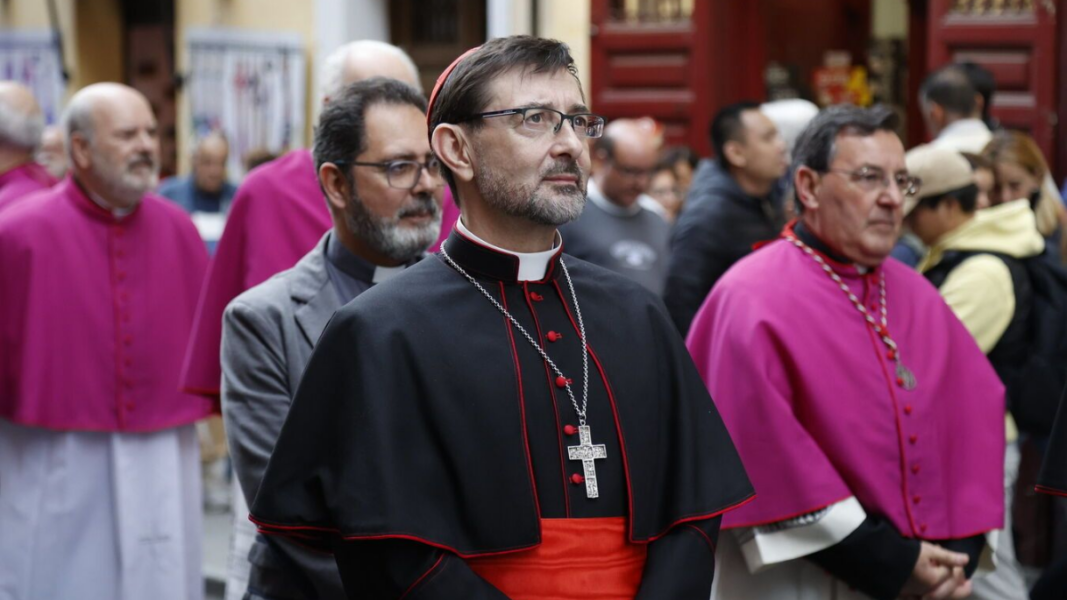
José Cobo does not govern Madrid from the serene authority of the legitimately recognized shepherd, but from the permanent complex of someone who knows he arrived where he is through an anomalous path. His problem is not conjunctural nor the fruit of a “campaign”: it is structural. He was not on the shortlist proposed for the Madrid see, he was not among the names gathered by the nunciature after long and serious dialogues with the local Church, and yet he ended up occupying one of the most relevant sees in the Catholic world. A forced landing, an eccentricity of Francis, very atypical in ecclesial terms, which explains much of his subsequent conduct.
That appointment occurred when the Congregation for Bishops was presided over by a newly arrived prefect, Cardinal Prevost, today Pope Leo XIV, who was able to witness without intermediaries the chain of strange decisions that led Cobo to Madrid. Decisions that evidence an uncomfortable reality: the lack of real support from the Madrid clergy and the absence of recognition among his peers. The then pontiff, Pope Francis, left us as a gift in Madrid this anomalous process and a brutal contrast between the weight of the see and the profile finally imposed.
From that origin comes the complex. A deep, corrosive complex that translates into a pathological fear of criticism and an obsessive compulsion with his image. Cobo does not act as someone who knows he is supported, but as someone who needs to continually prove himself strong because he knows he is not. Hence his nervousness, his fixation on what is published about him, and his tendency to react with judicial threats to those who simply report. Ridiculous threats, by the way, in a civil order where the exceptio veritatis prevails and where signatures without jurisdiction or decrees of fictitious authority are not enough.
In this context, the Convivium episode fits perfectly. We are not dealing with a pastoral assembly nor a serious exercise of synodality, but with a personal propaganda operation. After a supposed “listening process” in which openly heretical proposals—female priesthood, temporal priesthood—slipped in with disturbing normalcy, qualified with the euphemism of “peculiar,” Cobo convenes a grand event to stage the only thing that interests him: the photo. The image of strength. The appearance of unanimous support.
That is why he forces the clergy to attend physically and all at once. That is why he pressures, insists, and goes to the extreme of ordering that no Eucharists be celebrated if they coincide with his assembly, as if a pseudosynodal setup could be placed on the level of the Mass, the absolute center of the Church’s life. It is a pastoral recklessness and an ecclesiological obscenity, but for Cobo the goal is not faith nor doctrine, but the framing, the wide shot, the snapshot that he can sell as proof of authority to a Pope who knows his seams.
Convivium does not seek to discern, nor to listen, nor does it have a clear practical application. It seeks a photograph. It seeks to project an image of power that covers the fragility of origin. It is the classic resource of the insecure leader: to substitute real support with obligatory staging. Madrid is not witnessing the government of a shepherd, but the nervous management of an officeholder who knows that his legitimacy is questioned and that his ascent was, at minimum, profoundly irregular.
That is the level. That is the problem. And that is the cardinal who today occupies the see of Madrid.