


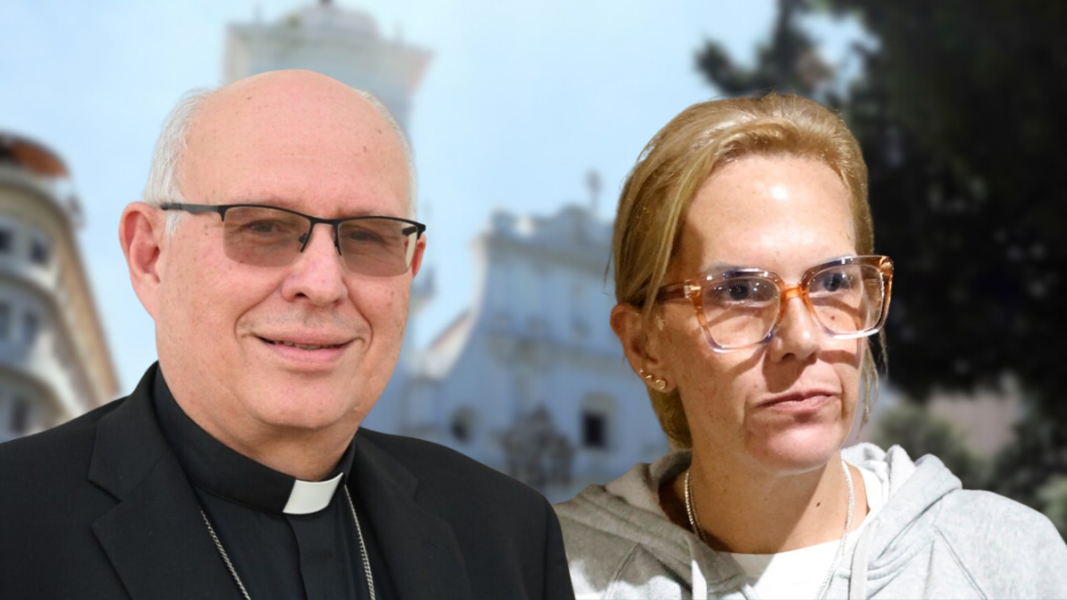
In Madrid, the controversy over the Valley of the Fallen and the Cobo signature has left a bad taste among the faithful. When political power pushes to intervene in sacred symbols and spaces and part of the hierarchy responds with negotiation language bordering on submission, the result is an ecclesial government that facilitates profanation in order to maintain «good relations» and sympathy from the State and its ideological agenda. That discussion is not just Spanish. In Caracas, a different scene emerges, harsher, but with a similar moral risk.
A denunciation that strikes the Church of Caracas
Mariana González de Tudares, daughter of Edmundo González, stated that she was the victim of three episodes of extortion linked to authorities in the country, people related to the Church, and individuals who claimed to represent important organizations. According to her testimony, she was demanded to force her father to renounce his opposition leadership in exchange for the release of her husband, Rafael Tudares, sentenced to 30 years in prison.
She added that those episodes occurred in spaces that should be neutral and protective and pointed out that there were witnesses in all three cases. The accusation describes a method. Using deprivation of liberty as leverage to break a civil family.
Biord denies it and claims ecclesial mediation
The Archbishop of Caracas, Raúl Biord, reacted with a statement dated January 20 affirming that at no time has extortion or pressure been carried out in the archdiocese on family members of detainees or anyone. The text appeals to the historical mission of mediation by the Church in Venezuela to achieve justice or releases of political prisoners. It states understanding the pain of the accuser and assures that the archdiocese has pastorally accompanied numerous family members of political prisoners with no other interest than to procure their well-being.
Accompanying and mediating is one thing. For the regime to use ecclesial spaces, or the cover of the ecclesial, as a scenario to condition family members of detainees, is something completely different. That is what González denounces. And in a country where Chavismo has turned coercion into a political instrument, that boundary cannot be treated as a minor misunderstanding.
Prisoners as bargaining chips
The Pillar adds a relevant fact to understand why the accusation has had social credibility. Rafael Tudares was not a public political actor. Precisely for that reason, human rights organizations would see his detention as a form of indirect pressure against his father-in-law. Tudares’ wife described the sentence as a violation of due process and maintained that neither she nor her lawyer had access to the file. She also stated that she was only able to visit her husband in prison for the first time last week.
The regime not only imprisons but administers confinement as a message. And that method becomes even more corrosive when the family feels that the institutions that should protect them, including ecclesial instances, are exposed to being used or invoked by power.
An archbishop under suspicion due to his relationship with Chavismo
The Pillar places this controversy in a prior climate of criticisms against Biord since his appointment as archbishop in 2024. The report describes that his designation was read by some as an option that would not be vetoed by the Government and that would avoid a stalemate in the episcopal appointment in Caracas. It also mentions an institutional framework that conditions appointments, with the State’s capacity to block candidates, which narrows the margin for maneuver.
In that context, the text collects internal accusations about harsh treatment toward his predecessor, Cardinal Baltazar Porras, known for his critical tone toward the regime. It is stated that Porras would have lost material support and that today he would live in a parish.
The report adds public episodes that fuel the perception of closeness to power. Among them, a Mass with an explicit prayer for the release of President Nicolás Maduro and Cilia Flores, and a public meeting of Biord with Maduro outside official settings, something his predecessor avoided.
From the Valley to Caracas, the same dilemma
The analogy with Spain does not seek to equate contexts. Madrid is not Caracas and the pressure from Chavismo has no democratic equivalent. But the ecclesial dilemma does resemble in its core. When power decides to intervene in a sacred symbol, as in the Valley of the Fallen, and the hierarchy adopts a role of cooperation or technical accompaniment, many faithful feel that the Church appears more as a manager of the conflict than as a custodian of the sacred.
In Venezuela the risk is even more serious. Because it involves lives. Pressured families. Prisoners turned into bargaining chips. If ecclesial spaces were used to condition the daughter of an opposition leader, the moral wound would be deep. And although the archdiocese denies it, the mere fact that this accusation seems plausible to so many reveals a crisis of trust that is not resolved with a press release.
The way out is not neutrality, it is the truth
The Church has a mission of mediation when that saves lives, opens doors, and avoids greater evils. But mediation requires a prior condition. Not to be captured by the power’s script. In a regime that extorts, distance is not a luxury. It is a moral obligation.
The denunciation by Mariana González and the denial by Archbishop Biord leave the question of what real guarantees a civil family has, with a political prisoner in the middle, when entering an ecclesial space. Does it find refuge or does it find a place where the regime feels comfortable to speak.
In Spain, the Valley of the Fallen has shown how ambiguity is paid for dearly. In Venezuela, ambiguity can cost a person’s freedom. That is why the problem is not one of communication. It is one of moral authority. And that authority is lost every time power perceives that it can use the Church as a corridor.