


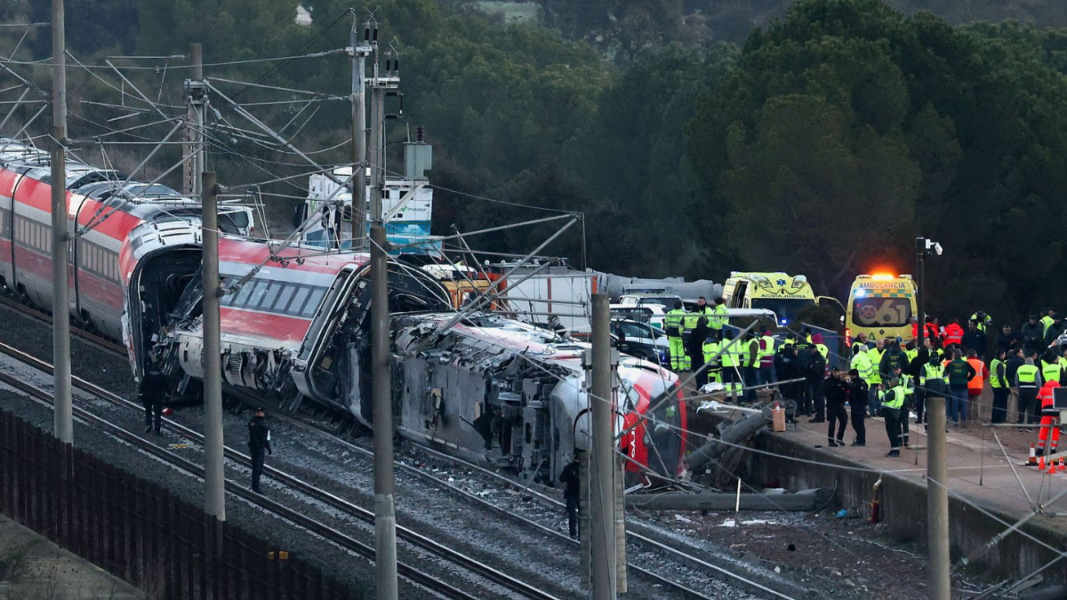
Faith testimonies that emerged after the Adamuz train accident have taken on an unexpected prominence in these days of mourning. Amid the shock, several family members have spoken before the cameras in a language uncommon in public conversation, with direct references to the Virgin, the rosary, and providence. This way of expressing themselves has had wide dissemination and has contributed to opening a debate in Huelva around the format of the official homage planned for the victims.
An official homage planned in Huelva
The Government of Spain and the Junta de Andalucía have announced a State homage for Saturday, January 31, in Huelva, with the presence of the King and Queen. According to what has been published, it will be a secular ceremony. This announcement, in a province where faith is part of everyday life, has generated rejection on social media and public comments. It is not just a protocol that is being discussed. What is being discussed is the intention to impose a framework of mourning that dispenses with spiritual consolation in a place where many families, precisely in difficult moments, sustain themselves through faith.
In parallel, the diocese will hold a funeral Mass on Thursday, January 29, in the Huelva Cathedral, presided over by Bishop Santiago Gómez Sierra. It is presented as an act of prayer for the victims, for the recovery of the injured, and for closeness to their families, with a remembrance also for those who participated in the rescue tasks.
Read also: Huelva Cathedral will host a funeral Mass for the victims of the Adamuz train accident
The intervention of a family member and a phrase that has been repeated
Gracia, sister of an injured man who remains in the ICU, in a television interview, stated that in Huelva a secular funeral makes no sense and recalled that the city recognizes itself as Marian land. She explained that her brother is, in her case, in the hands of the Virgin and defined his evolution as a miracle. She emphasized that it is not a time for partisan debates and that the priority is for her brother to leave the ICU as soon as possible.
«Those below in the end can do no more than put their hands, but those above are the ones who protect us, the ones who at least have saved my brother».
Fidel and his mother’s rosary
Another testimony that has had media reach is that of Fidel, a resident of Huelva, disseminated by Gaudium Press based on a television interview. Fidel recounted that his mother died in the accident and that she was praying the rosary. According to his interpretation, she offered her life to God so that her children and grandchildren would be saved. In his words, that intercession explains why several family members survived.
The account also includes the testimony of a family member who was trapped for a prolonged time among the wagon’s metal and who, despite the extreme situation, managed to help children get out. Fidel insisted that he is not seeking prominence and that his intention is to highlight the value of the family, the value of the rosary, and of what is essential when life changes abruptly.
A numerary among the victims
In the context of victim identifications, ACI Prensa reported the death of María Luisa Eugui, a numerary of Opus Dei, whose death was confirmed by the prelature. According to that information, she was traveling from Madrid to Huelva to visit her sister and her sister’s husband, who was seriously ill and died shortly afterward.
The report adds a detail that illustrates the personal dimension of the tragedy. The deceased’s sister explained that she spoke with her on the phone during the journey, about three quarters of an hour before the impact, when she learned that a granddaughter was also traveling on one of the trains involved. After agreeing that she would look for her among the wagons, the communication was cut off and she never responded again. The young woman was rescued and is recovering from injuries, out of danger.
The background of the debate, consoling without faith in a land of faith
An institution can organize a civil act. What is debatable is presenting it as a sufficient response in a land where consolation, for many people, involves entrusting the dead to God’s mercy and praying to the Virgin for the injured. In Huelva, many families cannot conceive of mourning without prayer, without Mass, and without Christian hope. The intention to hold a civil homage as the main framework for farewell is perceived as a way of emptying the pain of its natural language.
That is why the funeral Mass on January 29 does not appear as just another parallel event; it will be the place where Huelva acknowledges its pain and places it, without complexes, before God.