


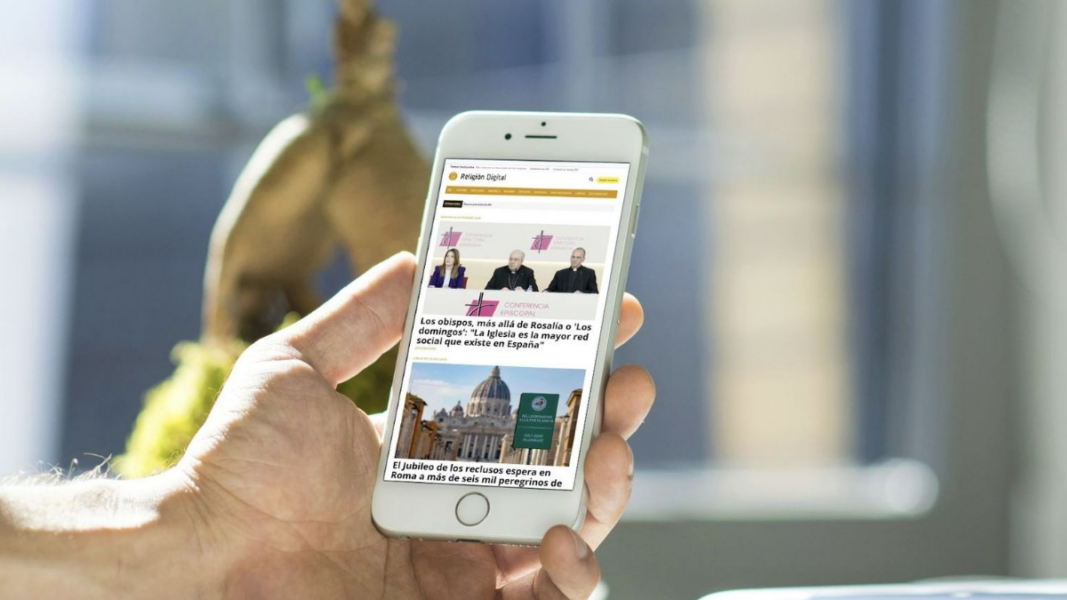
Digital Religion has published an article portraying Infovaticana as a sort of modern Inquisition, dedicated to persecuting heretics and denying «diversity» within the Church. It is not our intention to engage in a constant dialectic of reproaches with a small media outlet in its audience and dusty in its doctrine. Digital Religion would be an endearing museum piece of the ecclesial decadence of the eighties, if it weren’t for the fact that tens of thousands of euros from official Church resources continue to be diverted to finance that medium with the support of some disoriented bishops.
The scene they propose to us is almost comical: on one side, them, open, dialogical, and plural; on the other, a few killjoys obsessed with the catechism. The problem is that, when you scratch a little that moral painting, what appears is not pluralism, but ideological monopoly and imposition financed with ecclesial money.
Because if we talk about a real lack of diversity, few examples are clearer than Digital Religion. Not only in the doctrinal field, where anything goes except Catholic doctrine, but in the much more prosaic field of money. UMAS Insurance, directly dependent on Spanish dioceses; the Pontifical University of Salamanca; the Pontifical University Comillas; the University of Deusto; Manos Unidas; Oikocredit; the so-called Online School of Theology… All of them, we mention only some, finance Digital Religion in a constant and preferential manner. All of them do so despite the fact that its audience is far inferior to that of Infovaticana or other Catholic media. All of them do so without ever raising the slightest need for media pluralism. To distribute the money, there is no diversity: there is unanimity, ideological fidelity, and administrative silence. We will delve deeply into this topic shortly.
It is curious how diversity works when it bothers. To question dogmas, reinterpret Catholic morality, or present as «legitimate opinions» theses that the Church has constantly rejected for centuries, diversity is a sacred value. To distribute the institutional advertising of dioceses and Catholic universities, on the other hand, diversity disappears as if by magic. There, no one asks if other Catholic media exist, with more readers, more impact, and greater doctrinal fidelity. There, the same one is always financed, because what is being paid for is not information, but a ridiculous reputational protection in the official bulletin of self-consumption where some ecclesial officials like to see themselves flattered alongside a newly ordained Bishop Charo.
The irony is even greater when observing what Digital Religion understands by diversity in the Church’s official forums. We are not talking about honest debates or balanced confrontation between different Catholic currents. We are talking about unidirectional conferences, in seminaries and institutional events, where theses openly incompatible with the Catholic faith are taught without the slightest contrast. Theologians who consider it plausible that Christ’s body rotted and may appear someday, or «spiritual advisors» who hold that active homosexuality is perfectly compatible with the state of grace, are presented as references in seminaries! That is not dialogue.
And, of course, there is never any contrast. A theologian of traditional doctrine never appears on equal terms. It is never proposed, for example, that those «most interesting theses» be publicly confronted before seminarians with the real teaching of the Church. Diversity, apparently, consists of the same one always speaking, from the same approach and with the same result. It is something like inviting Morante de la Puebla to give ethical training at a PACMA congress and calling that pluralism. Everyone would see the absurdity… except when the nonsense is disguised as ecclesial progressivism.
What is truly revealing is that those who hold these positions do not create their own space, their own church, or their own forums with their own money. No, that would be too coherent. They prefer to occupy the official institutions of the Catholic Church, use its universities, its seminaries, and its budgets, and then accuse of inquisitor anyone who reminds them that an institution has the right and duty to be faithful to its identity.
Digital Religion openly defends, among many other heretical theses, the ordination of women and the existence of female bishops, something that is not just another «sensitivity» within the Church, but an explicit denial of its doctrine. Now they want to present as Catholic the possibility that Christ’s body rotted and corrupted. That someone took it out of the tomb. Presenting this position as diversity is a joke. No one prevents those who hold them from founding their own church, consecrating their bishops, and organizing as they wish. They can even dedicate themselves to searching for Christ’s body if that seems theologically stimulating to them. What is not acceptable is that they pretend to do it with diocesan money and from institutions that exist to teach exactly the opposite.
The underlying request is insultingly simple, and perhaps that’s why it bothers so much. No censorship, no bonfires, no ecclesiastical tribunals are requested. It is requested that the Catholic Church, in its official forums, teach Catholic doctrine. And it is requested that those who cry out for diversity have the decency to apply it also when deciding to which media the money of all Catholics is destined. Diversity to deny the catechism and absolute unanimity to collect institutional advertising is not pluralism. It is business. And quite well-oiled, moreover.