


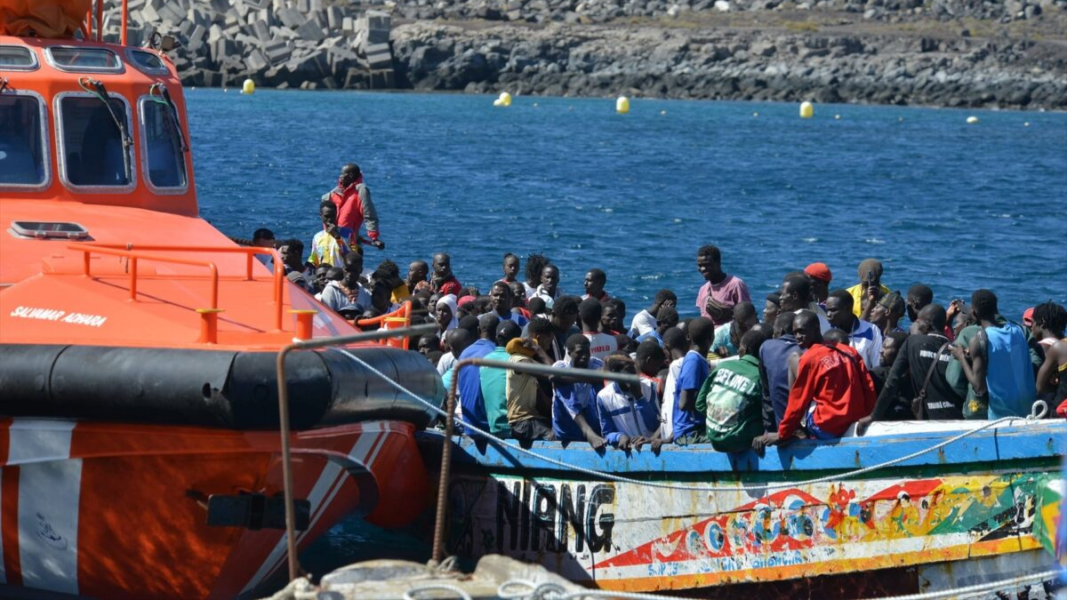
It is advisable to make something clear from the outset to avoid interested misunderstandings. It is not the human trafficking mafias from North Africa who usually read Infovaticana, nor the cayuco bosses who reflect on our editorials. Therefore, raising this issue does not generate new ideas or add incentives. The only thing we intend is to share a legitimate concern about a real, immediate, and potentially dramatic possibility.
In July 2013, when Pope Francis decided to travel to Lampedusa, he did so in a deliberately unexpected manner. There was a discreet announcement just days before, without a prolonged public agenda or weeks of media anticipation. The reason? That way of proceeding was not accidental. It responded to a very specific pastoral prudence: to avoid the gesture being interpreted as an opportunity by those who risk their lives at sea or by those who profit from that desperation.
It was not about diminishing the strength of the message, but about not creating a specific temporal window that could be read as a «propitious» moment to set out to sea. Precisely for that reason, it is legitimate to ask whether the same criterion of prudence is being applied today.
The announced visit of Pope Leo XIV to the Canary Islands, officially confirmed by José Cobo and Eloy Santiago, would apparently have the purpose of meeting with the immigrants arriving via the Atlantic route, embracing them, and offering them a message of mercy and welcome. No one disputes the good faith of the gesture or the moral coherence that inspires it. However, the problem is not in the intention, but in the foreseeable consequences when that gesture is inserted into an extremely fragile human context.
We are not talking about a possible abstract, theoretical, or ideological «call effect,» but about a very concrete one. The visit of a Pope to a specific point on the map turns that place into the center of world attention for several days. Cameras, headlines, and international pressure concentrate there. In that scenario, it is not far-fetched to think that those who organize the departures of precarious boats, or even those who consider embarking, interpret that moment as offering greater guarantees of arriving alive. Fewer interceptions and returns, greater rescue deployment, more media watching the sea, and an added practical difficulty in applying immediate repatriation measures under a global media spotlight. The perception, accurate or not, may be that «this is the moment.»
The logical consequence of that perception could be an extraordinary and simultaneous departure of dozens of boats. Not one more, not two more, but many more than usual, forcing a rescue system that already operates at its limit. And the sea, it is worth remembering, understands neither papal agendas nor good intentions. If that massive departure is compounded by bad weather, breakdowns, lack of coordination, or simple bad luck, the result could be a chain of shipwrecks and deaths that, as we sadly know, when they occur are not counted in units, but by the dozens or hundreds.
The question is uncomfortable but inevitable. Is this specific hypothesis being seriously considered? Has the real risk been measured that a gesture of mercy could indirectly translate into a human tragedy of gigantic proportions? Because if something like that were to happen, the crisis would not be just political or media. It would be a crisis of the first moral order. The Church would be challenged not by what it wanted to do, but by not having foreseen what could happen.
This is not about being doomsayers or turning into systematic critics of every pontifical gesture. Precisely because the intention is good, it is concerning that a prudence that was taken into account in 2013 may today be overlooked. There is still time to rethink the format, the timing, or even the advisability of the trip.