


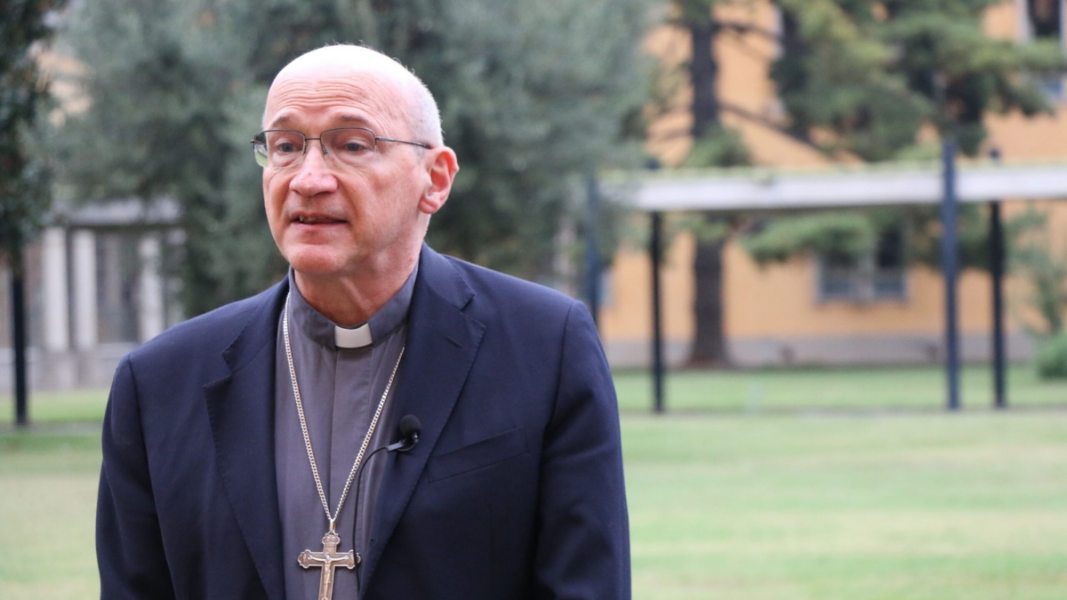
Pope Leo XIV has appointed Secretary of the Dicastery for the Clergy Mons. Carlo Roberto Maria Redaelli, until now Archbishop of Gorizia, according to the official bulletin of the Holy See. The move places a canonist with long experience in the legal structures of the Italian Church in a key position in the Curia, and with a name that is far from neutral. Redaelli was already noted in his time for supporting theses that questioned the legal foundation of Summorum Pontificum and the continuity of the 1962 Missal.
A Position That Weighs More Than It Seems
The Dicastery for the Clergy is a government office that deals with the discipline, formation, life, and conditions of the diocesan clergy. And the secretary is, in practice, the one who circulates files and turns the “line” into decisions. That is why, when Rome chooses a secretary, it usually selects someone methodical, normative, and geared toward internal workings, rather than someone for grand gestures.
Redaelli fits exactly into that pattern.
A Canonist’s Profile: Milan, Gregorian, and CEI
Born in Milan in 1956 and ordained a priest in 1980, Redaelli trained as a jurist and obtained a licentiate in Canon Law at the Gregorian (1988). His career was that of a curial and structural man in the diocese. In Milan, he worked in ecclesiastical advocacy and rose to become vicar general; later he was an auxiliary and, from 2012, Archbishop of Gorizia.
That technical profile was consolidated in the Italian Episcopal Conference. Redaelli chaired the Council for Legal Affairs of the CEI and was linked for years to issues of ecclesiastical goods and administration. It is the kind of curriculum that Rome uses when looking for someone capable of “putting the house in order” without sentimentality.
Rome’s Trust: Visitor Where There’s Fire
Redaelli was appointed Apostolic Visitor in Acqui in 2016 and then Apostolic Administrator in 2018. He was also sent as a visitor to Pescara-Penne (2020).
More recently, the Vatican sent him to Piazza Armerina on an apostolic visit marked by a context of maximum sensitivity: Italian media linked the visit to an attempt to clarify diocesan management and governance amid a judicial case affecting the diocese. Regardless of the details, the relevant fact is the same: Rome uses him as a man for inspection, diagnosis, and control.
The «Gay Marriage» in Staranzano
However, his name is not only associated with governance tasks. Redaelli was highlighted in 2017 by the Staranzano controversy, when a scout leader entered into a civil “marriage” with another man, and the case led to a public conflict within the diocese. The controversy was aggravated by the absence of a clear intervention from the ordinary in a particularly delicate situation, as it involved an educational and youth formation context.
According to the reconstruction by the Italian media outlet La Nuova Bussola Quotidiana, the parish priest Francesco Maria Fragiacomo stated that he had warned in advance the then-diocesan official—that is, Mons. Carlo Roberto Maria Redaelli—about the scandal that was brewing. However, the article describes that there was no effective intervention or clear stance from the archbishop in the case, which ended up exploding publicly.
In that context, a public letter from the parish priest to the archbishop gained relevance, in which he asked for clarity on ecclesial discernment and warned of the damage caused by the episode. The same note adds that, already with the controversy underway, from the diocesan environment it was made known that Redaelli was “very upset,” without that translating into a clear response that would close the conflict.
Redaelli and the Traditional Mass
In 2018, his name became associated with an offensive within the Italian Church against the practical legitimacy of the Traditional Mass as protected by Benedict XVI. According to that line, Redaelli would have argued that the 1962 Missal was abolished by Paul VI, and that Summorum Pontificum would depart from an erroneous legal premise.
The attribution of those theses was reported and commented on in various ecclesial circles, and it is especially significant now that Redaelli moves to a high-level position in the Curia.
However, Redaelli’s move to the Dicastery for the Clergy does not automatically equate to a “liturgical policy,” because that direct competence is not there. But it does place a man with a controversial history in an area that touches the everyday life of the clergy: seminaries, discipline, diocesan tensions, and often also the conflict over liturgy.