


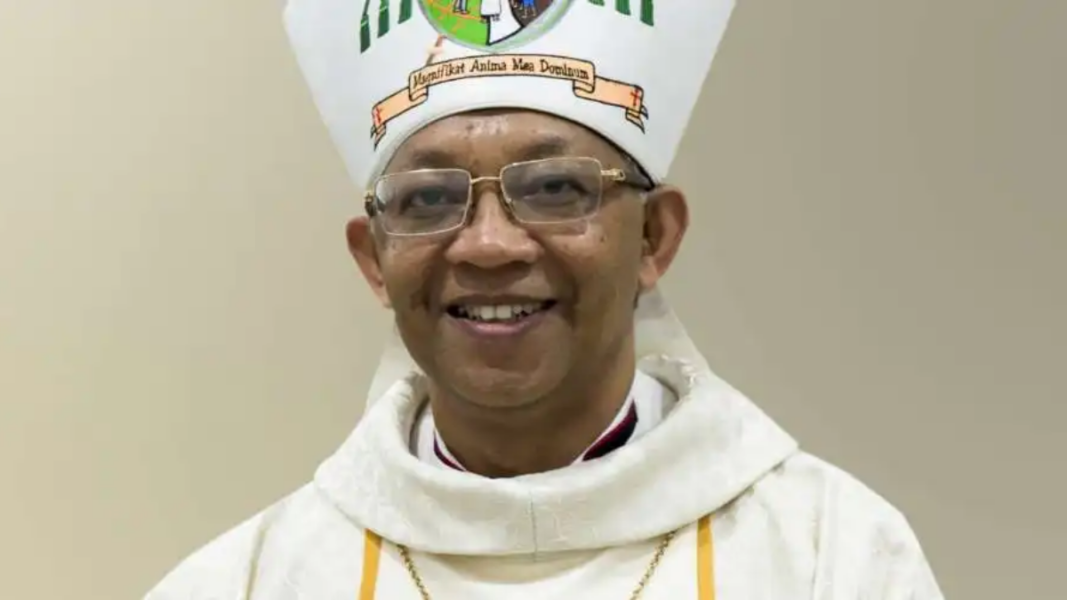
The resignation of the Franciscan bishop Paskalis Bruno Syukur, accepted on this January 19, 2026 by Pope Leo XIV, closes a stage marked by an unusual gesture—rejecting the cardinalatial purple in 2024—and by an internal climate of confrontation in the diocese of Bogor (Indonesia). Rome has appointed an apostolic administrator “at the disposal of the Holy See”, a format that underscores direct control of the case.
An unusual resignation
It is not common for a bishop to leave the governance of a diocese at the age of 63, far from the ordinary threshold of 75. Therefore, the acceptance of Syukur’s resignation by Leo XIV carries a weight that goes beyond a mere administrative procedure: it points to a change of stage decided from above, with the will to stabilize a local Church that, in recent months, has experienced evident internal wear and tear.
The Holy See, as is customary, has not provided detailed explanations. The Vatican limits itself to the fact: resignation accepted and appointment of an administrator.
An administrator “at the disposal” of Rome
The Holy See has appointed Bishop Christophorus Tri Harsono, current pastor of Purwokerto (Island of Java, Indonesia), as apostolic administrator vacant see et ad nutum Sanctae Sedis. Leaving the administrator directly under the authority of the Pope, and that his mission is to govern provisionally without the diocese yet entering an ordinary—and routine—succession process.
From the “no” to the cardinalate to the end in Bogor
Syukur’s figure jumped to the international scene in October 2024, when Pope Francis announced his name among the new cardinals. His subsequent refusal—accepted by the Pope—was interpreted as a gesture of personal humility. But that episode also made him a particularly exposed bishop: for some, a symbol of renunciation of honors; for others, a decision that revealed internal tensions or a governance with fragile support.
Two years later, his departure from office occurs in a much less luminous context. According to Vida Nueva, public accusations within the local clergy have been revealed about authoritarianism, abuse of power, and mismanagement, in addition to pointings about dynamics of influence in diocesan governance. Syukur himself, as has been disseminated, would have presented his resignation as an attempt to prevent the conflict from fracturing the diocese further, without admitting guilt.
A case that Rome does not want to become chronic
In countries with a Catholic minority, and even more so in a social environment of Muslim majority like Indonesia, the stability of ecclesial governance is a condition for sustaining seminaries, educational works, charity, and public presence. When internal conflict becomes chronic, the pastoral damage is usually deeper than any personal dispute.
Hence, the step taken by Leo XIV is read as a measure of containment and reorganization: remove the questioned bishop, cool the conflict under an administrator, and rebuild normality before appointing—if so decided—a stable successor.
Profile and trajectory
Born in Flores in 1962, Syukur belongs to an Indonesian region with a strong Catholic tradition. A Franciscan, with internal responsibilities in his order and experience in Rome, he was appointed bishop of Bogor in 2013 and governed the diocese for more than a decade. His case, however, will remain associated with two uncommon milestones: the public rejection of the cardinalate and an early departure from diocesan governance under a transition closely monitored by the Holy See.