


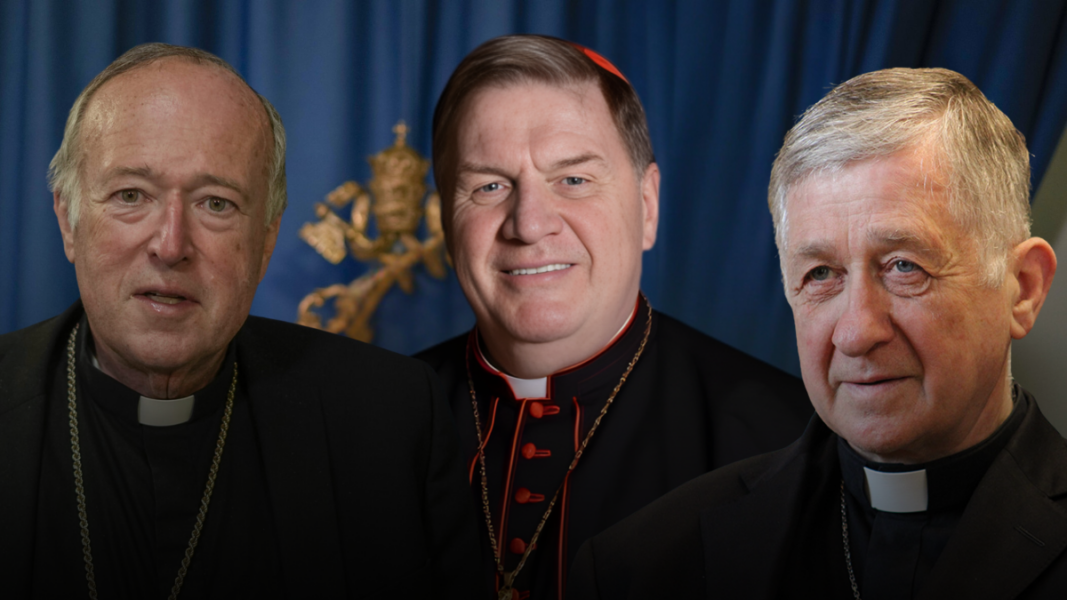
Cardinals Blase J. Cupich (Chicago), Robert W. McElroy (Washington), and Joseph W. Tobin (Newark) have published a joint statement this week on United States foreign policy in which they appeal to a recent speech by Pope Leo XIV to the Vatican diplomatic corps. Presented as a “rare statement” on the morality of North American international action, the text—which has been interpreted as criticism of the White House—has provoked responses from voices that reject the document representing “the Church” as a whole.
A “rare” text and an inevitable political reading
The document—disseminated from the Archdiocese of Washington—places the moral debate on foreign policy at the center of the political moment: it mentions Venezuela, Ukraine, and Greenland as scenarios that reopen questions about the use of force and the meaning of peace. Within that framework—and although it does not directly name any leader—the writing has been read by analysts and media as an indirect challenge to the orientation of the U.S. administration, —even Vatican News has dedicated a note to comment on it—.
The signatories say they assume as an “ethical compass” the speech of Leo XIV, especially his denunciation of the weakening of multilateralism, the replacement of dialogue with force, and the normalization of war as an instrument of domination. They also emphasize—citing the Pope explicitly—that the protection of the right to life is the indispensable foundation of other rights, along with the defense of religious freedom and conscience.
“They do not speak for the Church”: the reply from the Catholic world
Analyst Phil Lawler, in Catholic Culture, argues that the statement cannot be presented as the voice of “the Church” or of the U.S. episcopate, since it does not come from the episcopal conference and the signing cardinals do not act on behalf of the majority of bishops. For Lawler, the text mixes social doctrine with a concrete political purpose and, in doing so, seeks to “bend” Church teaching toward a partisan objective. The signatories say:
«Pope Leo also reiterates the Catholic teaching that ‘the protection of the right to life constitutes the indispensable foundation of any other human right’ and that abortion and euthanasia attack that right. He points out the need for international aid to safeguard the most essential elements of human dignity, which are being attacked due to the movement of rich nations to reduce or eliminate their contributions to foreign humanitarian assistance programs.»
Despite citing phrases from the Pope on the right to life, the practical focus of the document concentrates on geopolitical and migratory issues, while topics like abortion or marriage do not usually occupy an equivalent place in the public agenda of these cardinals. It is especially striking that Cupich is now a staunch pro-life defender—mentioning abortion and euthanasia—after defending his friend, Senator Durbin. Is that the case, or is he simply an opportunist in discourse?
The use of a pontifical speech as a “framework” for national policy
The cardinals do not limit themselves to repeating general principles, but rather formulate a line of action—and an implicit moral judgment—on foreign policy and international aid, insisting that military force must be the “last resort” and rejecting war as an instrument of narrow national interest. They say thus:
«We seek a foreign policy that respects and promotes the right to human life, religious freedom, and the improvement of human dignity worldwide, especially through economic assistance.»
The Pontiff’s speech—although it contains warnings that can apply to specific governments—was broader and more cautious, with references to multiple crises and actors, and without the tone of “total political battle” perceived in the U.S. reception of the text.
A signal of the internal pulse of Catholicism in the U.S.
The dispute reveals more than a disagreement over diplomacy. It exposes the clash of approaches within North American Catholicism regarding how pastors should intervene in concrete political debates. It is thus a gesture that confuses doctrinal authority with circumstantial opinion and that, moreover, is presented with a representativeness it does not have and, furthermore, they assure that they will continue to insist on their own agenda:
«Pope Leo has given us the prism through which to elevate it to a much higher level. We will preach, teach, and advocate in the coming months so that this higher level is possible.»