


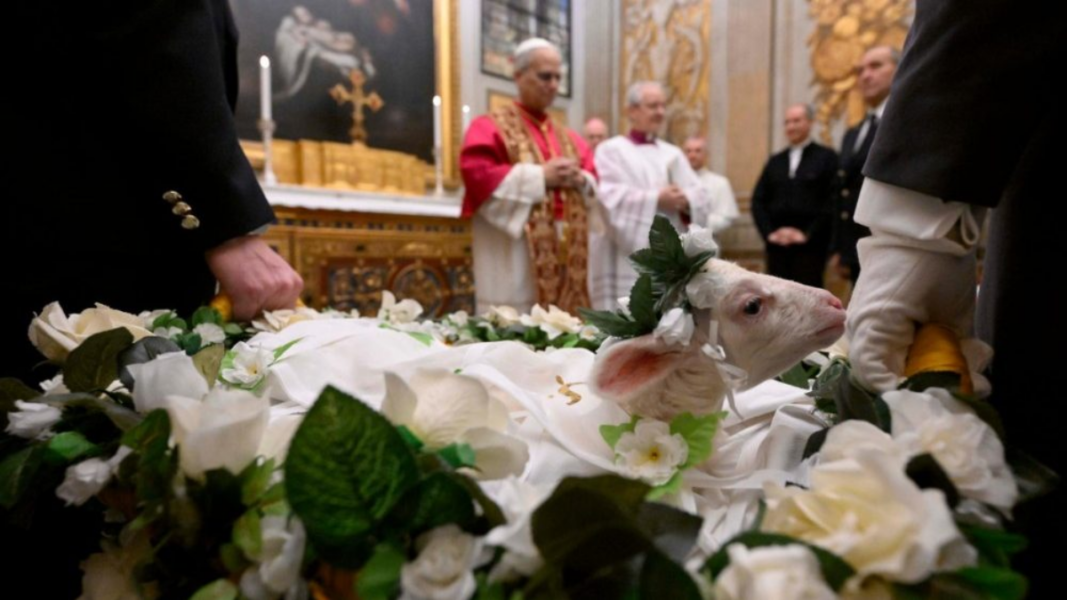
On this January 21st, in the memory of Saint Agnes, two lambs were presented to the Pope whose wool will serve—as every year—to make the palliums that the new metropolitan archbishops will receive. With this gesture, the Church continues to remember that authority is not a “position” that is assigned, but a service that is received, carried, and rendered.
It is no coincidence that this occurs around Saint Agnes. The Roman Church preserves her memory as that of a young martyr, a symbol of purity, self-giving, and uncompromising fidelity. And it is precisely that contrast: soft, white wool; hard, bloody witness. The tradition joins what the world separates: tenderness and firmness, insignia and cross.
The pallium: it is not an ornament, it is a sign of bond and burden
The pallium is a narrow band of white wool, marked with six black crosses. But its meaning is not in the fabric but in what it represents: a jurisdiction exercised in communion. It is not “a prize” for the ecclesiastical career; it is a visible sign that the metropolitan does not fully belong to himself. He carries on his shoulders a part of the weight of the local Church and, at the same time, its bond with Rome.
The Church, with these symbols, resists the temptation to turn pastoral governance into pure management. In times of structures, commissions, and protocols, the pallium returns to the essential: the bishop is not a manager; he is a father and a shepherd, and his authority has a concrete form: service, sacrifice, vigilance, and responsibility.
Why lambs?
The origin of the wool is not a picturesque detail; they are two lambs to weave an insignia that rests on the shoulders, an image that evokes Christ, who is the Lamb and the Good Shepherd. The bishop—in his own level—participates in that shepherding. There is no legitimate authority if it is not “in the key of the flock”: to care for, guide, correct, protect. The wool that warms also reminds that the shepherd wears himself out. If the ministry does not wear one out, perhaps it is because it is being exercised from afar.
June 29: Peter and Paul and communion in continuity
The tradition culminates on June 29, the solemnity of Saints Peter and Paul, when the Pope blesses and delivers the palliums. It is not done on any day. Peter represents the rock, continuity, unity. Paul represents the mission, the proclamation, the clash with the world. A bishop is called to sustain both tensions: fidelity and mission; unity and courage.
In an era when much is spoken of “processes” and “paths,” this sign restores a simple truth: communion is not a kind word; it is a real, visible, and demanding structure.
A tradition that endures over time
Today’s scene—lambs presented to the Pope, wool destined for palliums—is not a museum whim. It is Rome’s way of remembering that the episcopal ministry does not arise from applause, nor from consensus, nor from the cultural climate, but from a charge received in the Church and for the Church.