


For nearly two years, the war has strangled everyday life in the Holy Land. The conflict has not only brought death and uncertainty, but also silence: that of the pilgrims who stopped arriving at the places where our faith was born. For the Christians of Bethlehem—a population that is increasingly reduced—that absence is not a secondary fact, but an existential threat. Without pilgrims, there is no work; without work, there are no families; and without families, there is no Christian presence in the city where Christ was born.
Cardinal Pierbattista Pizzaballa—Latin Patriarch of Jerusalem—has insisted on the importance of resuming Christian pilgrimages to the Holy Land, not only for their spiritual value, but also for their direct impact on the livelihood of local Christian families.
In this context, Ramzi Ghattas, a Catholic born in Bethlehem and spokesperson for his community, has gone out to the world to make known the artisanal work carried out by Christian families in the Holy Land and to invite priests and the faithful to visit what he calls “The fifth Gospel,” that is, the land of Jesus, the places and its people as an authentic pilgrimage to the origin of our Catholic faith.
In this conversation with Infovaticana, Ramzi addresses the Christian demographic collapse, the suffering experienced during the war, and a firm conviction: the survival of Christians in the Holy Land depends, to a large extent, on Catholics returning to pilgrimage.
How has the demographic decline of Catholics been in a city like Bethlehem?
When I was born, in 1975, Catholics made up about 75% of the city’s population. Today, in 2025, we are barely 8%, perhaps a little more, but very little. We, the Catholics of Bethlehem, live solely from pilgrimages. That’s why I’m here. I left Bethlehem after being locked up for almost two years, like the entire Christian community, because if we stay alone, we disappear.
In Spain and Latin America, the war is perceived as distant. How has this time been lived in Bethlehem, especially for Christians?
The war does not distinguish between Muslims or Christians. We all suffer. In Gaza, the suffering has been extreme, and Pope Francis understood it very well, which is why he was in constant contact with Father Romanelli until the end of his life. The Christians there have suffered deaths, injuries, attacks.
In Bethlehem, we have not experienced that direct destruction, but something very hard: uncertainty. Two years without pilgrims. Two years without work. We live solely from pilgrimages. Hotels, workshops, shops… everything depends on that. The constant question was: “Is this going to happen to us too?” And even so, we insist on staying. We have roots here. No one chooses where they are born; that is decided by God. And if God decided that I was born in Bethlehem, then I have a mission, otherwise where do I go? I don’t leave Bethlehem, I don’t leave the Holy Land. From Bethlehem straight to heaven.
You insist a lot on the importance of pilgrims. Why are they so decisive for the survival of Christians in Bethlehem?
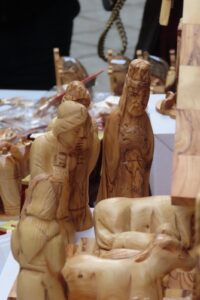
Because without pilgrims, there is no life. In Bethlehem, we have more than 50 hotels, olive wood workshops, entire families who live from religious souvenirs. It is not empty commerce: it is faith transmitted with the hands. Each piece is made praying, believing, transmitting tradition.


The Holy Land is the fifth Gospel. It is not visited, it is lived. When pilgrims come, they stay with us, eat with us, pray with us. That gives work, but it also gives hope. The worst is not poverty; the worst is feeling alone.
What can a Catholic who wants to help Christians in the Holy Land do concretely?
The main thing is to go. And the one who decides is the priest. When a priest gets encouraged, his community follows. Some groups are already starting to return, and that gives us life.
During the pilgrimage, help is given in everything: staying in Bethlehem, eating there, using local transportation, participating in Mass with the community. It is not just a Mass “for tourists”; it is praying with the Christians who guard the holy places.
And there is also support by buying products from Bethlehem: nativity scenes, crosses, souvenirs made of olive wood. They are not decorative objects; they are part of our faith. Bethlehem is not just Christmas. Bethlehem is all year round.
Today in the West, there is a strong de-Christianization, even the ideological manipulation of the manger. How do you see this situation from Bethlehem?
With a lot of pain. Bethlehem is not an idea or an ideology. It is a living city. We from Bethlehem are not figures. We are people. Here is the heart of the world, the origin of faith. If the heart is abandoned, what remains of the body?
When one enters the Basilica of the Nativity, I always say: first close your eyes, leave the camera, pray for a minute. Take away a spiritual souvenir. That lasts forever. Then take the photo if you want. But without faith, everything turns into ideology.
I personally accompany priests and groups, even those going for the first time. I am not just a guide: I am a son of Bethlehem who wants the Catholic world to return to its origin.
We are a big family. But a family that does not visit its home ends up forgetting it.
If you are interested in a pilgrimage to the Holy Land with a group of pilgrims and priests who live the tradition and fidelity to the Gospel, sign up here
Loading…