


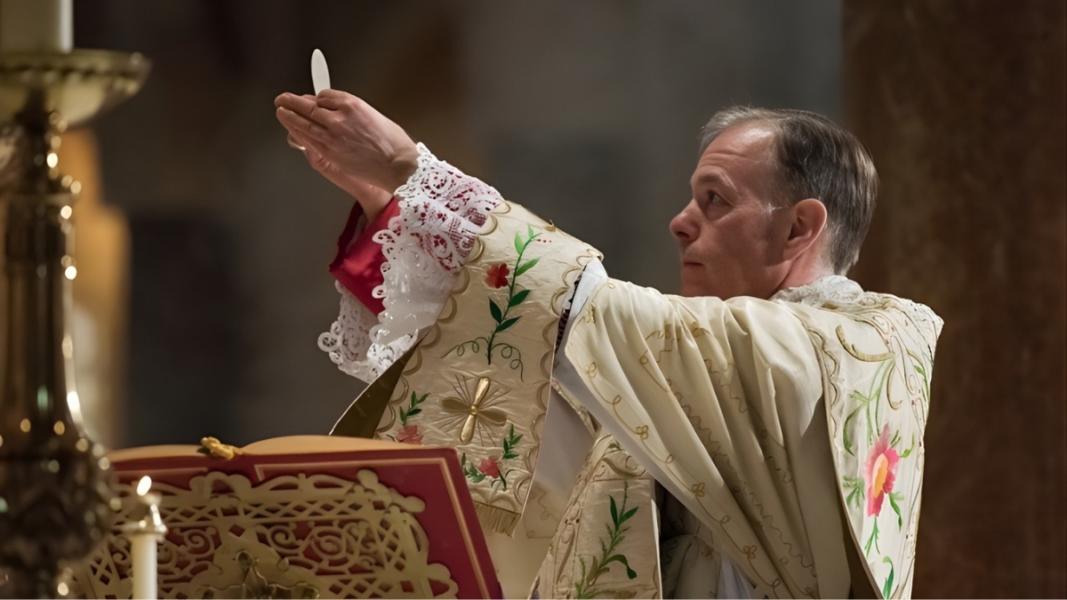
The Archbishop of Portland (Oregon), Alexander K. Sample, published a pastoral letter on sacred music in the liturgy in which he outlines the pastoral guidelines for his diocese on the matter following a thorough diagnosis. In not a few celebrations, singing has ceased to serve worship and has ended up debasing it. His proposal is not a cosmetic adjustment, but a renewal “in qualitative terms” of sacred music and liturgical singing, precisely because —he warns— “at times a certain mediocrity, superficiality, and banality have prevailed, to the detriment of the beauty and intensity of liturgical celebrations”.
Sample starts from a basic principle that is easily forgotten today: music in the Mass is not an accessory. It is a constitutive part of the rite and, therefore, cannot be left to the mercy of taste or fashion. That is why he rejects the subjective approach that so often dominates musical choices: “so often the music selected for the Mass is reduced to a matter of ‘subjective taste’… as if there were no objective principles to follow”.
The Mass demands the best: “Nothing can be too beautiful for God”
The archbishop maintains that music decisively influences the spiritual quality of the celebration. And he emphasizes that the Mass must reflect the greatness of God: “The Holy Mass must be truly beautiful, the best we can offer to God, reflecting his own perfect beauty and goodness”.
He thus recalls a maxim from Benedict XVI that serves as a general criterion for the ars celebrandi: “Nothing can be too beautiful for God, who is Beauty itself infinite”.
Three objective criteria for liturgical music
Sacred music —he says— must possess three qualities: holiness, beauty (artistic goodness), and universality. And he warns that “only music that possesses the three qualities is worthy of the Holy Mass”.
It is not enough for a lyric to “speak of God.” Sample denounces a very widespread idea: “often there is the impression that, as long as the written text… speaks of God, then it qualifies as ‘sacred music.’ … this clearly is not the case”.
And he gives an example to make it clear: “the Gloria of the Mass set to a polka rhythm or in a rock music style is not sacred music”. Why? Because those styles —although they may please or entertain— do not fulfill the intrinsic notes proper to worship: “they do not possess the three intrinsic qualities of holiness, artistic goodness (beauty), and universality”.
Not “four songs”: “sing the Mass” and not just “sing at the Mass”
Music is not there to “decorate” the liturgy, but to make the texts of the Mass itself sing. Sample criticizes the mentality of “adding” pieces as an appendix: “This would exclude the common notion that we take the Mass and simply ‘tack on’ four songs to it…”.
In contrast to that custom, he proposes recovering the liturgical ideal: “the function of sacred music is to help us sing and pray the texts of the Mass itself, not simply to ornament it”. In concrete terms, he recalls that the liturgical books “provide” as a norm “that we sing the Mass in the Mass, rather than sing songs during the Mass”.
Gregorian chant and Latin: “it must be rectified” that it is scarcely heard
The archbishop reaffirms that Gregorian chant has a “principal place” in the Roman rite and that official teaching repeats it again and again. However, he notes the reality: “Gregorian chant is rarely, or never, heard” and adds, “this is a situation that must be rectified”. Gregorian chant “must be introduced more widely as a normal part of the Mass”.
He also recalls the conciliar orientation that the faithful be able to sing together in Latin at least some ordinary parts: “steps must be taken so that the faithful… can say or sing together in Latin those parts of the Ordinary of the Mass that pertain to them”.
A sung Sunday Mass in every parish
Sample establishes a concrete proposal to raise the real standard: “One parish celebration each Sunday must be a sung Mass (Missa cantata), offered consistently and with the greatest care and attention that the community can give it”.
He also clarifies that it does not need to be turned into a display: “A sung Mass does not need to be elaborate; in fact, it must be guided by the principle of noble simplicity”.
Hymns: permitted, but as “substitution” and with doctrinal requirements
Regarding the use of hymns in place of the proper chants, Sample recalls a fact that is often omitted: when hymns are sung at certain moments, “we are omitting some of the chants of the Mass, that is, the Propers”.
He admits that for pastoral reasons substitution can be tolerated at the entrance, offertory, and communion, but he imposes strict conditions: the texts must be theocentric, linked to the liturgical season, and doctrinally sound. He states it without ambiguity: “The texts must conform to the teachings and doctrines of the Church, especially regarding the Eucharistic Sacrifice and the Real Presence of Christ in the Eucharist”.
And he adds a warning, “it must sadly be recognized that some hymns… in approved hymnals… do not reflect Catholic theology and should not be used”.
Instruments: organ “held in high esteem,” and clear limits for the secular
Sample vindicates the proper place of the pipe organ: “in the Latin Church, the pipe organ must be held in high esteem, for it is the traditional musical instrument… and powerfully elevates man’s mind to God and to the things above”.
For other instruments, he applies the Church’s criterion: they can be admitted only if they are suitable for worship and edify. But he draws a boundary: “those instruments that, by common opinion and use, are suitable only for secular music, must be completely prohibited in all liturgical celebrations”. Giving practical examples, Sample speaks of “instruments like electric guitars… used in rock music… are not suitable”, and he rules: “the rock drum set is never appropriate”.
Additionally, he prohibits recorded music from replacing real musicians: “pre-recorded music cannot substitute for real musicians during the Mass”.
Against the “show”: “Please, do not be ‘prima donnas’”
The document also corrects a frequent vice: turning liturgical singing into a performance. Sample quotes Pope Francis with a phrase that summarizes the problem: “Please, do not be a ‘prima donna’!”. Music, he insists, must serve the liturgy: “it must not seek to entertain or draw attention to itself or to the musicians. Over-amplification and the impression of spectacle are two things that must always be avoided”.
And he vindicates a forgotten element: silence. “The importance of silence in the liturgy cannot be exaggerated”, he writes, rejecting the idea of filling every pause with sound: “the notion that all moments… must be filled with singing or instrumental music is invalid”.
“Preparation, not planning”: recover the Church’s plan
Another of his keys is pastoral and disciplinary: it is not a matter of “inventing” the celebration every Sunday, but of obeying the framework that already exists. “We do not plan the Holy Mass; the Church has already given us a plan. We prepare to celebrate the Mass”.
Sample thus calls for a reform that aims at the heart of liturgical worship, truly sacred music, at the service of the rite, with objective criteria, with love for tradition, and with spiritual exigency.