


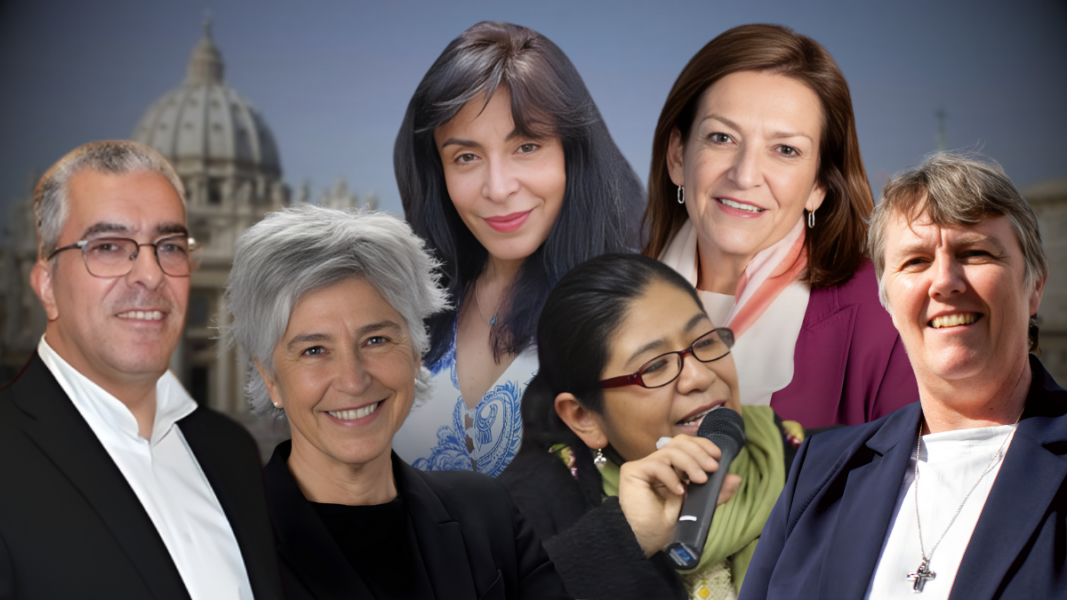
The Holy See Bulletin announced this Monday the appointment of new consultants to the Dicastery for Interreligious Dialogue. The statement, strictly administrative in tone, limits itself to listing 19 names, positions, and origins. However, the list includes profiles that were already associated with very specific ecclesial debates—due to their public activity, statements, or theological framework—and therefore the announcement has raised questions about the type of approach that is intended to be reinforced in a particularly sensitive dicastery, where language and gestures have pastoral and doctrinal consequences. The en.news portal has highlighted several profiles for their public positions and symbolic weight within the ecclesial debate.
Among the appointed consultants are, among others, Emilce Cuda (Pontifical Commission for Latin America), Mónica Santamarina (World Union of Catholic Women’s Organizations), the religious Mary Teresa Barron (superior general of the Missionaries of Our Lady of the Apostles), Ana María Bidegain (ICMICA–MIIC Pax Romana), Catherine Cornille (Boston College), and Sofía Nicolasa Chipana Quispe (Community of Wise Women and Theologians of Abya Yala), in addition to priests and academics from different countries.
Emilce Cuda and the “ideological” framework of the pro-life debate
The name of Emilce Cuda—Argentine and close to Víctor Manuel Fernández—has been the subject of controversy in recent years due to her reading of the public debate surrounding abortion. In 2022, National Catholic Reporter reported a statement of hers that generated criticism in pro-life circles: she warned that many Catholics “confuse the defense of life with the defense of ideological positions”.
Beyond the intention with which it is formulated, this type of approach is usually interpreted as a displacement of the moral center of the problem. Instead of emphasizing the intrinsic gravity of abortion, there is a tendency to dilute the emphasis in a broader framework where everything appears as part of the same package of social issues.
Mónica Santamarina and the agenda of “more female presence” after the Synod
The general president of the World Union of Catholic Women’s Organizations, Mónica Santamarina, has also intervened publicly in the synodal debate. In 2023, National Catholic Reporter quoted her warning that, once the Synod is over, the Church might “go back to closing its doors,” an argument she uses to insist that the participatory process should not remain in an exceptional phase.
The controversy does not center on lay participation—necessary—, but on the way the objective is presented: whether as ordered collaboration within the ecclesial structure or as pressure to reconfigure internal governance in terms of representation and quotas.
Mary Teresa Barron and the debate on ordination in terms of “vocation”
The case of the religious Mary Teresa Barron is particularly delicate because it links to a doctrinally sensitive issue. In October 2024, during a Synod press conference, Catholic News Agency reported statements in which she suggested that the question of the female diaconate should not be read only as whether women “can or cannot” be ordained, but also as whether “the Spirit” is calling women, adding that some “feel a call to the priesthood”.
The controversial point here is not pastoral sensitivity, but the effect of the language. Speaking of a “call to the priesthood” in women introduces a framework that fuels expectations on matters that the Church has already addressed clearly according to tradition.
“Pachamama”, indigenous and decolonial theologies
Among the profiles that have generated the most alarm in circles critical of the Amazonian drift and syncretism is that of Sofía Nicolasa Chipana Quispe, linked to the Community of Wise Women and Theologians of Abya Yala. Associated with indigenous, feminist, and decolonial currents, she maintains that she promotes “prayer with Pachamama”; she also cites a statement from 2025: “We are not Pachamama… we belong to Pachamama”.
This is an appointment that carries symbolic weight because it connects with recent debates on inculturation, limits of religious language, and the risk of syncretism. In a dicastery whose work moves precisely on that frontier—the frontier of religious language and gestures—it is no surprise that this type of profile is scrutinized closely.
Cornille and “religious pluralism” with yoga and meditation
The case of Catherine Cornille (Boston College), to whom the promotion of “religious pluralism” and the idea that “Buddhist meditation” and “Hindu yoga” can help Christians to “live according to our own highest aspirations” is attributed.
The problem here is not the academic study of other religions, but the tendency to present foreign spiritual practices as “integrable” tools without warning of the risks of syncretism.
Wasim Salman and the “Abu Dhabi” reading of dialogue
Among the clerics is the Syrian-Italian priest Wasim Salman, presented as a defender of interreligious dialogue as “the only path” toward peace between religions and as a promoter of the framework of the Document on Human Fraternity (Abu Dhabi). According to the portal, Salman has spoken of Islam as “this great religion, whose spread is impressive today”.
In European contexts marked by cultural tensions and persecution of Christians in Islamic countries, that language is usually read as an excessively celebratory tone.
A list that marks orientation
The appointment is official and falls within the ordinary functioning of the dicasteries, which rely on consultants for studies and advice. However, by concentrating several names associated with synodal activism, religious pluralism, and doctrinally sensitive openings, it is clear to us that the Dicastery for Interreligious Dialogue will continue to orbit in coordinates very similar to those of the previous pontificate.