


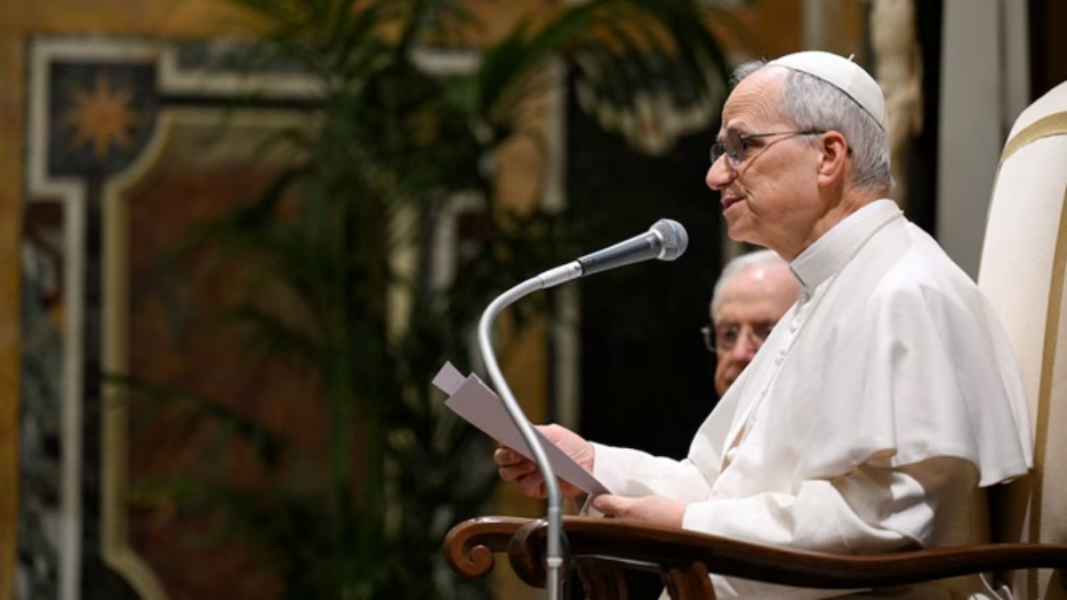
In the General Audience of this January 21, 2026, held in the Paul VI Hall, Pope Leo XIV resumed the cycle of catecheses on the Documents of the Second Vatican Council and centered his meditation on the Dogmatic Constitution Dei Verbum, under the theme: “Jesus Christ, Revealer of the Father” (Jn 14,6-8).
In his address, the Pontiff insisted that Revelation is not a set of religious ideas, but a personal act of God who communicates in a history and calls to communion, and he emphasized that its fullness is fulfilled in a real and concrete encounter with Jesus Christ, in whom “shines” the intimate truth of God and the salvation of man, because Christ is “the mediator and the fullness of all revelation” (DV 2). Knowing the Father is not achieved through abstractions, but by entering—through the action of the Spirit—into the relationship of the Son with the Father; and, at the same time, in Christ man discovers his true identity as a son, known by God “in secret” and called to a full life.
The Pope concluded by emphasizing a decisive point of Dei Verbum: Jesus reveals the Father with his integral humanity—words, works, signs, death and resurrection—so that the truth of God is not understood where the human is cut short, and the Christian faith leads to a practical certainty: nothing can separate us from the love of the Father, to whom the believer abandons himself with trust.
We leave below the complete message of Leo XIV:
Dear brothers and sisters, good morning and welcome!
We continue the catecheses on the Dogmatic Constitution Dei Verbum of the Second Vatican Council, on the divine Revelation. We have seen that God reveals himself in a covenant dialogue, in which he addresses us as friends. It is, therefore, a relational knowledge, which does not communicate only ideas, but shares a history and calls to communion in reciprocity. The fulfillment of this revelation takes place in a historical and personal encounter in which God himself gives himself to us, becoming present, and we discover ourselves known in our deepest truth. This is what happened in Jesus Christ. The Document says that the intimate truth both of God and of man’s salvation shines for us in Christ, who is at the same time the mediator and the fullness of all revelation (cf. DV, 2).
Jesus reveals the Father to us by involving us in his own relationship with Him. In the Son sent by God the Father, “men […] can present themselves to the Father in the Holy Spirit and are made partakers of the divine nature” (ibid.). We thus arrive at full knowledge of God by entering into the relationship of the Son with his Father, by virtue of the action of the Spirit. This is attested, for example, by the evangelist Luke when he recounts the Lord’s prayer of exultation: “In that same hour Jesus rejoiced in the Holy Spirit and said: ‘I give you praise, Father, Lord of heaven and earth, for although you have hidden these things from the wise and the learned you have revealed them to the childlike. Yes, Father, such has been your gracious will. All things have been handed over to me by my Father. No one knows who the Son is except the Father, and who the Father is except the Son and anyone to whom the Son wishes to reveal him’” (Lk 10,21-22).
Thanks to Jesus we know God as we are known by Him (cf. Gal 4,9; 1 Cor 13,13). Indeed, in Christ, God has communicated himself to us and, at the same time, has manifested our true identity as sons, created in the image of the Word. This “eternal Word enlightens all men” (DV, 4) unveiling their truth in the gaze of the Father: “Your Father who sees in secret will repay you” (Mt 6,4.6.8), says Jesus; and he adds that “the Father knows our needs” (cf. Mt 6,32). Jesus Christ is the place in which we recognize the truth of God the Father while we discover ourselves known by Him as sons in the Son, called to the same destiny of full life. Saint Paul writes: “When the fullness of time had come, God sent his Son, […] so that we might receive adoption as sons. As proof that you are sons, God sent the Spirit of his Son into our hearts, crying out, ‘Abba, Father!’” (Gal 4,4-6).
Finally, Jesus Christ is the revealer of the Father with his own humanity. Precisely because he is the incarnate Word who dwells among men, Jesus reveals God to us with his true and integral humanity: “For this reason He—says the Council—, seeing whom we see the Father (cf. Jn 14,9), with all his presence and manifestation, with words and works, with signs and miracles, and above all with his death and glorious resurrection from the dead, and finally with the sending of the Spirit of truth, completes the revelation, bringing it to fulfillment” (DV, 4). To know God in Christ we must welcome his integral humanity: the truth of God is not fully revealed where something human is removed, just as the integrity of Jesus’ humanity does not diminish the fullness of the divine gift. It is the integral humanity of Jesus that narrates to us the truth of the Father (cf. Jn 1,18).
What saves and summons us is not only the death and resurrection of Jesus, but his very person: the Lord who becomes incarnate, is born, heals, teaches, suffers, dies, rises and remains among us. Therefore, to honor the greatness of the Incarnation, it is not enough to consider Jesus as the channel of transmission of intellectual truths. If Jesus has a real body, the communication of the truth of God takes place in that body, with his own way of perceiving and feeling reality, with his way of inhabiting the world and traversing it. Jesus himself invites us to share his gaze on reality: “Look at the birds in the sky; they do not sow or reap, they gather nothing into barns, yet your heavenly Father feeds them. Are not you more important than they?” (Mt 6,26).
Brothers and sisters, by following the path of Jesus to the end, we arrive at the certainty that nothing can separate us from the love of God: “If God is for us, who can be against us? He who did not spare his own Son but handed him over for us all, will he not also give us everything else along with him?” (Rom 8,31-32), writes Saint Paul as well. Thanks to Jesus, the Christian knows God the Father and abandons himself to Him with trust.