


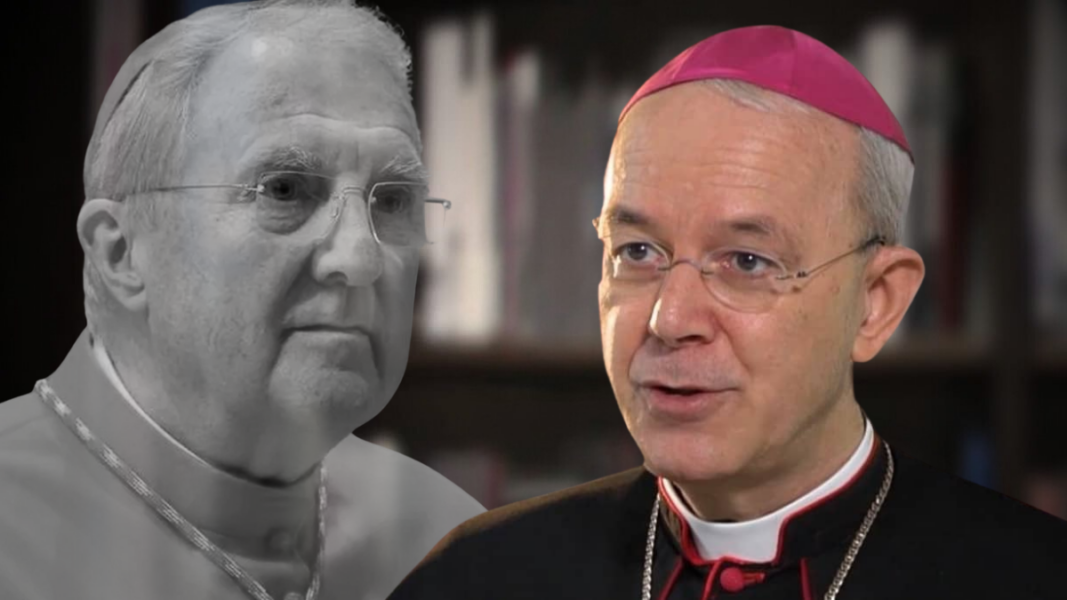
The auxiliary bishop of Astana (Kazakhstan), Monsignor Athanasius Schneider, has responded with severe criticism to the latest liturgical report by Cardinal Arthur Roche, prefect of the Dicastery for Divine Worship, prepared for the consistory of January 7-8 in Rome. In an interview published by journalist Diane Montagna, Schneider argues that the document relies on “manipulative reasoning” and goes so far as to “distort historical evidence” to justify the restrictive line of Traditionis custodes.
Read also: They reveal Roche’s document on the liturgy
A document distributed at the consistory
Roche’s text—two pages presented as a “careful theological, historical, and pastoral reflection”—was distributed among the members of the College of Cardinals during the consistory convened by Pope Leo XIV. Although it was not formally debated—due to, we must suppose, lack of time—its subsequent circulation generated significant rejection upon noticing the manipulation and intentionality in the discourse.
Schneider places the problem in the realm of intention and method. In his view, the report “conveys the impression of a clear prejudice against the traditional Roman rite and its current use” and seems driven by “an agenda aimed at denigrating this liturgical form and, ultimately, eliminating it from ecclesial life.”
“Lack of objectivity”: the underlying accusation
The bishop denounces that “the commitment to objectivity and impartiality—marked by the absence of bias and a genuine concern for the truth—is conspicuously absent.” Instead, he asserts, the text “employs manipulative reasoning and even distorts historical evidence.”
Schneider summarizes the demand with a classical principle that, according to him, the report violates: sine ira et studio, that is, an approach “without anger or partisan zeal.”
Continuity or rupture: Benedict XVI as a reference
At the core of his response, Schneider denies that the modern liturgical reform can simply be described as organic development. For this reason, he quotes Benedict XVI: “In the history of the liturgy there is growth and progress, but no rupture.” From that premise, he argues that the Novus Ordo of 1970 is perceived as a break with the millennial tradition of the Roman rite.
“The Mass most faithful to the Council was the Ordo Missae of 1965,” Schneider recalls, and adds that the order of Mass presented in 1967 to the synodal fathers—substantially the same as would be promulgated later—would have been rejected by the majority for considering it too “revolutionary.”
Ratzinger: “a type of prohibition” alien to tradition
Likewise, Schneider turns to a testimony from Joseph Ratzinger. He quotes a 1976 letter to Professor Wolfgang Waldstein, in which the then-theologian clearly denounces:
“The problem with the new Missal lies in that it separates itself from this continuous history—which progressed uninterruptedly both before and after Pius V—and creates a completely new book, whose appearance is accompanied by a type of prohibition of what existed previously, something totally alien to the history of canon law and the liturgy of the Church.”
he adds Ratzinger’s conclusion, decisive for his argument:
“I can state with certainty that this was not what was intended.”
Quo primum: “unity does not mean uniformity”
Schneider also combats the reading that Roche would make of Quo primum (St. Pius V). He reproaches him for a selective reference that “distorts” the meaning of the document and recalls that the text allowed legally continuing variants of the Roman rite with at least two hundred years of uninterrupted use. Hence his conclusion:
“Unity does not mean uniformity, as attested by the history of the Church.”
Liturgical pluralism: “manipulative and dishonest”
The bishop rejects the idea that the plurality of liturgical forms “freezes division.” He argues that this claim contradicts the two-thousand-year praxis of the Church and qualifies it in explicit terms:
“Such a claim is manipulative and dishonest, because it contradicts (…) the practice of two thousand years of the Church.”
Schneider recalls historical episodes in which imposed uniformity did not bring unity, but deep and lasting wounds, and argues that the peaceful coexistence of legitimate forms would avoid fractures and allow for authentic communion.
“Concession” without promotion? Schneider appeals to St. John Paul II
Another point he rebuts is the thesis that the use of books prior to the reform was a mere “concession” without intention to promote them. Schneider contradicts this by appealing to the notion of pluriformity and quoting St. John Paul II on the Missal of St. Pius V:
“In the Roman Missal of St. Pius V (…) there are very beautiful prayers (…) that reveal the very substance of the liturgy.”
For the bishop, this testimony disproves that it is an uncomfortable tolerance: the ancient rite possesses an objective spiritual value and is part of the liturgical life of the Church.
Toward June: a way to restore liturgical peace
Schneider looks to the extraordinary consistory scheduled for the end of June and suggests that, given the lack of liturgical formation among many members of the hierarchy, the Pope could rely on experts who provide a more solid analysis. He proposes a clear way out: recognizing for the oldest form of the Roman rite the same dignity and rights as for the ordinary form, through a broad pastoral measure that ends casuistic interpretations and de facto discriminatory treatment toward many faithful, especially young people and young families.
The closing: “instrumentalizing power and authority”
In the final stretch, Schneider hardens his diagnosis and describes Roche’s document as characteristic of an aging structure that seeks to stifle criticism, especially that arising from younger generations. He expresses it thus:
“Cardinal Roche’s document is reminiscent of a desperate struggle of a gerontocracy (…) whose voice it seeks to silence through manipulative arguments and, ultimately, by instrumentalizing power and authority.”
Faced with that logic, Schneider concludes that authority in the Church is ordered to safeguard Tradition, not to be used against it, and therefore calls for liturgical peace to be rebuilt on bases of continuity, justice, and respect.