


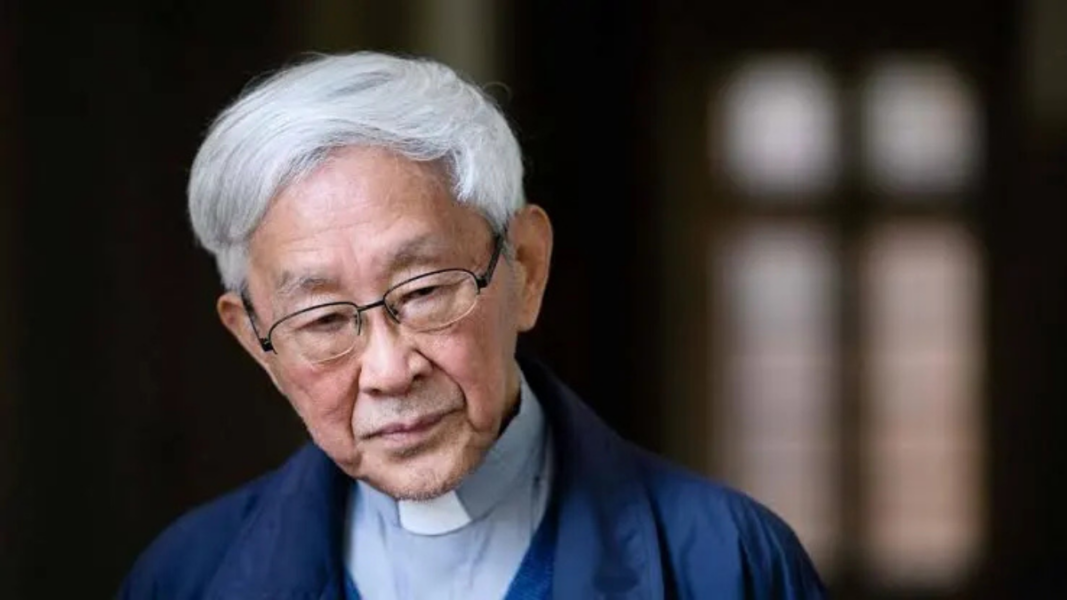
Cardinal Joseph Zen, emeritus bishop of Hong Kong, has published a detailed account of his recent stay in Rome for the consistory of January 7-8. Zen thanks the closeness of Pope Leo XIV—with whom he says he had a private half-hour audience—but at the same time harshly denounces the development of the consistory, which he describes as a “trimmed-down,” “controlled” meeting with a format that, in his opinion, reproduces the vices of the synodal process.
The cardinal states that he traveled to Rome after recovering his passport without the need for bail or surety and that he celebrated Mass on January 6 (Epiphany) in his titular church, and on January 7 in St. Peter’s Basilica “asking the Lord to bless the consistory that began that afternoon.”
Audience with Leo XIV: “I spoke a lot and he listened a lot”
Zen recounts that on the morning of January 7 he was received in a private audience by the Pope. He summarizes the encounter with a significant phrase: “I spoke a lot; he listened a lot. He really is a leader who knows how to listen”. That positive impression, however, contrasts with his judgment on the mechanics of the consistory, which he considers frustrating and designed to limit real debate among the cardinals.
Four topics planned, two chosen “due to lack of time”
According to Zen, the consistory initially had four planned matters: Evangelii gaudium, “synodality,” the reorganization of the Curia (Praedicate Evangelium), and the issue of the Tridentine Mass and the Mass after Vatican II. However, due to “lack of time,” the cardinals were asked to choose only two topics to discuss, and finally the first two were selected. Zen does not hide his disgust and comments, with irony, that in his view an entire afternoon was “wasted” with that selection.
“A copy of the Synod”: round tables, little plenary, and three minutes per intervention
He explains that the two-day meeting was in fact reduced to one day, and that the working style was practically a replica of recent synodal dynamics: “sitting around round tables”, with very little time for plenary discussion. He states that there were only two 45-minute plenary sessions and that in each one barely fifteen people were able to speak. Even more: the time assigned per intervention would have been three minutes, which prevented him from reading his full text.
In his account, Zen describes the impression of a meeting “railroaded” from outside: before beginning there was a homily by the preacher linked to the Synod, documents were distributed by the prefect of the Dicastery for the Doctrine of the Faith, the general secretary of the Synod intervened, and although the liturgical theme was not to be addressed, a document was also sent from the Dicastery for Divine Worship. His conclusion is unequivocal: it seemed that some wanted to turn the consistory into a prolongation of the “synod on synodality”.
“I lean toward the conspiracy theory”: “it was hijacked” by Francisco’s “pawns”
He acknowledges that he tends toward the “conspiracy theory” and states that the consistory was “hijacked” by those he calls the “pawns” of Pope Francis. He puts it this way, in explicit terms: “I lean toward the ‘conspiracy theory’ and think that this meeting was hijacked by Francisco’s ‘pawns.’ They did everything possible to prevent the cardinals from speaking”./
Read also: Zen questions the «Bergoglian synodality» before the Consistory of cardinals
The cardinal emphasizes that this control of the debate contradicts the very purpose of a consistory: for the Pope to listen broadly to his brother cardinals. He adds that several purple princes commented to him afterward that the organization had been problematic, although they did not share his interpretation. Some attributed the disorder to the load of events closing the Jubilee and to the fact that Leo XIV would not have been able to personally direct the preparation.
“The only bad boy”: a “very sharp” critique of the Synod
Zen explains that he had prepared a text for the topic of Evangelii gaudium, but due to the time limitation he could only present some points. Afterward, he handed the full text to several cardinals and assures that “very soon” it reached the hands of journalists. He says that the Pope encouraged speaking frankly and that he took advantage to criticize with “quite sharp” words the Synod and the subsequent measures on a supposed “implementation phase.”
He acknowledges that other cardinals share those reservations, but that they spoke little or with extreme prudence. He concludes with a personal image: “I had the bad luck of being the only ‘bad boy’”. He also says that he perceived reactions of disapproval, but that many faithful and Catholics of traditional sensitivity expressed support to him.
Balance: gratitude and hope for a “step forward” from Leo XIV
Despite his denunciation, Zen states that his general impression is one of gratitude. He considers it a “step forward” that Leo XIV has convened a consistory and highlights that the Pope immediately announced another for the end of June, in addition to the intention of holding annual meetings, longer ones, with improved procedures. Zen expresses his hope that the organization will allow the Pontiff to listen “a lot” to the faithful opinions of his brother cardinals.
Finally, Zen concludes: “May the Lord bless Pope Leo XIV”.