


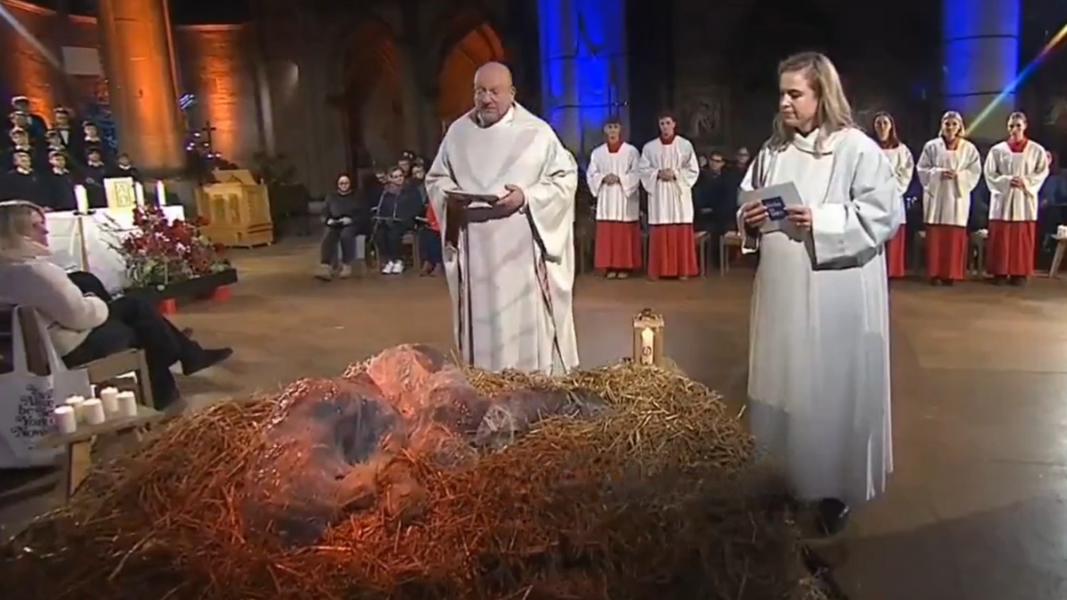
The Christmas Eve Mass broadcast from St. Maria church in Stuttgart by the public broadcaster ARD became an international scandal case after including an “artistic installation” about the birth of Jesus. Instead of the traditional representation of the Child God in the manger, the broadcast showed a performance with an adult figure in a fetal position, covered with a wet and translucent material, presented as an attempt to show the “vulnerability” of the Incarnation. It was, without a doubt, a profanation. A “viscous monster” that deformed the mystery of Bethlehem and turned the liturgy into a grotesque spectacle.
The Diocese of Rottenburg-Stuttgart has issued a formal apology following the national scandal caused by this event, admitting that sensitivities were hurt and recognizing the liturgical deviations in a celebration adapted “too freely” for television.
The diocese apologizes: “religious sensitivities were offended”
Following the wave of criticism, the Diocese of Rottenburg-Stuttgart published a statement in which it acknowledges the damage caused. It states that Bishop Klaus Krämer and the diocesan leadership reviewed the public reaction and admitted that “religious sensitivities were offended.” The responsible parties—according to the text—“deeply regret” it and assure that they did not intend to provoke or denigrate central truths of the faith.
Recognition of liturgical deviations
The diocese also admits that the liturgy was adapted with excessive freedom for the television format, with deviations from the liturgical order, including the interpretation of certain roles, the language used, and performative elements introduced during the celebration. The statement maintains that those deviations “were not correct” and that they will be corrected.
As a consequence of the controversy, the diocese announces that it will tighten the decision-making and approval processes for future televised celebrations. The goal—they claim—is to reflect the Church’s responsibility and the sensitivity required when broadcasting worship on a national platform. The broadcaster SWR, linked to the program’s production, said it received more than 1,400 comments, many of them critical.
A symptom of the liturgical crisis in Germany
In Germany, internal tensions over liturgy, doctrine, and culture have become increasingly visible, and the resort to “experiments” that supposedly seek to be “understandable” or “contemporary” has frequently ended up diluting the reverence due to the sacred. The underlying question remains: how Christ is presented in the liturgy is not an aesthetic detail, but a matter that affects the faith transmitted to the people.